

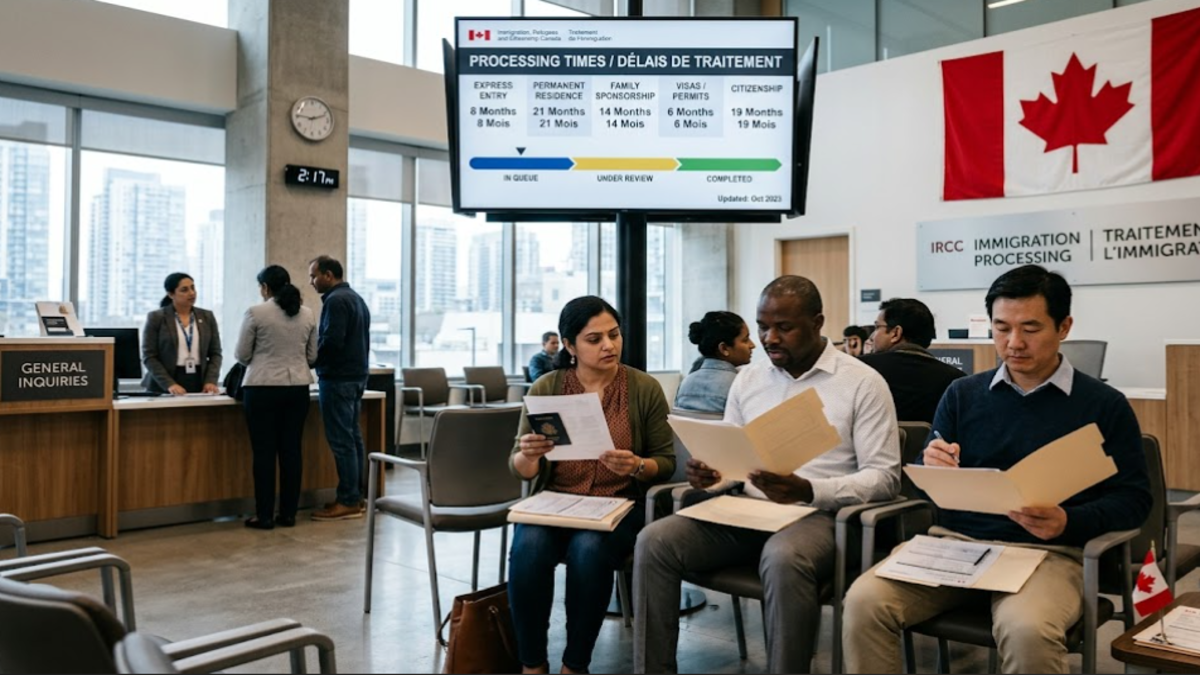
OTTAWA – Canadist: Canada Immigration Processing Times remain uneven as IRCC updates its latest estimates

Canada’s immigration department has refreshed its processing-time estimates, showing a mixed picture for people waiting for permanent residence, family reunification and citizenship decisions. Some economic immigration streams have improved, while provincial and family applications continue to face lengthy queues. Temporary residence applications are also moving at different speeds depending on where an applicant is applying from.
The latest figures show that an Express Entry application can take around six months, while some provincial and family categories can stretch into several years. For applicants making plans around employment, education, travel or family reunification, the difference can be substantial. So, how long is each major Canadian immigration application taking now?
Canada Immigration Processing Times show sharp differences between programs
Immigration, Refugees and Citizenship Canada (IRCC) refreshed its permanent-residence and citizenship estimates on August 10. The update showed relatively little movement across many categories, but several changes stood out.

For Express Entry, the Canadian Experience Class (CEC) now has an estimated processing time of six months. The Federal Skilled Worker Program (FSWP) also stands at six months, down from seven months in the previous update. IRCC does not currently publish a separate estimate for the Federal Skilled Trades Program because it says there is not enough data.
The six-month figure is particularly important because it matches IRCC’s service standard for Express Entry programs. However, applicants should not interpret the figure as a guaranteed deadline.
The latest inventory figures also show that tens of thousands of applications remain in the assessment queue. The CEC inventory stood at about 59,700 applications, while the FSWP inventory was about 52,400. Both queues declined compared with the previous update.
The picture becomes less favourable for applicants using the Provincial Nominee Program outside the Express Entry route.
Enhanced PNP applications submitted through Express Entry have an estimated processing time of seven months, unchanged from the previous update. Base, or non-Express Entry, PNP applications now stand at 13 months, up from 12 months.
That increase came even though IRCC reduced the base-PNP inventory by approximately 1,400 applications. The remaining base-PNP inventory was about 102,400 applications, compared with 11,800 applications in the enhanced category.
The contrast illustrates why applicants cannot assume that a reduction in the queue will immediately translate into a shorter processing time.
Quebec programs remain divided
Applicants planning to settle in Quebec face another set of timelines.
The Skilled Worker Selection Program, known as the PSTQ, remains at 11 months. The Quebec Business Class remains dramatically longer at 75 months, equivalent to more than six years.
The PSTQ inventory fell by about 1,000 applications, leaving approximately 21,200 applications awaiting assessment. The Quebec Business Class inventory remained at about 3,700 applications.
The Atlantic Immigration Program is also among the slower economic pathways. Its current estimate remains 26 months, despite the removal of about 200 applications from the inventory.
IRCC’s service standard for the Atlantic program is 11 months, meaning the published estimate remains substantially above that target.
Canada Immigration Processing Times remain especially long for some applicants
The most striking figures in the latest update concern two economic immigration programs with exceptionally large backlogs.
The Start-Up Visa program has a processing estimate of more than 10 years. The Federal Self-Employed Persons Program also carries an estimate exceeding a decade.
The Start-Up Visa inventory was approximately 47,600 applications, an increase of about 100 from the previous update. The Federal Self-Employed Persons Program had about 8,000 applications in inventory, with no change reported in the latest figures.
These figures place the two programs in a completely different category from Express Entry. Someone considering an immigration route based primarily on speed would therefore face a very different outlook depending on the program selected.
The government has also acknowledged concerns surrounding the Self-Employed Persons Program, with an IRCC evaluation finding that the program is no longer well suited to current economic immigration priorities. Recent reporting has highlighted its large backlog and long waits.
For applicants, the lesson is straightforward: eligibility alone does not determine how quickly a permanent-residence application will be finalized. The program’s inventory, annual admissions space and processing capacity can have a major effect on the queue.
Family sponsorship remains a major source of delays
Family reunification continues to produce some of the longest waits faced by people applying for Canadian permanent residence.
Outside Quebec, a spouse or common-law partner living inside Canada faces an estimated wait of 27 months. The estimate for a spouse or common-law partner living outside Canada is 17 months.
The Parents and Grandparents Program has improved slightly, falling from 30 months to 29 months. Even after that reduction, the wait remains considerably longer than the 12-month service standard that applies to spousal sponsorship outside Quebec.
The inventory figures underline the scale of the family-sponsorship queues. IRCC reported about 56,800 applications involving partners living in Canada and approximately 58,000 involving partners living outside Canada. The parents-and-grandparents inventory stood at about 39,000 applications.
The situation is considerably slower for families intending to settle in Quebec.
A spouse or common-law partner living inside Canada faces an estimated 32-month wait. For a spouse or common-law partner living outside Canada, the estimate is 33 months.
The Parents and Grandparents Program is the most severe case, with an estimated processing time of 64 months, or more than five years. That figure is down from 65 months in the previous update but remains substantially longer than family-sponsorship timelines elsewhere in Canada.
For families, these numbers can affect far more than immigration paperwork. They can influence housing decisions, employment arrangements, childcare, travel and plans for elderly relatives.
Temporary applications are changing at a different pace
Permanent-residence figures are updated periodically, while temporary-residence processing estimates can change more frequently.
A recent IRCC update highlighted longer waits for several temporary-residence applications. For Nigerian applicants, for example, the estimated study-permit processing time increased from six weeks to seven weeks. Visitor-visa processing rose from 64 days to 68 days, while work-permit processing remained at seven weeks.
The estimated processing time for a Super Visa for Nigerian applicants also increased slightly, from 41 days to 43 days.
The update also showed that processing times can move sharply in individual countries. For Pakistani applicants, the reported work-permit estimate increased from 11 weeks to 25 weeks in the same update.
That country-by-country variation matters because there is no single waiting time that applies to every visitor visa, study permit or work permit applicant.
Students, in particular, need to pay attention to the estimate for the country from which they are applying rather than relying on a general Canadian figure. A delay of even one or two weeks can become important when a university or college has a fixed start date.
The same applies to workers with employment contracts waiting for authorization. A processing estimate is not a promise that an application will be finalized before an intended start date.
Why processing times can change
IRCC says processing times depend on several factors, including the type of application, whether the submission is complete, the volume of applications already in the system, the department’s ability to verify information and how quickly applicants respond to requests.
The department also uses two different approaches when calculating processing estimates.
Some figures are historical. These are based on how long it took to finalize 80 percent of similar complete applications in the past.
Other figures are forward-looking. These estimates consider the current inventory, expected monthly processing capacity and the number of admissions available under the immigration levels plan.
That distinction helps explain why two applicants can receive very different outcomes even when they submit applications under the same immigration category.
What applicants should know before relying on an estimate
The first point is that a processing time is an estimate, not a guarantee.
IRCC itself warns that an individual application can take longer than the published figure. A file may require additional documentation, clarification, background checks or other review. An incomplete application can also create delays or result in the application being returned.
Applicants should therefore treat the published timeline as a planning indicator rather than a firm deadline.
The second point is that processing does not necessarily begin when an applicant starts preparing documents. IRCC says the clock begins when it receives a complete application. For online or in-person applications, the start point is submission; for applications sent by mail, it is when the complete application reaches the mailroom.
Biometrics can also form part of the processing calculation, depending on the application.
The third consideration is that processing-time figures can change. Permanent-residence and citizenship estimates are generally revised monthly, while temporary-residence estimates are updated more frequently.
That means an applicant who checks the estimate today may see a different figure several weeks later.
Where to check the official figure
Applicants should rely on IRCC’s official processing-time service for the estimate applicable to their specific application type and location.
Check IRCC’s official processing times
The government specifically says that its online tool provides an estimate and that the displayed figure is not a maximum or guarantee. It also explains that the calculation can change according to inventory, staffing, expected application volumes and individual circumstances.
Applicants should avoid relying on an old screenshot, social-media post or processing-time table that does not identify when the figures were collected.
What the latest figures mean for prospective immigrants
The latest numbers reveal a Canadian immigration system moving at very different speeds.
For skilled applicants using Express Entry, the outlook remains comparatively predictable. Both the CEC and FSWP stand at six months, matching the service standard.
Enhanced PNP applications remain at seven months, while base PNP applications have moved to 13 months. Quebec’s Skilled Worker Selection Program stands at 11 months, and the Atlantic Immigration Program remains at 26 months.
At the other end of the scale, the Quebec Business Class and certain economic programs carry waits measured in years rather than months.
Family sponsorship presents another major challenge. Outside Quebec, spousal applications range from 17 to 27 months depending on where the sponsored partner lives. Inside Quebec, the corresponding estimates are 32 and 33 months. Parents and grandparents face 29 months outside Quebec and 64 months when the destination is Quebec.
Citizenship processing is considerably more stable. The latest estimate for a citizenship grant remains 12 months, matching the service standard. Renunciation has improved to four months, while a search of citizenship records remains at 17 months. IRCC reported an inventory of about 328,200 citizenship-grant applications.
Taken together, the figures show that there is no single answer to the question of how long Canadian immigration takes. The answer depends on the program, destination, application location, inventory and the complexity of the file.
For anyone preparing an application, the safest approach is to identify the exact immigration category first and then check the latest IRCC estimate immediately before submitting. Applicants should also leave additional time for circumstances that fall outside the normal processing estimate.
FAQ
How long does Express Entry take?
The latest estimates put both the Canadian Experience Class and Federal Skilled Worker Program at about six months.
How long does spousal sponsorship take?
Outside Quebec, the estimate is 27 months for a spouse or common-law partner living in Canada and 17 months for one living outside Canada.
Which immigration programs have the longest waits?
The Start-Up Visa and Federal Self-Employed Persons Program have estimates exceeding 10 years, while the Quebec Business Class is estimated at 75 months.
Can Canada immigration processing times change?
Yes. IRCC updates estimates as application inventories, processing capacity and expected application volumes change. Individual cases can also take longer or shorter than the published estimate.
Contact: info@canadaalyom.com