
OTTAWA – Canadist: Canada Immigration Application Status: How to Track Your File Online

Canada’s immigration system is undergoing important changes as federal authorities tighten some pathways, adjust processing priorities and expand digital services for applicants. At the same time, applicants are increasingly relying on online tools to find out whether their files have been received, whether processing has started and whether immigration officials require additional information. So, what does your Canada Immigration Application Status actually mean, and how can you track your file online?
For applicants waiting on permanent residence, temporary residence, citizenship, family sponsorship or other immigration decisions, the status displayed by Immigration, Refugees and Citizenship Canada (IRCC) can provide important information about where a case stands. But the wording used by the system can also create confusion, particularly when an application remains unchanged for weeks.
Recent immigration developments have made tracking even more important. The federal government has announced measures affecting immigration levels, asylum processing and permanent residence pathways, while IRCC continues to modernize how applicants receive information about their files.

Canada Immigration Application Status: What the Online Tracker Shows
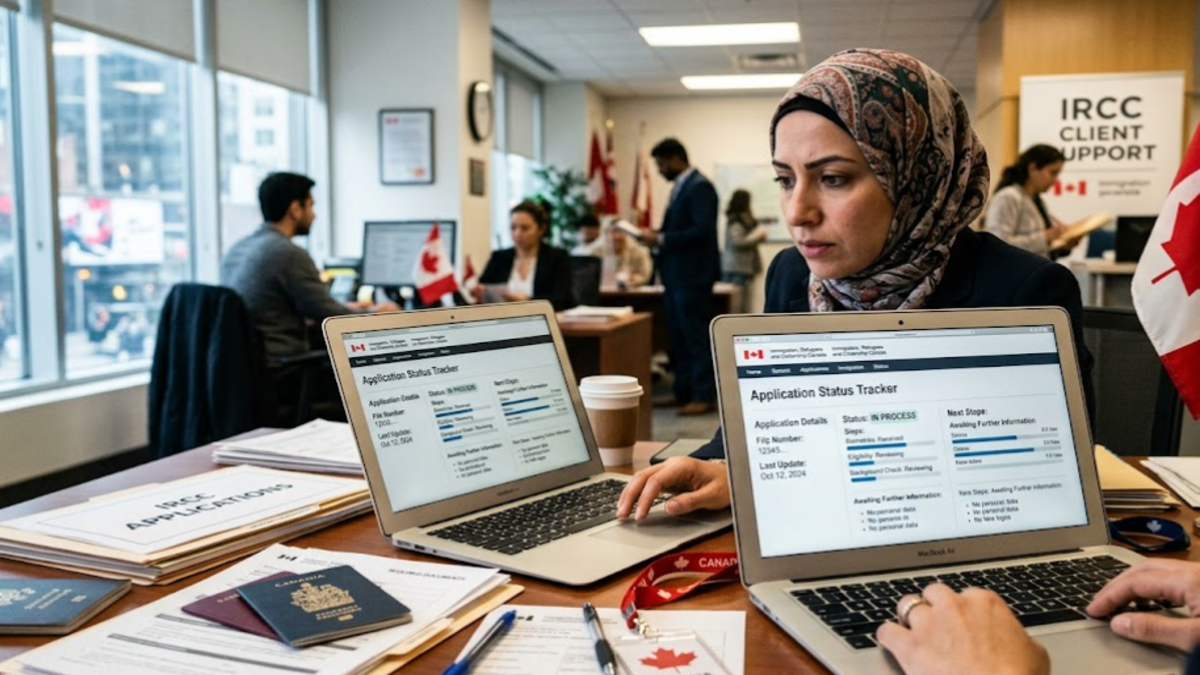
IRCC provides several ways for applicants to follow their cases online. Depending on the type of application, people may use an IRCC secure account, the Client Application Status tool or a dedicated application status tracker.
The federal government says applicants can use these services to see information about their application, receive messages and, in some cases, follow a more detailed timeline of events. Applicants who submitted paper applications can also link eligible files to an online account.
The official IRCC guidance explains that status updates in the application status tracker generally appear after the applicant receives an acknowledgement of receipt, commonly known as an AOR. The AOR confirms that IRCC has received the application and completed an initial completeness check.
This distinction matters because receiving confirmation that an application was delivered does not necessarily mean that IRCC has started processing it.
An application can arrive at an IRCC office and remain without a detailed online status until officials open it and establish that it meets the initial completeness requirements.
The meaning of “Received”
When an application shows as “Received,” IRCC indicates that the file has been received and is being checked for completeness.
This stage does not mean that an officer has completed an eligibility assessment. Applicants should therefore avoid interpreting “Received” as an indication that approval is imminent.
The online system may also display basic information before the full status becomes available. IRCC says applicants can sometimes see the date the application was received and other basic details while waiting for the AOR.
What “In Progress” means
“In Progress” generally means that IRCC continues to review the application.
The tracker may provide separate information about different portions of the case. Depending on the application type, this can include document checks, eligibility, background processing or other stages.
A file remaining “In Progress” does not automatically indicate a problem. Immigration applications can require different forms of verification, and processing times vary according to the program and circumstances of the case.
When an application is “Closed”
A “Closed” status can indicate that the application has reached its conclusion. According to IRCC’s guidance, the status can cover an application that has been approved or otherwise finalized.
Applicants should read the accompanying message or decision information rather than relying only on the single word displayed in the status field.
Canada Immigration Application Status and Recent Immigration Changes
The wider immigration environment has also been changing.
The federal government has been emphasizing more sustainable immigration levels and directing attention toward areas where immigration can help address labour shortages. One recent initiative is designed to accelerate the transition of up to 33,000 workers already in Canada toward permanent residence, with a particular focus on smaller communities and workers who have established strong local ties.
These policy decisions can affect applicants differently depending on the immigration program they use.
A person applying through an economic pathway, a family sponsorship program, a temporary residence category or an asylum-related process should therefore avoid assuming that the processing experience of another applicant will be identical.
The government has also introduced legal and administrative changes affecting asylum processing and immigration documents. Federal authorities say the measures are intended to modernize the asylum system, improve information sharing and strengthen the administration of immigration processes.
For applicants, the practical lesson is straightforward: the program attached to an application matters when interpreting its status and expected processing timeline.
Another recent development has drawn particular attention among people dealing with citizenship by descent. The immigration minister confirmed that Canada had stopped finalizing new citizenship-by-descent applications while officials reviewed files, including certificates that had already been issued.
That situation demonstrates why applicants should not rely solely on old timelines or information shared by other applicants online. Immigration rules and administrative procedures can change, and an online status must be interpreted in the context of the applicant’s specific program.
How to Track Your Canada Immigration Application Online
The safest starting point is the federal government’s immigration application-status service.
Check your IRCC application status
Applicants should first identify which online system applies to their case.
For many applications, the IRCC secure account provides access to status information and messages. If the application was submitted on paper, eligible applicants may be able to link the existing application to an online account.
The Client Application Status tool is another option for eligible applications. IRCC says the tool is updated daily for certain categories, although the information available depends on the type of application.
Applicants should have their immigration documents available before attempting to check a file.
Important information can include the application number and other identifying details contained in correspondence from IRCC. Keeping copies of the application, payment receipt, confirmation messages and correspondence in one secure location can make the tracking process easier.
What happens if you cannot see your application?
Not seeing a detailed application status immediately does not necessarily mean IRCC has lost the file.
The department explains that there can be a delay between receiving an application and opening it for processing. IRCC also states that an AOR is sent only after an application has been opened and checked for completeness.
An incomplete application, missing fees or the closure or pause of a program can result in an application being returned instead of moving forward.
For online submissions, applicants should retain the confirmation page and confirmation information received after submitting the application. IRCC advises applicants to keep these records because they provide evidence of the submission and can help with later tracking.
Why Your Canada Immigration Application Status May Not Change
One of the biggest sources of anxiety for applicants is an apparently frozen status.
An online account can show the same wording for an extended period even though the file remains active. A lack of visible movement does not, by itself, establish that processing has stopped.
Recent reporting on Canadian immigration processing has highlighted this issue. Applicants can complete important steps such as biometrics and still see an “In Progress” status in their account while the application remains under review.
The best approach is to compare the status with the official processing-time information for the relevant program.
Applicants should also check whether IRCC has sent a message requesting documents, medical information, biometrics or another action.
Missing a request can create problems even when the general status appears unchanged.
Processing times are not guarantees
IRCC’s processing-time figures are designed to give applicants an indication of how long applications can take, but they should not be treated as a guaranteed decision date.
The actual timeline can depend on the application type, completeness, verification requirements, security or background checks, biometrics and other factors.
This is especially important when applicants compare their cases with friends, relatives or people posting on social media.
Two people can submit applications around the same time and receive different updates because their files may require different processing steps.
Changes Applicants Should Watch Closely
The immigration landscape has continued to evolve, making official communication increasingly important.
Federal authorities have recently emphasized measures designed to manage immigration levels while focusing on labour needs and communities experiencing shortages. The one-time initiative for workers already established in Canada is one example of how policy priorities can influence permanent residence opportunities.
At the same time, asylum-related reforms have changed aspects of the legal framework governing claims and processing.
Bill C-12 received royal assent and became law, introducing measures covering asylum eligibility, modernization of the asylum process, domestic information sharing and immigration document and application authorities.
Applicants should therefore distinguish between an individual application’s status and broader immigration policy announcements.
A government announcement does not automatically mean that every existing application will receive a new status or faster processing.
Similarly, a policy change affecting a particular immigration stream does not necessarily apply to applications submitted through unrelated programs.
Digital services are becoming more important
IRCC’s online infrastructure is now central to how many applicants follow their cases.
The department’s application guidance directs applicants toward online status checking, secure accounts, application linking and processing-time information.
This means applicants should regularly check the account associated with their application and monitor their email for IRCC correspondence.
It is also sensible to keep contact information current.
If an applicant changes address, telephone number or email address, failing to update the relevant information can create unnecessary complications.
What Applicants Should Do While Waiting
The most practical strategy is to maintain accurate records and check the correct IRCC channel rather than repeatedly contacting different services.
First, keep the application number and AOR accessible.
Second, check the online account for new messages and status changes.
Third, review the processing time applicable to the specific immigration program.
Fourth, respond promptly if IRCC requests additional information.
Applicants should also be cautious about immigration information circulating on social media. Online discussions can provide useful experiences, but another person’s timeline is not an official prediction for a different application.
The same caution applies to claims that a particular status wording guarantees approval or refusal.
Only IRCC can make the formal decision on an application.
For people who submitted applications through representatives, it is also important to understand who receives official correspondence and how the applicant can access information about the case.
Canada Immigration Application Status: What Comes Next?
For applicants, online tracking is ultimately a tool for information rather than a guarantee of a particular outcome.
The status can show whether IRCC has received the application, whether processing is underway and whether additional information or a decision has been recorded. However, applicants must read the detailed messages attached to the account and consider the rules of their specific immigration program.
Recent Canadian immigration developments show why that distinction matters. Changes to permanent residence priorities, asylum procedures and citizenship-related processing can influence different groups in different ways.
The most reliable approach is therefore to use official IRCC information for the status of an individual file and current immigration policy, rather than relying on unofficial predictions.
For anyone waiting for a decision, the key message is simple: a quiet account does not necessarily mean a forgotten application. It can simply mean that processing is continuing behind the scenes.
FAQ
How can I check my Canada immigration application status?
You can use the IRCC secure account, the Client Application Status tool or the application status tracker, depending on your application type.
When does IRCC provide detailed status updates?
Detailed updates generally become available after IRCC sends an acknowledgement of receipt and confirms that the application has passed the initial completeness check.
Does “In Progress” mean my application has a problem?
No. “In Progress” means IRCC is still reviewing the application. It does not by itself indicate approval, refusal or a problem.
What should I do if my status has not changed?
Check your IRCC account, review your messages and compare your case with the official processing information for your program. If IRCC requests additional documents or information, respond within the stated deadline.
Contact: info@canadaalyom.com