

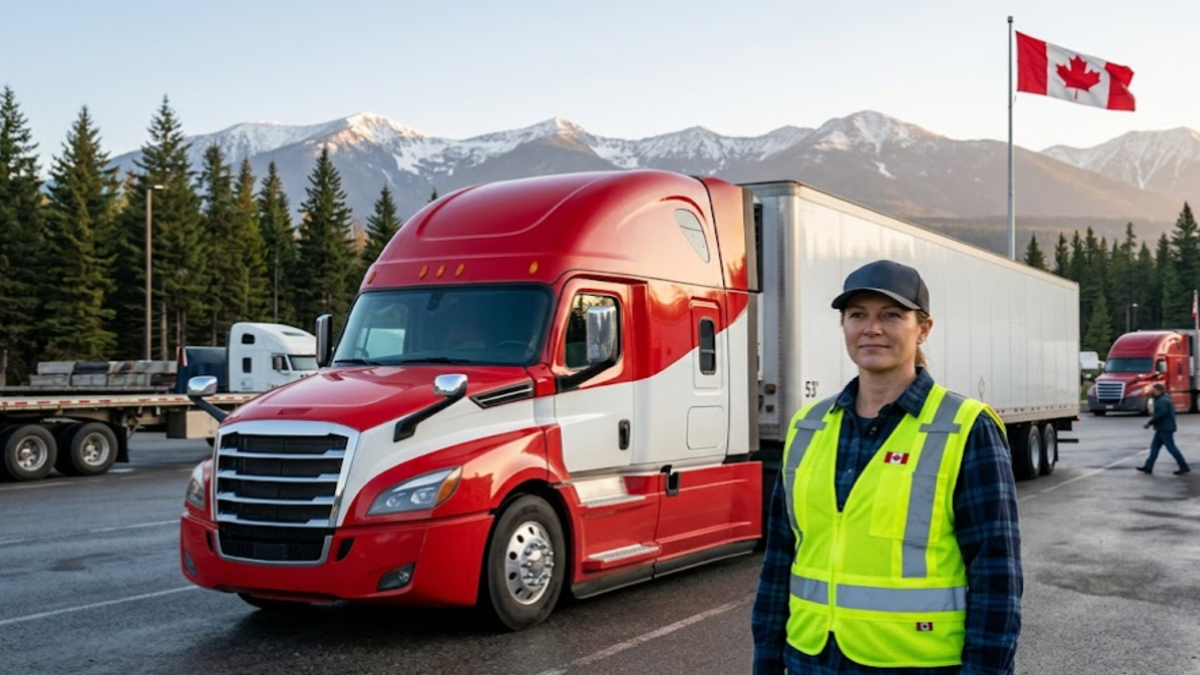
OTTAWA – Canadist: Truck Driver Jobs in Canada are drawing renewed attention as the country’s trucking industry faces questions over recruitment, working conditions, licensing, immigration and enforcement. Recent industry reporting has highlighted both the continuing importance of truck drivers to the Canadian economy and concerns about how some workers are recruited and classified. What does the latest news mean for people looking to build a trucking career in Canada?

Truck Driver Jobs in Canada Remain Important to the Economy
Truck driving remains one of the most visible occupations in Canada’s transportation sector, with drivers moving manufactured goods, agricultural products, industrial materials and consumer supplies between communities and across provincial borders.
Transport Canada says about 350,000 people work in Canada’s trucking and logistics sector, with most of them working as truck drivers. The department describes trucking as an essential link for manufacturing, agriculture and mining, connecting Canadian businesses with markets and customers.
The industry also stretches far beyond Canada’s major cities. Trucking jobs can be found from the northern territories to coastal ports in British Columbia and Newfoundland and Labrador, giving qualified drivers opportunities in different parts of the country.

For job seekers, that geographic reach is one of the main attractions of the occupation. A driver may work on local routes, regional deliveries or long-haul assignments covering large distances.
Transport Canada also points applicants toward the federal Job Bank, where transport truck driver positions and other transportation occupations are listed alongside information about career prospects, skills and job requirements.
The latest industry discussion, however, shows that finding a trucking job is not simply a matter of obtaining a licence. Applicants increasingly need to understand the type of employer they are joining, how they will be paid and whether the position provides proper employment protections.
The Job Market Is Changing for Truck Drivers
Recent trucking-industry news has placed a strong emphasis on the quality of available driving jobs rather than simply the number of vacancies.
One major issue involves the so-called “Driver Inc.” model. The Canadian Trucking Alliance has argued that some carriers improperly classify workers as independent contractors when they should be employees. According to the alliance, the practice can allow companies to avoid taxes and employment obligations while leaving drivers without benefits and other protections.
The issue has become an important part of the national conversation around truck driver employment.
The Canadian Trucking Alliance has called for stronger enforcement against companies it says use illegal employment practices. Its campaign has also raised concerns about labour and immigration abuse, workplace safety and tax compliance.
The alliance says the government has committed funding to address tax non-compliance and has taken steps concerning reporting requirements for businesses operating under the Driver Inc. model.
For drivers, the message is significant: a job advertisement offering attractive earnings should not be judged by the headline pay alone.
Workers should also examine whether the position is classified as employment or self-employment, what expenses they must cover, whether benefits are included and who is responsible for the vehicle and operating costs.
The Canada Revenue Agency notes that truck drivers can be employees or self-employed workers, depending on the actual relationship between the driver and the company. The classification can affect taxes, employment insurance and other rights and responsibilities.
What Qualifications Are Needed?
The exact licensing requirements depend on the type of truck and the province or territory where a driver works.
Transport Canada states that people seeking to drive tractor-trailer combinations need the appropriate commercial licence. Its trucking information specifically identifies the Class 1 or AZ licence as the credential required for drivers who want to pull trailers in the jurisdictions described on its career page.
The department says the AZ training route requires at least 112 hours of training through a public or private trucking school.
An AZ licence allows a driver to operate a truck and tractor-trailer combination with air brakes and pull a trailer weighing more than 4,600 kilograms. It also covers combinations in which both the truck and trailer have air brakes.
The DZ licence covers a different category of heavy vehicles. Transport Canada says DZ drivers can operate vehicles weighing more than 11,000 kilograms, including certain fire and rescue trucks, crane trucks, dump trucks and cement trucks, while also pulling trailers below the specified weight threshold.
Prospective drivers therefore need to choose their training based on the kind of work they want.
Someone interested in long-haul freight will have different requirements and career expectations from someone seeking local delivery or municipal heavy-vehicle work.
Before paying for training, applicants should check the licensing rules in the province where they intend to work and confirm that the school and program meet the applicable requirements.
Truck Driver Jobs in Canada Are Concentrated in Major Provinces
Although trucking work exists throughout the country, employment is particularly concentrated in Canada’s largest provinces.
Transport Canada says more than 80% of trucking work is located in Ontario, Quebec, Alberta and British Columbia.
That concentration reflects the importance of these provinces to Canada’s manufacturing, agriculture, energy, construction, retail and international trade networks.
Ontario remains a major transportation hub because of its large population, industrial base and connections to the United States.
Quebec has an extensive freight network serving major population centres and manufacturing industries, while Alberta and British Columbia play major roles in western Canada’s energy, agriculture, forestry, mining and international trade sectors.
For applicants willing to relocate, this concentration can create more choices than restricting a job search to one small community.
However, location also affects the nature of the work. A driver operating from a major logistics centre may encounter different schedules, freight types and distances from someone working in a smaller regional market.
Job seekers should therefore look beyond the job title and investigate the route, home-time arrangements and expected schedule before accepting an offer.
Long-Haul and Local Driving Offer Different Lifestyles
Truck driving is not one single type of job.
Long-haul drivers may spend extended periods away from home while transporting freight between provinces or across international routes. Local and short-haul drivers generally operate within a smaller geographic area and may return home more frequently.
Transport Canada describes long-haul truck drivers as workers who move goods over urban, rural and international routes, while short-haul and local drivers transport goods within cities and surrounding areas.
The difference can have a major impact on a driver’s quality of life.
A long-haul position may suit someone comfortable with extended travel and changing schedules. A local position may appeal more strongly to workers who prioritize predictable home time.
Pay structures can also vary. Some positions may pay by the mile, others by the hour, while additional compensation can depend on freight, experience, bonuses or specific assignments.
That is why job seekers should calculate the complete compensation package rather than comparing advertised headline rates.
A position with a slightly lower advertised rate but consistent home time, benefits and paid downtime may be more attractive than a higher-rate position with substantial unpaid expenses.
Immigration and Foreign Workers Are Part of the Debate
Immigration has become another major issue in Canada’s trucking labour market.
Recent reporting based on a Teamsters Canada report says approvals for Temporary Foreign Worker permits for truck drivers increased more than fourfold between 2010 and 2024. The union argues that the growth raises questions about wages and working conditions rather than proving that the industry has a simple shortage of workers.
The union’s position has generated debate because trucking companies and worker organizations do not necessarily agree on the causes of recruitment difficulties.
For employers, foreign-worker programs can provide access to additional labour.
For workers, however, the discussion raises questions about wages, bargaining power and whether temporary immigration programs should be used to address structural problems in the industry.
Recent coverage has also reported concerns about vulnerable foreign workers and alleged abuses involving recruitment and employment arrangements. The Canadian Trucking Alliance has separately called for enforcement against what it describes as labour and immigration abuse within parts of the industry.
These allegations do not apply to every trucking company or every foreign worker.
Applicants should therefore assess individual employers rather than assuming that all companies operate in the same way.
Safety and Enforcement Are Becoming Bigger Issues
The trucking industry’s employment debate is closely connected to road safety.
Commercial truck drivers operate large vehicles in demanding conditions, often travelling long distances and working under strict rules governing driving and rest periods.
The Canada Revenue Agency notes that commercial drivers must hold valid licences and follow national safety-code requirements concerning driving activities and hours of service.
The Canadian Trucking Alliance has recently intensified its campaign for stronger enforcement against illegal trucking operations. The organization says weak oversight can create risks for workers, legitimate carriers and other road users.
The alliance has also raised concerns about uninspected vehicles and what it describes as “ghost fleets,” arguing that stronger provincial and national oversight is needed.
For drivers considering a new employer, safety should therefore be one of the first questions asked during recruitment.
Applicants can ask who owns the truck, how maintenance is handled, whether vehicles undergo regular inspections and what procedures exist when a driver reports a mechanical problem.
A company that pressures a driver to continue operating an unsafe vehicle should be treated as a serious warning sign.
Understanding NOC Classification
Truck driving also has a formal place in Canada’s occupational classification system.
Under Canada’s National Occupational Classification system, transport truck drivers are identified under NOC code 73300 and fall within TEER category 3. The federal classification system groups occupations according to factors including training, education, experience and responsibilities.
This classification can be important for workers researching employment, career planning and immigration-related programs.
However, the occupation code alone does not guarantee eligibility for a particular immigration pathway.
Applicants should always compare the actual duties of a job with the official occupation description and check the specific requirements of the immigration or employment program they intend to use.
The federal government advises users of the NOC system to make sure the main duties associated with a classification match the work they actually performed.
That distinction matters for experienced foreign drivers because job titles can differ between countries and employers.
A driver should focus on actual duties, qualifications and experience rather than relying only on a title written on an employment letter.
Where Applicants Can Search for Jobs
The federal government identifies Job Bank as a leading source of Canadian labour-market information and provides a dedicated listing for transport truck drivers.
Applicants can use the platform to compare available positions, locations and employer requirements.
Beyond government listings, applicants should research individual trucking companies carefully before accepting an offer.
Important questions include whether the position is local, regional or long-haul; whether the driver is an employee or contractor; how compensation is calculated; what deductions apply; whether benefits are included; and how much time drivers normally spend away from home.
Applicants should also be cautious about recruitment arrangements that require unusually large payments in exchange for a job offer.
A legitimate employment opportunity should provide clear information about the employer, position, compensation and requirements.
What Recent News Means for Job Seekers
The latest trucking news presents a mixed picture.
On one side, trucking remains a major part of Canada’s economy, and the federal government continues to identify truck driving as an important transportation career.
On the other, labour organizations and industry groups are increasingly focused on employment standards, enforcement, worker classification, foreign-worker recruitment and road safety.
That means applicants should approach the market with more information than simply a résumé and commercial driving licence.
Experienced drivers may have an advantage when applying for positions that require specific equipment knowledge, clean driving records, specialized freight experience or long-distance experience.
New drivers, meanwhile, need to pay particular attention to training quality and the type of licence required for their target job.
The biggest lesson from the recent industry debate is that a truck driving career should be evaluated as a complete employment package.
A good position should offer lawful employment conditions, appropriate training, safe equipment, transparent compensation and clearly defined responsibilities.
The Outlook for Aspiring Truck Drivers
Canada’s trucking sector will continue to play a central role in moving goods across the country.
The government’s own transportation information describes trucking as an essential service and points to opportunities for drivers as well as logistics planners, mechanics, dispatchers, supervisors and other transportation professionals.
That broader ecosystem means a trucking career does not necessarily have to remain behind the wheel forever.
Drivers can eventually move into dispatch, fleet supervision, safety, training, logistics or management, depending on their experience and qualifications.
For newcomers to the industry, the first priority should be obtaining the correct licence and understanding the requirements for the kind of truck they want to operate.
The second should be finding an employer that follows employment, tax and safety rules.
For experienced drivers, the current debate provides another reason to examine contracts carefully and compare employers before changing jobs.
Canada continues to need a functioning road-freight system. But the latest news also shows that the future of trucking jobs will depend not only on how many drivers are recruited, but on the quality, safety and fairness of the jobs available to them.
Frequently Asked Questions
Are truck driver jobs available across Canada?
Yes. Trucking jobs exist across the country, although Transport Canada says more than 80% of trucking employment is concentrated in Ontario, Quebec, Alberta and British Columbia.
What licence is needed for tractor-trailer work?
Transport Canada identifies the Class 1 or AZ licence as the relevant licence for operating tractor-trailer combinations in the jurisdictions covered by its trucking guidance. Training and licensing rules can vary by province.
Is truck driving classified under Canada’s NOC system?
Yes. Transport truck drivers are listed under NOC 73300 and are classified in TEER category 3.
Should applicants check whether they are employees or contractors?
Yes. Employment status can affect taxes, employment insurance, benefits and other responsibilities. The Canada Revenue Agency considers the actual working relationship when determining status.
Contact: info@canadaalyom.com