
OTTAWA – Canadist: Canada Farm Jobs for Foreign Workers remain an important route into the country’s agricultural labour market, but the latest reporting points to a more complicated recruitment environment, with Labour Market Impact Assessment processing times rising across most temporary foreign worker streams while the Seasonal Agricultural Worker Program has recorded a small improvement.

For people overseas looking for farm work in Canada, the opportunity is real, particularly in seasonal agriculture, harvesting, greenhouse work and other primary agricultural occupations. At the same time, applicants must understand that a job advertisement alone does not guarantee a work permit, and employers must satisfy Canadian recruitment and labour-market requirements before bringing in many foreign workers. So, what do prospective workers need to know before applying for a seasonal farm position in Canada?
Canada Farm Jobs for Foreign Workers face a changing recruitment landscape
Recent reporting on Canada’s Temporary Foreign Worker Program shows that employers have been dealing with longer waits for Labour Market Impact Assessments, commonly known as LMIAs. The latest figures reported in September show increases across nearly every major TFWP stream, although the Seasonal Agricultural Worker Program moved in the opposite direction, recording a modest reduction in its processing time.
That distinction matters for agriculture because farms often depend on workers arriving at specific points in the growing cycle. Planting, cultivation and harvesting cannot always wait for administrative delays.

The Seasonal Agricultural Worker Program is one of the established mechanisms that allows Canadian agricultural employers to recruit workers from abroad for temporary agricultural employment. It operates through agreements involving Canada and participating foreign governments.
Canada also maintains an Agricultural Stream that allows employers to hire eligible temporary foreign workers from countries beyond the SAWP participant list. Government information says the Agricultural Stream applies to specified on-farm primary agricultural occupations and commodities.
The result is a system with several routes rather than one universal “farm visa”. The correct route depends on the worker’s nationality, the type of agricultural activity, the employer, the position and the requirements attached to the relevant program.
For applicants, that means the first question should not simply be whether a farm is hiring. The more important question is whether the position is being offered through a legitimate immigration and employment pathway.
How the Seasonal Agricultural Worker Program works
The Seasonal Agricultural Worker Program has particularly clear nationality rules. Under the federal program, participating workers must be citizens of Mexico or one of the participating Caribbean countries. The agricultural production must also fall within eligible commodity sectors, and the work must involve on-farm primary agriculture.
The Caribbean countries participating in the program include Anguilla, Antigua and Barbuda, Barbados, Dominica, Grenada, Jamaica, Montserrat, St. Kitts-Nevis, St. Lucia, St. Vincent and the Grenadines, and Trinidad and Tobago. Mexico is also part of the program.
The program relies on cooperation between governments. Participating foreign governments help recruit and select workers, ensure that workers have the necessary documentation, maintain pools of qualified candidates and appoint representatives who can assist workers in Canada.
This government-to-government structure is one reason applicants should be cautious about claims that anyone can simply purchase a place in a seasonal recruitment program.
A legitimate recruitment process should identify the employer, occupation, employment conditions and immigration route. Workers should also receive the documents required for their application rather than being asked to rely on vague promises of “visa sponsorship.”
Canada Farm Jobs for Foreign Workers: who can apply?
Eligibility depends heavily on the stream used by the employer.
For the SAWP, nationality is a fundamental requirement. A worker from a country outside the participating list cannot use that specific program simply because they have agricultural experience.
The Agricultural Stream is broader in that the worker can come from any country, provided the position and employer meet the applicable requirements. Federal guidance distinguishes this stream from the SAWP and from other TFWP routes.
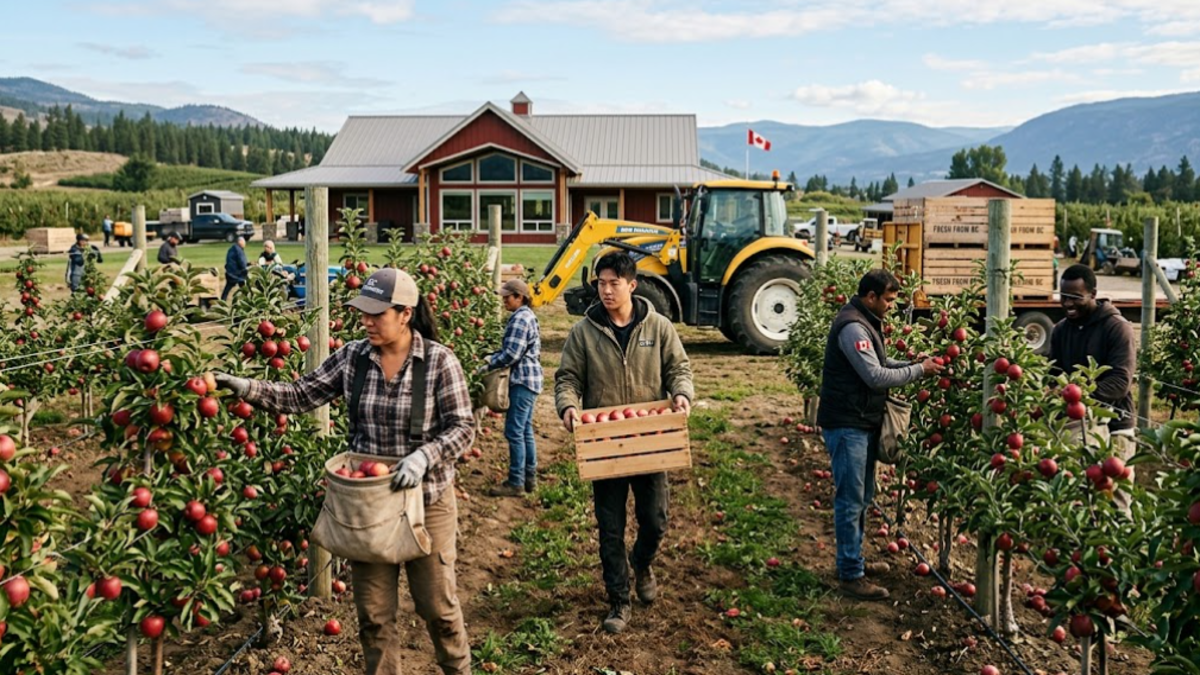
Typical agricultural positions can include general farm workers, harvesting labourers, nursery and greenhouse workers and other occupations associated with primary agriculture. Government material describes primary agriculture as including activities such as operating agricultural machinery and cultivating or harvesting plants and animals or animal products.
The precise job requirements still depend on the position.
Some employers may seek previous farm experience, machinery experience, a driver’s licence or the ability to perform physically demanding work. Those requirements come from the employer and job itself and should not be confused with universal federal eligibility rules.
Applicants should therefore read the actual vacancy carefully instead of assuming that every farm position requires the same qualifications.
Recruitment starts with the Canadian employer
One of the most important facts for prospective foreign farm workers is that the process generally begins with the employer.
Under the Temporary Foreign Worker Program, Canadian employers must demonstrate that they have followed the relevant recruitment rules and that they genuinely need temporary foreign labour. The program exists to address labour shortages when suitable Canadian workers are not available.
The employer may need to obtain an LMIA from Employment and Social Development Canada. A positive LMIA indicates that the employment of a temporary foreign worker meets the applicable labour-market requirements.
For workers, this means a recruiter cannot legitimately promise that a work permit is guaranteed simply because a candidate has paid an application or recruitment fee.
The worker still has to satisfy immigration requirements and submit the required application.
Recent information on Job Bank also highlights an important distinction between an employer that has requested an LMIA and one that already has an approved LMIA. A posting marked “LMIA requested” means an application has been submitted and no final decision has yet been made. It is not proof that the employer has received approval.
That distinction is especially important for international applicants who search online for Canadian farm jobs.
Why LMIA processing times matter to seasonal recruitment
Agriculture is particularly sensitive to processing delays because the value of a seasonal worker depends on timing.
A farm that needs additional labour during planting or harvesting cannot necessarily move the work to a later date. Delays can therefore affect employers as well as foreign workers.
The latest reporting shows that LMIA processing times increased across nearly all TFWP streams in August, with some categories experiencing substantial additional waiting time. The Seasonal Agricultural Worker Program was the exception, recording a small improvement rather than an increase.
That does not mean every agricultural application faces the same waiting period.
Processing times can change according to the stream and circumstances, and applicants should not treat an average processing figure as a personal guarantee.
For workers, the practical lesson is straightforward: seasonal recruitment requires planning. A candidate should not make irreversible travel arrangements merely because an employer has expressed interest.
The worker needs the appropriate documentation and immigration approval before travelling to Canada to begin employment.
Wages, working conditions and employer responsibilities
Foreign agricultural workers are protected by Canadian employment rules while working in the country.
Employers must comply with the conditions attached to the relevant program, including applicable wage and employment requirements. Federal guidance states that employers must ensure temporary foreign workers receive the prevailing wage applicable to the position, with wage reviews forming part of the LMIA and employment arrangements.
The employment agreement is therefore an important document.
Applicants should examine the offered wage, expected hours, job duties, accommodation arrangements where applicable, deductions and duration of employment before accepting an offer.
A worker should also retain copies of the employment contract, work permit documents and other important records.
For seasonal employees travelling from overseas, practical details can be just as important as the advertised hourly wage. Accommodation, transportation, working hours and the location of the farm can significantly affect the overall experience and financial outcome.
Applicants should ask questions before departure rather than after arriving in Canada.
What foreign workers should prepare before applying
A strong application begins with accurate documents.
Applicants should normally be prepared to provide a valid passport and whatever personal, employment or immigration documents the relevant program requires. Depending on the position and circumstances, additional documentation may be necessary.
Agricultural experience can strengthen an application for jobs where the employer specifically requests it, although there is no single experience requirement that applies to every Canadian farm position.
Candidates should also prepare a clear employment history.
If a vacancy asks for experience operating tractors, harvesting equipment, greenhouse systems or other machinery, the applicant should be able to explain where and when that experience was obtained.
Language ability can also matter in practice, even when a particular agricultural job does not advertise a formal language-test requirement. Workers need to understand safety instructions, workplace rules and employment information.
The safest approach is to match qualifications to the actual vacancy rather than relying on generic lists circulating online.
Canada Farm Jobs for Foreign Workers and rural employers
Canada’s approach to temporary foreign labour also includes special measures affecting certain rural employers.
Federal rules provide temporary measures under which eligible employers in participating rural areas may receive flexibility around the proportion of low-wage temporary foreign workers they employ. In some circumstances, the cap can rise to 15 percent instead of the usual 10 percent, while other employers may retain an existing proportion under specified conditions.
These measures do not eliminate the rest of the TFWP requirements.
Eligible employers still have to demonstrate recruitment efforts aimed at Canadians and permanent residents and satisfy the applicable LMIA rules.
For foreign workers, the important point is that rural flexibility is an employer-side measure. It should not be interpreted as an automatic relaxation of immigration requirements for individual applicants.
The rules can also differ by province and territory, so candidates should look at the location of the farm and the precise program being used.
Seasonal work does not automatically mean permanent residence
Another common misunderstanding concerns the relationship between farm employment and permanent immigration.
A seasonal agricultural job is, by definition, temporary. Holding a temporary work permit does not automatically give a worker permanent resident status.
Canada does have immigration pathways connected to agricultural and agri-food experience, but eligibility depends on the specific program and the candidate’s circumstances.
Workers should therefore avoid recruiters who promise permanent residence simply in exchange for accepting a farm job.
A legitimate employer can offer employment and participate in an authorized recruitment process, but immigration decisions remain subject to Canadian immigration rules.
Workers who want to use Canadian agricultural experience as part of a longer-term immigration plan should examine the requirements of the relevant permanent-residence pathway separately.
How to identify a legitimate Canadian farm job
The growing number of online advertisements makes verification essential.
Applicants should first establish the identity of the employer. The name of the farm or agricultural company should be clear, and the job description should contain meaningful information about the occupation and location.
A legitimate offer should also make the employment conditions understandable.
Extreme claims should raise concerns. Advertisements promising guaranteed visas, unusually high earnings for basic farm work or permanent residence without explaining the immigration process deserve careful scrutiny.
Applicants should also be wary of anyone demanding large sums of money merely to provide access to an alleged Canadian employer.
The existence of an online job advertisement does not by itself prove that a company has authorization to hire foreign workers.
The distinction between “LMIA requested” and “LMIA approved” is particularly important. As recent reporting explains, a requested LMIA remains pending and is not the same as an approved labour-market assessment.
What the latest news means for applicants
The latest picture is neither a complete shutdown of foreign farm recruitment nor an unrestricted expansion of opportunities.
Canada continues to use agricultural temporary worker programs to address seasonal labour needs, while the wider Temporary Foreign Worker Program faces tighter scrutiny and changing processing conditions.
For agriculture, the small improvement reported for the Seasonal Agricultural Worker Program is notable because it contrasts with the broader increase in LMIA waiting times.
For applicants, however, the key message is caution.
A worker should apply through a genuine employer, confirm which agricultural stream applies, understand whether an LMIA is required and wait for the necessary authorization before travelling.
The strongest applications are not necessarily the ones attached to the most sensational job advertisements. They are the ones where the worker, employer, employment contract and immigration pathway all fit together.
A practical checklist for foreign farm workers
Before accepting a Canadian seasonal farm job, applicants should check several points.
First, verify the employer. Make sure the business exists and that the person making the offer is authorized to represent it.
Second, identify the program. Determine whether the job uses the Seasonal Agricultural Worker Program, the Agricultural Stream or another TFWP route.
Third, confirm eligibility. Nationality, occupation, commodity and employer requirements can determine whether a particular stream is available.
Fourth, examine the employment agreement. Check wages, duties, hours, accommodation and the expected period of employment.
Fifth, understand the LMIA status. “LMIA requested” is not the same as “LMIA approved.”
Sixth, protect personal documents. Keep copies of your passport, contract, immigration correspondence and other important records.
Finally, never assume that a job offer equals a visa. The work permit application remains a separate immigration step.
For people who meet the requirements, Canadian agriculture can provide a legitimate opportunity to earn income and gain Canadian work experience. But the process rewards careful preparation rather than shortcuts.
The latest recruitment figures reinforce that point. Processing conditions can change, and seasonal agriculture operates according to a tight calendar. Workers who understand the rules before applying are better positioned to recognize legitimate opportunities and avoid costly mistakes.
FAQ
Can foreigners get seasonal farm jobs in Canada?
Yes. Canada has programs that allow eligible foreign workers to take temporary agricultural jobs, including the Seasonal Agricultural Worker Program and the Agricultural Stream.
Does every foreign farm worker need an LMIA?
Not every situation follows exactly the same route, but many Temporary Foreign Worker Program agricultural jobs involve an employer obtaining an LMIA. The applicable program determines the process.
Can workers from any country use the Seasonal Agricultural Worker Program?
No. The SAWP is limited to Mexico and participating Caribbean countries. Workers from other countries may need to qualify through another agricultural stream.
Does a Canadian farm job guarantee permanent residence?
No. A temporary agricultural job does not automatically provide permanent residence. Any permanent-residence application must meet the requirements of the applicable immigration program.
Contact: info@canadaalyom.com