

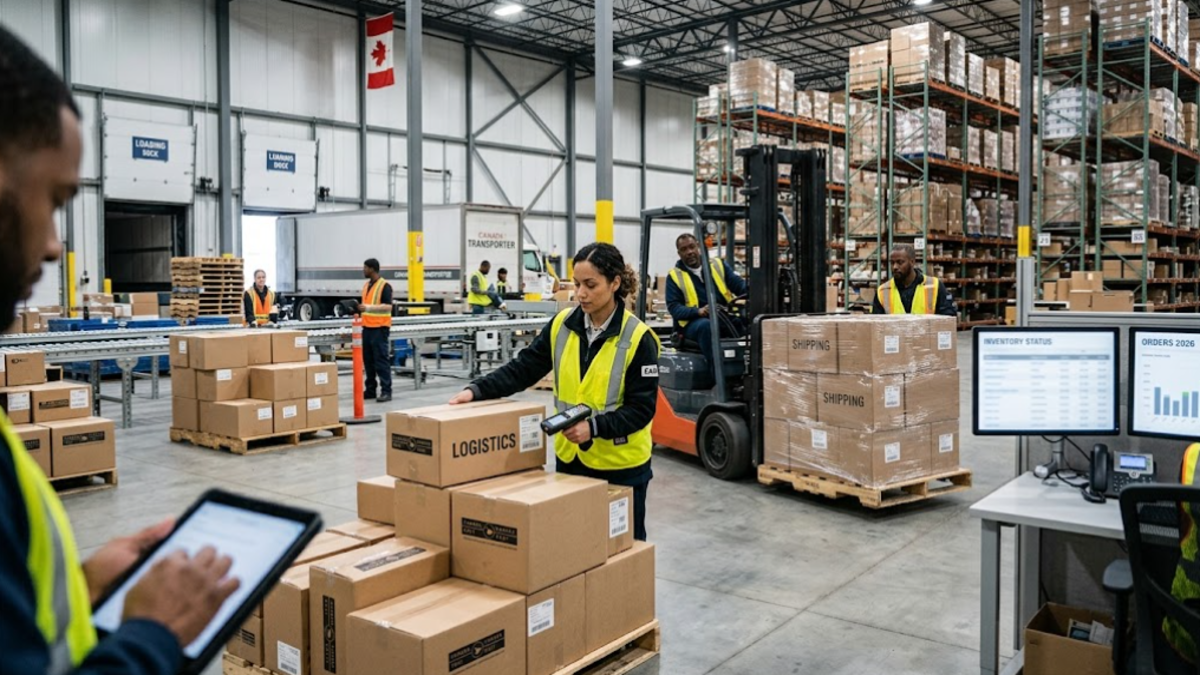
OTTAWA – Canadist: Canada Warehouse Jobs are attracting continued attention as employers across logistics, distribution and material handling adjust to a changing labour market, rising operating costs and greater use of automation. For jobseekers, warehouse work can offer an accessible entry into Canada’s supply-chain industry, while experienced workers can move into equipment operation, inventory control, logistics coordination and management. But what do current salaries, hiring conditions and employer requirements really look like?

Canada Warehouse Jobs: What the Latest Labour Data Shows
Canada’s warehouse and logistics labour market is operating in a more cautious economic environment than it did during the strongest post-pandemic hiring periods.
The latest national employment figures showed that Canada’s economy lost 41,700 jobs in August, while the unemployment rate remained at 6.4%. Full-time employment accounted for most of the decline, falling by 35,900 positions, while part-time employment decreased by 5,800. Transportation, wholesale and retail activity were among the areas affected by the broader employment slowdown.
That does not mean warehouse employment has disappeared. Instead, the figures point to a labour market in which employers are becoming more selective while workers face greater competition for some positions.

This distinction matters for people searching for warehouse jobs. Warehousing is closely connected to retail, manufacturing, transportation and e-commerce. When consumer demand changes, companies can adjust staffing levels, overtime and temporary hiring quickly.
At the same time, Canada’s distribution network still requires large numbers of employees to receive shipments, move goods, prepare orders, operate equipment, manage inventory and coordinate deliveries.
Government Job Bank listings continue to show openings for material handlers in major markets. A recent search for the Toronto region, for example, identified 26 material-handler vacancies.
The available positions also demonstrate that the warehouse sector is not limited to one type of job. Employers recruit workers for material handling, order preparation, shipping and receiving, inventory duties, equipment operation and related logistics functions.
For newcomers and people without extensive formal education, that variety can make warehouse employment an important starting point.
The broader Canadian labour market, however, requires applicants to approach the search strategically. Recent employment data showed that wage growth for permanent employees slowed to 2%, while youth unemployment increased to 12.9%.
For warehouse applicants, this means that simply applying to large numbers of jobs may not be enough. Reliability, physical readiness, workplace safety and practical experience can make a significant difference.
Canada Warehouse Jobs Salaries: What Workers Can Expect
Warehouse wages vary considerably depending on the position, province, experience, shift and employer.
Indeed’s latest salary information puts the average Canadian warehouse-worker wage at about C$21.03 an hour, based on thousands of reported salaries.
Government Job Bank information provides another useful reference point. Warehouse workers involved in mail and parcel sorting generally earn between C$18.56 and C$30.66 an hour nationally, according to the occupation information available through the federal employment service.
Those figures illustrate why jobseekers should look beyond a single national average.
An entry-level warehouse position may sit near the lower end of the range, particularly when the employer provides training and the worker has limited experience. Positions involving specialized equipment, greater responsibility, night shifts or supervisory duties can command more.
Regional differences are also important.
A warehouse employee in a major metropolitan logistics market may encounter different wage levels from someone applying for a similar position in a smaller community. Labour availability, local living costs, industrial activity and the concentration of distribution centres all influence compensation.
The job itself matters just as much.
A general warehouse associate may handle picking, packing, loading and unloading. A forklift operator may receive a higher rate because the role requires specific equipment training and greater responsibility. Inventory or shipping-and-receiving positions may require computer skills and familiarity with warehouse-management systems.
Experienced workers can progress further.
Warehouse supervisors, logistics coordinators and managers generally earn substantially more than entry-level warehouse employees. Salary information from Canadian employment platforms shows that logistics-management positions can reach well above the earnings associated with basic warehouse work, although compensation varies significantly by experience and employer.
Applicants should therefore treat an advertised hourly rate as the starting point for evaluating a job, not the complete picture.
Overtime, shift premiums, benefits, vacation, pension contributions and opportunities for promotion can change the total value of an offer.
What Employers Require From Warehouse Workers
One of the major attractions of warehouse employment is that many entry-level positions do not demand a university degree.
Government employment information for some warehouse-related occupations shows that workers can enter the field with short-term experience and no formal education. A recent Job Bank listing for a warehouse disposal-worker occupation in Quebec, for example, identified short-term work experience and no formal education as the usual requirements.
That does not mean employers hire without assessing qualifications.
Physical ability remains important for many positions. Workers may need to stand for long periods, repeatedly lift or move products and work in busy environments where speed and accuracy matter.
Employers also place considerable importance on attendance and reliability.
A warehouse depends on coordinated teams. If one employee repeatedly arrives late or misses shifts, picking, packing, loading and dispatch operations can fall behind.
Safety is another central requirement.
Workers need to follow workplace procedures, use protective equipment when required and understand how to move around machinery and other employees safely.
For jobs involving forklifts or other powered equipment, employers may require appropriate training or certification. Requirements can differ depending on the equipment, workplace and provincial rules.
Computer literacy is becoming increasingly valuable.
Modern warehouses use digital systems to track inventory, record shipments, print labels, manage orders and monitor stock levels. A worker who can comfortably use scanners, tablets, warehouse software and basic computer systems may have an advantage over an applicant with no digital experience.
Communication skills also matter.
Warehouse employees frequently interact with supervisors, drivers, shipping departments, inventory teams and other workers. Clear communication can prevent incorrect shipments, damaged products and delays.
For people seeking their first warehouse position, a strong application should therefore emphasize practical qualities rather than trying to compensate for limited industry experience with unnecessary qualifications.
Hiring Trends Are Moving Beyond Traditional Warehouse Work
The definition of warehouse employment is changing.
Distribution centres increasingly depend on technology to track products, optimize storage and speed up order fulfillment. Automation is becoming an important part of that transition.
Recent industry reporting has highlighted increased investment in warehouse robotics as companies respond to labour costs, delivery expectations and pressure to improve efficiency. A report on the North American market noted substantial growth in robot orders during the first half of the year, with companies deploying autonomous equipment, drones and other technologies.
For workers, automation does not necessarily mean the end of warehouse employment.
Instead, it can change the skills employers value.
As machines handle some repetitive or physically demanding tasks, workers may increasingly operate equipment, monitor automated systems, resolve exceptions, maintain inventory accuracy and coordinate processes.
This creates a stronger case for applicants to develop technical skills alongside physical warehouse abilities.
A worker who begins in picking or packing can potentially move toward inventory control, equipment operation or logistics coordination by learning how the facility’s systems work.
The same trend also means that employers may look for workers who can adapt to new processes.
A warehouse employee who learns quickly and follows digital instructions accurately can become more valuable as technology changes the workplace.
Why Location Matters for Warehouse Jobseekers
Canada’s warehouse opportunities are closely linked to transportation corridors and population centres.
Large urban markets attract distribution facilities because they provide access to consumers, highways, airports, rail networks and large pools of workers.
Toronto and the surrounding Greater Toronto Area remain important logistics markets, while other major employment centres across Ontario, Quebec, Alberta and British Columbia also support distribution and material-handling activity.
Government job listings provide a useful way to examine regional opportunities. The federal Job Bank publishes occupation information, wage data and available positions by region, allowing jobseekers to compare conditions before applying.
Applicants should not automatically choose the city with the highest advertised wage.
A higher hourly rate can be offset by transportation costs, housing expenses or a long commute.
Shift patterns should also form part of the calculation.
Night and weekend positions may offer additional compensation in some workplaces, but they can impose significant demands on workers. Candidates should review the full schedule before accepting an offer.
For newcomers, location can also affect accessibility.
A warehouse outside a major city may offer lower living costs but require a car or reliable transportation. A facility closer to a transit network may offer a lower hourly wage but be easier to reach consistently.
What Can Improve a Warehouse Application?
The first step is to tailor the résumé to the position.
An applicant for a picker-packer role should highlight accuracy, physical work, order fulfillment and reliability. Someone applying for a forklift position should clearly identify relevant equipment experience and training.
Previous experience does not have to come from another warehouse.
Construction, retail, manufacturing, agriculture, delivery work and other physically demanding jobs can demonstrate transferable skills.
Retail workers, for example, may already have experience receiving merchandise, organizing stock and helping customers. Manufacturing workers may understand production procedures, safety requirements and shift work.
Applicants should also be precise about availability.
If an employer needs evening or overnight workers, clearly stating availability can make an application easier to evaluate.
References can help when an applicant has previous employment experience.
For people with little work history, the emphasis should instead fall on reliability, willingness to learn and relevant practical skills.
Jobseekers should also avoid paying anyone who promises guaranteed warehouse employment.
A legitimate employer should provide clear information about the position, location, compensation and hiring process. Requests for unusual payments or sensitive financial information before a genuine employment process should be treated cautiously.
The Outlook for Warehouse Workers
The immediate employment environment is mixed.
Canada’s latest labour report showed a significant monthly decline in employment, while unemployment remained at 6.4%. Transportation and wholesale and retail activities were among the service industries affected by the broader slowdown.
At the same time, Canada’s supply chains still depend on workers who can move products from manufacturers and importers to stores, businesses and consumers.
The warehouse sector is therefore unlikely to disappear. Its workforce is more likely to evolve.
The strongest opportunities may increasingly favour people who combine traditional warehouse skills with technology, equipment operation and inventory knowledge.
This is particularly important as companies invest in automation.
Workers should not assume that automation eliminates every position around a machine. Someone still needs to monitor operations, handle exceptions, move materials, maintain accurate inventory and respond when automated processes cannot complete a task.
The broader economic environment also matters.
Trade tensions with the United States have created additional uncertainty for Canadian businesses. Recent labour-market reporting warned that trade-exposed industries could face greater pressure as new tariffs affect companies and supply chains.
That uncertainty makes it difficult to predict exactly how quickly warehouse hiring will grow.
For jobseekers, however, the practical strategy is clearer: target employers with stable distribution operations, develop transferable skills and pay attention to positions that offer training and advancement.
Is Warehouse Work a Good Entry Point in Canada?
For many people, the answer can be yes.
Warehouse jobs can provide a relatively accessible route into Canada’s logistics and supply-chain economy without requiring a university degree.
The work can also create a pathway toward better-paid positions.
An employee who gains experience with inventory systems, forklifts, shipping documentation and warehouse technology can potentially move into specialized or supervisory roles.
Salary progression depends on the employer and the worker’s qualifications, but the difference between entry-level warehouse work and experienced logistics positions shows why career development matters. Current salary estimates place the average warehouse-worker rate around C$21 an hour, while logistics-management roles can command considerably higher compensation.
The most important point for applicants is that the first warehouse job does not have to be the final destination.
Workers can use the position to learn the operation, build references, gain equipment experience and develop the skills needed for more advanced supply-chain roles.
What Jobseekers Should Watch Next
Applicants should monitor four areas closely: advertised wages, available shifts, regional vacancies and employer investment in technology.
A rise in warehouse automation could increase demand for workers with technical skills even as it reduces the need for some repetitive tasks.
Changes in consumer spending could also affect distribution-centre staffing.
Meanwhile, broader employment conditions will influence how competitive entry-level vacancies become.
The latest labour figures show that Canada’s employment market has lost some momentum, but warehouse and material-handling positions continue to appear across the country.
For workers willing to build experience and adapt to new technology, the warehouse sector can remain a practical route into Canada’s wider logistics economy.
FAQ
How much do warehouse workers earn in Canada?
Current salary data puts the average warehouse-worker wage at roughly C$21 an hour, although pay varies by location, employer, experience and job duties.
Do warehouse jobs require a university degree?
Many entry-level warehouse occupations do not require formal post-secondary education. Requirements depend on the specific position and employer.
Are warehouse jobs still available in Canada?
Yes. Government job listings continue to show openings for material handlers and other warehouse-related occupations, including in major metropolitan regions.
Will automation reduce warehouse jobs?
Automation is changing warehouse work, particularly repetitive tasks, but it is also increasing the importance of equipment operation, technology, inventory and supervisory skills.
Contact: info@canadaalyom.com