
VICTORIA – Canadist: World’s tallest totem pole has been removed in Alert Bay, British Columbia, after standing for more than five decades as one of the most recognizable landmarks on Cormorant Island, bringing an emotional end to the life of a structure that had become closely associated with the community and the Kwakwaka’wakw people. Why did the towering cedar pole have to come down after more than 50 years?

The 52.7-metre (173-foot) pole stood near the Gukwdzi, or Big House, in Alert Bay. The structure had been a defining feature of the community since it was erected in 1973.
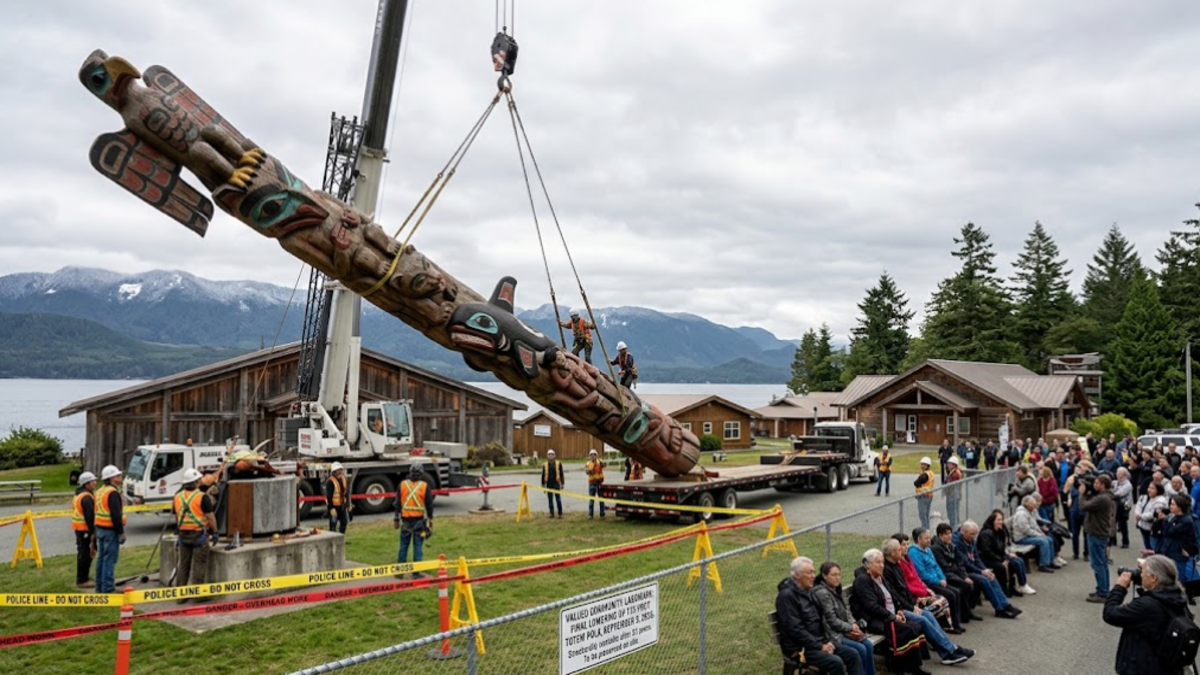
Its removal followed serious concerns about the pole’s structural stability. The ‘Na̱mg̱is First Nation announced that the work would take place on Sept. 9, with safety measures put in place around the site before the operation began.
The decision marked the end of an era for a landmark that had attracted visitors to Alert Bay for decades. It also highlighted a familiar challenge for large wooden poles on the Pacific Northwest coast: even monumental works of cultural significance eventually face the effects of age, weather and structural deterioration.

World’s tallest totem pole stood for more than 50 years
The World’s tallest totem pole became part of Alert Bay’s landscape when it was erected in 1973.
The pole itself had been carved earlier, in the late 1960s, by a team of sculptors led by Jimmy Dick. According to Guinness World Records, the completed structure measures 52.7 metres, or 173 feet, and consists of two sections joined together.
The main section measures 49.6 metres, while a second section measures about three metres. That construction has been part of the long-running discussion surrounding claims to the title of the world’s tallest totem pole.
Despite that debate, Guinness World Records lists the Alert Bay pole as the tallest totem pole at 52.7 metres. The record was recorded on Nov. 28, 2024.
The scale of the structure made it exceptional even in a region known for monumental First Nations carving. Its height placed it well above many familiar totem poles seen elsewhere in British Columbia and the Pacific Northwest.
For Alert Bay, however, the pole represented more than a measurement.
Its location near the Gukwdzi placed it within an important cultural landscape, while its carvings connected the structure to Kwakwaka’wakw traditions and histories.
The pole featured figures including the Sun Man, Thunderbird, salmon, whale and a bear holding a salmon. Guinness records the work as unusual because it represents several factions within the Kwakwaka’wakw people rather than serving only one family.
That distinction helped give the pole a broader meaning within the community.
Over the decades, the towering cedar became an instantly recognizable part of Alert Bay’s identity. Visitors arriving on Cormorant Island could encounter a landscape in which traditional architecture, carved poles and the surrounding coastal environment formed a powerful expression of Indigenous culture.
The pole’s height made it particularly prominent, but its cultural setting gave it significance beyond the record books.
Why the World’s tallest totem pole was removed
The immediate reason for the removal was safety.
In its official notice, the ‘Na̱mg̱is First Nation said it had serious concerns about the structural stability of the pole. The Nation therefore arranged for the structure to be safely removed, with the operation carried out step by step.
The decision did not come with a fixed timetable for when the pole would actually be lowered.
Instead, crews had to prepare the site and assess conditions before beginning the removal. The Nation said the timing would depend on site conditions and on how the pole and its supports responded as the work progressed.
That approach reflected the extraordinary size of the structure.
A 52.7-metre wooden pole cannot simply be dismantled like an ordinary building component. Its height, weight and location meant that the surrounding area needed protection while workers carried out the operation.
The Gukwdzi parking lot and surrounding work area were closed to establish a safety perimeter.
The closure began on the evening before the scheduled removal, allowing workers to prepare the area and keep community members and visitors away from the potential fall zone.
Power lines added another safety consideration.
BC Hydro temporarily disconnected power to the Gukwdzi while the work was underway because electrical lines were located within the potential fall zone.
The precautions underscored the central issue facing the project: preserving public safety while dealing with a structure that had stood in place for more than half a century.
The ‘Na̱mg̱is First Nation asked members of the community and the public to respect barricades, closures and instructions from personnel at the site.
The removal therefore represented not only a cultural moment but also a complex practical operation.
The official notice emphasized that the safety of community members, workers and people in the surrounding area remained the priority throughout the process.
A landmark tied to Kwakwaka’wakw history
The importance of the pole cannot be separated from the cultural landscape of Alert Bay.
Cormorant Island is home to the ‘Na̱mg̱is First Nation and forms part of the broader homeland of the Kwakwaka’wakw peoples.
Alert Bay, known as ‘Yalis in Kwak’wala, has long been associated with Kwakwaka’wakw cultural traditions, including monumental carving, ceremonial practices and the potlatch.
The region also contains other important examples of carved poles and cultural sites.
The Gukwdzi, where the world’s tallest pole stood, is itself a significant part of the community’s cultural landscape.
That context matters when considering the removal.
The pole was not simply a tourist attraction or an oversized wooden sculpture. Its carvings, location and history connected it to Indigenous artistic traditions and the people whose cultural landscape surrounds it.
Totem poles can communicate family histories, ancestral connections, stories and cultural identities. Their figures are not merely decorative elements.
The carvings can carry meanings that are connected to particular families, communities and histories.
The Alert Bay pole was distinctive because its figures represented several Kwakwaka’wakw factions rather than a single family. That gave the structure a wider community dimension.
Its enormous size also made it a visible symbol of Alert Bay.
For generations of residents and visitors, seeing the pole meant seeing one of the community’s defining landmarks.
Its disappearance therefore changes the physical appearance of the site as well as the emotional landscape for people who had known it throughout their lives.
The World’s tallest totem pole and the passage of time
The removal also illustrates the complicated relationship between wooden monuments and time.
Large carved poles are exposed to the elements. Rain, moisture, wind, temperature changes and biological decay can affect wooden structures over many decades.
The Pacific Northwest’s coastal environment can be particularly demanding for large wooden works.
A structure may remain visually impressive while its internal condition changes over time.
That makes decisions about safety difficult.
A landmark can continue to hold enormous cultural and historical importance while no longer being structurally sound enough to remain standing.
The decision in Alert Bay reflects that tension.
The pole’s record-breaking height and cultural significance could not eliminate the physical realities of aging wood.
The ‘Na̱mg̱is First Nation therefore chose a controlled removal rather than waiting for an uncontrolled structural failure.
That distinction is important.
A naturally collapsing structure of this size could have endangered people, buildings, electrical infrastructure or nearby property. A planned operation allowed the community and workers to establish a controlled environment.
The process also provided an opportunity to recognize the pole’s history rather than allowing it simply to disappear through an unexpected collapse.
What happens after the pole comes down?
The removal does not mark the end of the pole’s story.
The ‘Na̱mg̱is First Nation said it would work with the family connected to the pole’s original artist to discuss plans for a future recognition event.
The announcement leaves open the question of how the community will commemorate the structure.
That future recognition could become an important opportunity to reflect on the pole’s history, its artistic significance and the generations of people who saw it as part of Alert Bay.
For now, the physical landmark is gone from the skyline.
But the stories associated with it remain.
The pole’s history reaches back to the late 1960s, when the carving team led by Jimmy Dick created the structure, and to 1973, when it was finally erected.
For more than 50 years, it occupied the same landscape and became a familiar reference point for people living in or visiting Alert Bay.
Its presence also helped draw attention to the community’s wider cultural attractions.
Alert Bay remains home to other carved poles, cultural institutions and places connected to Kwakwaka’wakw history. The removal of one monumental structure does not erase that broader cultural landscape.
Instead, it changes one part of it.
Why the removal matters beyond Alert Bay
The story has attracted attention far beyond the small British Columbia community because the pole carried an unusual combination of characteristics.
It was exceptionally tall.
It had a documented world record.
It had stood for more than half a century.
And it occupied a culturally important Indigenous setting.
Each of those factors would make the loss significant on its own. Together, they explain why the removal has generated widespread interest.
For visitors who knew Alert Bay primarily through images of its monumental pole, the change may be especially striking.
The skyline will no longer contain the towering structure that once rose above the surrounding landscape.
For residents, the experience is more personal.
A landmark that had been present for decades can become part of the visual memory of everyday life. People grow accustomed to seeing it from familiar roads, paths and buildings.
When such a structure disappears, the change can feel larger than the physical space it occupied.
There is also a broader conversation about how communities care for aging cultural objects.
Preservation does not always mean keeping a structure standing forever.
In some cases, responsible stewardship means recognizing when a structure has become unsafe and taking action before it fails.
The challenge then becomes finding ways to preserve its story, artistic legacy and cultural meaning.
That is particularly important for Indigenous cultural works, where questions of ownership, community authority and cultural interpretation require careful attention.
In Alert Bay, the ‘Na̱mg̱is First Nation is leading the process concerning the pole and its future recognition.
That community role is central to understanding what happens next.
A record that became part of Alert Bay’s identity
The World’s tallest totem pole was never only about height.
Its 52.7-metre measurement made it a record-holder, but its deeper importance came from the people, stories and cultural landscape connected to it.
The pole stood through decades of change in Alert Bay.
It became a landmark for visitors and a familiar feature for residents. Its figures told stories through a visual language rooted in Kwakwaka’wakw carving traditions.
Its record also placed Alert Bay on lists of unusual and remarkable destinations in British Columbia.
But the end of its physical presence does not necessarily mean the end of its influence.
The history of the pole will remain part of the story of Alert Bay.
The photographs taken over decades will continue to show its scale. Visitors who saw it before its removal will remember the experience. Residents will carry their own memories of the structure.
And the planned recognition work offers an opportunity for the community to determine how the pole should be remembered.
That may ultimately prove more important than the record itself.
A world record can be replaced.
A landmark can disappear.
But cultural history continues through the people and communities who preserve, explain and pass it on.
What the removal means for Alert Bay
The immediate landscape around the Gukwdzi has changed permanently.
The towering pole that once dominated the site is no longer standing, and the community now faces the task of remembering it while continuing to protect the cultural significance of the area.
The decision to remove the structure came after serious concerns about its stability, not because its history had become less important.
In fact, the attention surrounding its removal demonstrates how important the pole had become.
The operation also shows the practical difficulties that accompany the preservation of very large wooden structures.
The pole had survived for more than 50 years after its erection in 1973. Eventually, however, structural concerns made continued display too risky.
The controlled removal allowed the community to put safety first.
At the same time, the planned recognition event offers a way to acknowledge the work of the original artists and the significance of the monument.
The next chapter will therefore focus less on height and more on memory.
Alert Bay has lost one of its most recognizable landmarks, but it has not lost the cultural history surrounding it.
The World’s tallest totem pole may no longer rise above the community, yet its place in the history of Alert Bay, the Kwakwaka’wakw and British Columbia remains.
FAQ
Why was the World’s tallest totem pole removed?
The ‘Na̱mg̱is First Nation ordered its removal because of serious concerns about the pole’s structural stability.
How tall was the World’s tallest totem pole?
The pole stood 52.7 metres, or 173 feet, making it the tallest totem pole listed by Guinness World Records.
When was the pole erected?
The pole was erected in 1973 after being carved in the late 1960s by a team led by Jimmy Dick.
What will happen after its removal?
The ‘Na̱mg̱is First Nation said it will work with the family connected to the original artist to discuss a future recognition event.
Contact: info@canadaalyom.com