

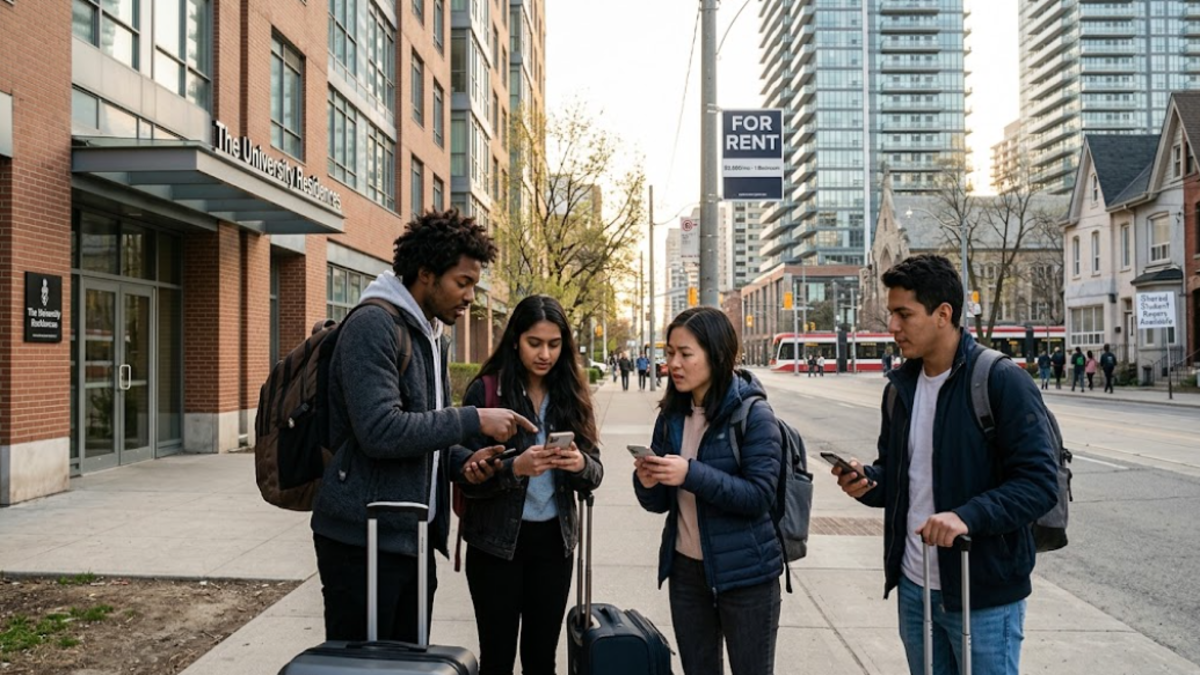
OTTAWA – Canadist: Canada International Student Housing Crisis

Canada’s international student housing market is entering a complicated new phase. Rental demand around colleges and universities has eased as fewer international students arrive, while new purpose-built accommodation and a broader supply of rental units are beginning to give students more choices in several markets. Yet the improvement does not mean housing has suddenly become affordable. In major cities, advertised rents remain far above many student budgets, and lower-cost rooms can still be difficult to secure near campus. What does the latest housing data actually mean for international students searching for a place to live?
The Canada International Student Housing Crisis has changed rather than disappeared. Recent rental data shows that asking rents across the country have moved lower over the past year, while vacancy has increased in parts of the market. At the same time, colleges and universities continue to face a structural shortage of dedicated student residences, particularly in the largest urban centres. The result is a housing market with more listings in some areas, but a persistent affordability problem for students with limited budgets.
Canada’s rental market is also becoming increasingly divided. Newer buildings often have more available units and may offer incentives to attract tenants, but they frequently charge higher rents. Older apartments, shared homes and rooms can cost less, yet students must compete for these properties and may face longer commutes or fewer protections depending on the arrangement.

Canada International Student Housing Crisis Changes as Rental Demand Cools
The latest national rental figures point to a meaningful change from the extreme tightness seen in earlier years. Rentals.ca reported that the average asking rent for all property types reached $2,037 in July, down 4.0 per cent from a year earlier. That marked another annual decline, although the monthly figure edged up 0.2 per cent as the rental market entered its seasonal peak.
The distinction between asking rents and existing rents matters for international students. A person already living in a rental unit may face a different price from someone searching for a new home. The Canada Mortgage and Housing Corporation has noted that the recent easing has been concentrated particularly in newer and more expensive units, where landlords have increasingly competed for tenants with incentives.
CMHC Deputy Chief Economist Tania Bourassa-Ochoa said the rental market has experienced a combination of increased supply and weaker demand. According to CMHC, asking rents have been falling across most major centres, while landlords in some markets are offering incentives such as free rent, cash bonuses and assistance with moving costs.
That change can benefit international students who are flexible about location and housing type. A student arriving for a new academic term may now encounter more choice than students faced during the tightest period of the rental shortage. But the cheapest segment of the market remains under pressure.
CMHC’s analysis makes clear that the market is not improving evenly. Lower-priced accommodation remains much tighter than newer, higher-priced stock. That distinction is critical because international students frequently arrive with fixed budgets determined by tuition, savings, family support, scholarships and immigration requirements.
The national average therefore tells only part of the story. A student searching for a room for $700 or $900 a month is competing in a different market from a tenant who can afford a modern apartment costing more than $2,000.
This helps explain why news of falling rents can coexist with reports of student housing difficulties. More supply can reduce competition at the top end while leaving affordable rooms scarce.
Rent Prices Remain a Major Barrier for International Students
Canada’s biggest student markets continue to show a sharp gap between rents and what many renters can realistically afford. A recent Rentals.ca analysis found that Vancouver’s average asking rent stood at $2,715, while Toronto’s average was $2,537 and Ottawa’s was $2,149. Montreal was lower at $1,949, while Calgary stood at $1,820.
Those figures describe complete rental units rather than the amount a student necessarily pays alone. International students often reduce costs by sharing accommodation with roommates, renting a private room in a house or choosing a smaller unit farther from campus.
Even with those strategies, however, the affordability gap remains substantial. Rentals.ca reported that nearly three-quarters of Canadian renters were searching for homes priced at $2,000 or less, below the national average asking rent.
Toronto illustrates the problem particularly well. The city has experienced easing rents, but average prices remain high relative to student budgets. The City of Toronto’s published market figures put the average market rent for a hostel or dwelling room at $1,246, compared with $1,763 for a one-bedroom apartment and $2,055 for a two-bedroom unit.
For many international students, renting an entire apartment is therefore difficult unless they share the cost. A two-bedroom unit split between two students can dramatically reduce the individual monthly payment, although students must then account for utilities, deposits, furniture and other living expenses.
Vancouver remains especially challenging. The average asking rent there is considerably higher than the national figure, and even renters with relatively large budgets can struggle to find units within reach. Rentals.ca’s renter survey found that 48 per cent of Vancouver-area renters were targeting budgets of at least $2,000 a month, yet the city’s average asking rent still exceeded that level.
The same survey showed a different picture in Calgary. The city’s average asking rent was $1,820, making it the most affordable of Canada’s six largest rental markets in that comparison. Yet even there, many renters were still budgeting below market asking prices.
For international students, the lesson is straightforward: choosing a city can have as much impact on housing affordability as choosing the university itself.
Housing Options Are Expanding, but Supply Still Falls Short
Purpose-built student accommodation is becoming a more important part of Canada’s housing landscape. These buildings are designed specifically for students and can offer furnished rooms, shared kitchens, study areas, internet access and other student-focused services.
Ontario is seeing a particularly large expansion. Urbanation projected 6,313 new student housing beds to come online across the province, with the Greater Toronto Area accounting for 2,734 of them. The wider pipeline included 70,450 beds either under construction or proposed, although not all proposed projects will necessarily reach completion.
The figures show both progress and the scale of the remaining challenge. Across Ontario, on-campus residence beds combined with purpose-built student accommodation represented only 20.6 per cent of university enrolment in the reported analysis. The rate in the Greater Toronto Area was just 11.8 per cent, highlighting the region’s long-standing reliance on private rentals and condominium units for student housing.
The market is also responding to changes in international enrolment. Urbanation reported that national post-secondary enrolment declined after study-permit restrictions took effect, with the largest impact occurring in colleges. The organization reported a 73 per cent decline in study-permit issuance to colleges across the measured period, compared with a 38 per cent decline at universities.
That shift matters because colleges have historically attracted large numbers of international students. Lower demand can free up some rental stock around campuses, but fewer international students also changes the business case for some student housing projects.
For students, the expanding supply creates several possible routes. University residences remain the most straightforward option for students who can secure a place. Purpose-built residences provide another alternative, often with utilities and services included in a single package. Private room rentals can be less expensive but require more careful screening.
The federal government’s EduCanada guidance also notes that students can consider residence, private housing and shared accommodation. Official information says private rooms in houses may cost between CAD $400 and $800, while apartments can range much higher depending on the city, size and location. In major markets such as Toronto and Vancouver, the costs can rise substantially.
Shared Housing and Private Rooms Remain the Most Accessible Options
For students focused on controlling monthly expenses, shared housing remains one of the most practical choices. Instead of renting an entire apartment, students can divide rent with roommates and split costs for internet, electricity and other household expenses.
The trade-off is privacy. Shared bedrooms and common spaces reduce housing costs but may not suit every student, particularly those balancing demanding academic schedules. The arrangement also requires careful attention to the lease and to the responsibilities of each tenant.
Private rooms in shared houses can offer a middle ground. A student may have a private bedroom while sharing the kitchen and bathroom with other residents. This model is common near university districts and can cost substantially less than a private apartment.
Students should also examine what the advertised rent includes. A room that appears cheaper may become more expensive once electricity, heating, internet, laundry, furniture and transportation are added. EduCanada specifically warns students to consider these additional costs when comparing private accommodation.
Another option is to live farther from the university and commute by public transit. This can work particularly well in metropolitan areas with extensive transportation networks. The savings in rent, however, must be weighed against the monthly cost and time required for commuting.
Students should also consider the academic calendar when selecting a lease. Some accommodation providers offer fixed-term contracts aligned with semesters, while others require longer commitments. Breaking a lease can create significant financial obligations.
Residence accommodation can simplify these decisions because students often pay a defined housing charge and receive access to facilities in one location. However, university residence is not automatically the least expensive option, and spaces can be limited.
The right choice ultimately depends on the student’s budget, campus location, privacy needs and willingness to share. There is no single housing model that works for every international student.
Toronto, Vancouver, Montreal and Calgary Offer Very Different Choices
Location is becoming one of the most important factors in the Canada International Student Housing Crisis because rental conditions vary dramatically between cities.
Toronto remains one of the country’s largest and most important international student markets. The city offers a broad range of accommodation, from university residences to shared houses, condominium rentals and dedicated student buildings. Its advantage is choice; its weakness is price.
Vancouver has the same combination of strong educational appeal and high housing costs. Average asking rents remain among the highest in the country, making shared accommodation particularly important for students trying to manage a limited budget.
Montreal offers a different balance. Rentals.ca’s comparison placed the city’s average asking rent below Toronto, Vancouver and Ottawa. That does not make housing inexpensive for students, but it can make Montreal more manageable for those willing to compare neighbourhoods and housing types.
Calgary has recently stood out for relatively lower asking rents among major Canadian markets. Students may therefore find that the cost of living changes significantly by destination, even when tuition costs remain comparable.
Students also need to examine the local relationship between housing demand and campus concentration. Statistics Canada found that Toronto, Montreal and Vancouver accounted for a large share of international students, while some municipalities had much higher rates of unsuitable housing among international students.
The data reinforces a broader point: housing conditions depend not just on national supply, but on where students live and how closely their accommodation is connected to major education hubs.
More Listings Do Not Automatically Mean Affordable Housing
Canada’s rental market is showing signs of balance, but affordability remains uneven. CMHC says new supply is lifting vacancy rates and reducing asking rents in many centres. Yet much of that easing is concentrated in newer, higher-priced properties.
For international students, this creates an unusual situation. They may see more listings online and face less competition than students did during the most severe shortage, but many of those listings may still sit beyond their budget.
The gap is especially important for newcomers who do not have a Canadian rental history. Students arriving from overseas may lack local references, established credit records and detailed knowledge of provincial tenancy rules.
A recent evidence brief from the Social Sciences and Humanities Research Council highlighted several housing barriers faced by international students, including limited credit history, unfamiliarity with the local housing system, dependence on temporary accommodation and gaps in tenancy protections. It also pointed to fragmented or outdated housing information as a continuing problem.
These issues can push students toward informal arrangements. A student who cannot secure a standard lease may accept a room through a personal network or social media listing without fully understanding the legal terms.
That can produce another layer of risk. Cheap accommodation is not necessarily good accommodation, and students should be cautious about sending money before verifying the property, landlord and rental agreement.
Universities, colleges and student associations can therefore play an important role by providing verified housing resources. Students should also inspect a property before signing whenever possible and confirm exactly what the monthly payment covers.
What International Students Should Expect During the Housing Search
Students arriving in Canada should plan their housing search before the academic term begins. The strongest demand often appears around the start of the school year, when large numbers of students compete for the same rooms and apartments.
A realistic budget should include more than rent. Depending on the accommodation, students may need to pay a deposit, utilities, internet, transportation, food, furnishings and laundry costs.
Shared accommodation often provides the best route to lower monthly expenses in expensive cities. Students who value privacy may need to accept a longer commute or choose a smaller city to keep costs under control.
Purpose-built student housing can also simplify the move because some facilities bundle services into the overall price. Students should compare the total package rather than looking only at the headline weekly or monthly rent.
For example, current published rates at a Toronto student residence show how significantly prices can vary by room type. HOEM lists different weekly rates depending on whether students choose two-, three- or four-bedroom arrangements, with lower per-person costs generally available in larger shared configurations.
University-operated accommodation in Montreal also shows the range available within shared residences. McGill’s published rates include shared-facility rooms below $1,000 per month in some buildings, while apartment-style units cost more.
These examples underline a key point for international students: accommodation prices can vary substantially even within the same city. Room size, bathroom arrangements, location, lease length and included services all influence the final cost.
The housing market is therefore giving students more possibilities, but finding a suitable and affordable place still requires early research and careful comparison.
The Housing Crisis Is Easing in Some Areas, Not Ending Everywhere
The most recent evidence does not support a simple claim that Canada’s student housing crisis has either ended or worsened everywhere. Instead, the market is splitting into different segments.
National asking rents have declined compared with a year earlier, while some cities are beginning to stabilize. Toronto’s annual decline has narrowed sharply, and monthly rents have moved higher during the seasonal period.
At the same time, purpose-built student housing construction is expanding, particularly in Ontario. New projects should add capacity, but the scale of the pipeline must be measured against the enormous number of students who depend on private housing.
International student policy has also influenced the market. Fewer new students mean lower demand in some campus districts, which can improve vacancy and weaken rent growth. Government data has linked international student reductions with slower rent growth in certain student-heavy markets.
The effect is most visible where student housing had previously absorbed a large amount of rental supply. Markets near major colleges and universities can react quickly when enrolment changes.
For students, that shift creates an opportunity: more listings, more bargaining power in some segments and a wider range of accommodation than during the peak of the shortage.
But affordability remains the decisive issue. A falling average rent does not help a student who still cannot afford a private apartment, and higher vacancy in luxury buildings does not necessarily create more low-cost rooms.
Canada’s student housing challenge therefore remains a question of matching the right kind of supply to the needs of the people who actually require it.
FAQ: Canada International Student Housing Crisis
Is housing becoming cheaper for international students in Canada?
In many markets, asking rents have declined compared with a year earlier, but the cheapest accommodation remains difficult to secure and affordability varies sharply by city.
What is the cheapest housing option for international students?
Shared housing and private rooms are generally among the more accessible options, especially when students divide rent and household costs with roommates.
Which Canadian cities are more affordable for student renters?
Current rental comparisons put Calgary and Montreal below Toronto and Vancouver on average asking rents, although prices vary by neighbourhood and accommodation type.
Are more student housing units being built?
Yes. Ontario has a large pipeline of purpose-built student accommodation and on-campus housing projects, although supply still covers only a minority of university enrolment.
Contact: info@canadaalyom.com