

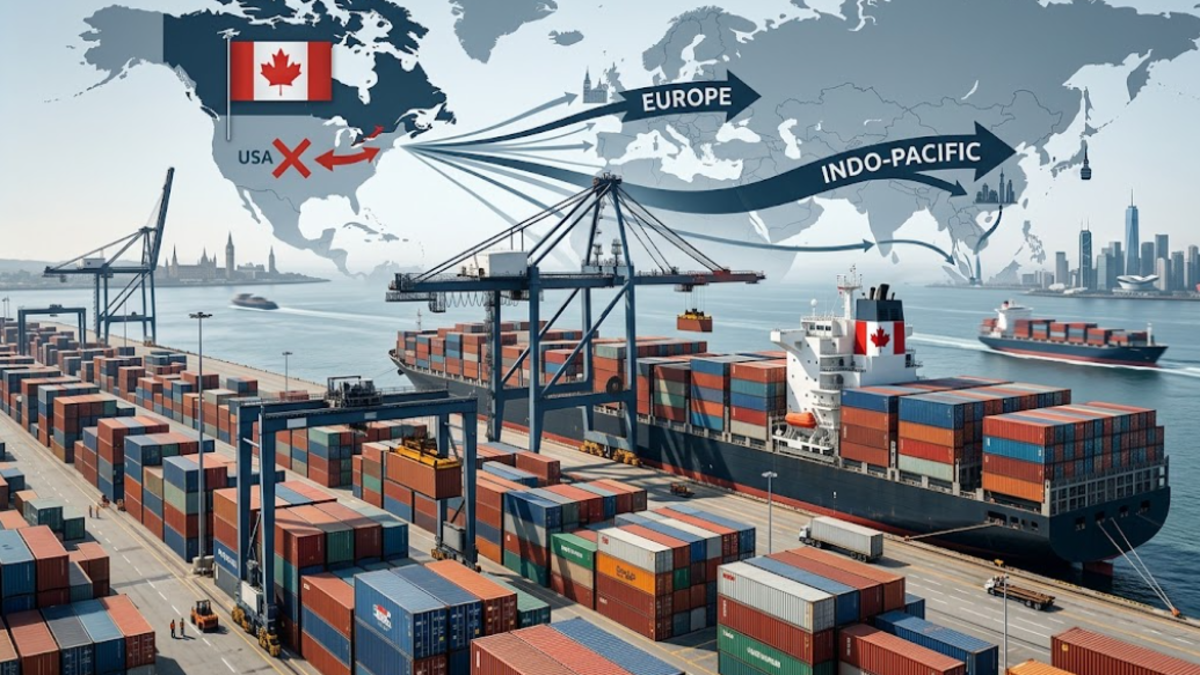
OTTAWA – Canadist: Canada is looking for new trading partners as its trade dispute with the United States intensifies, pushing Prime Minister Mark Carney’s government to accelerate efforts to deepen economic ties with Europe, Asia and other international markets. With Washington imposing new tariffs and trade negotiations suspended, Ottawa is facing a question that could reshape Canada’s economic strategy for years to come: how quickly can the country reduce its reliance on the U.S. market without damaging businesses that remain deeply tied to it?

Canada is looking for new trading partners after talks with Washington collapse
Canada’s search for new markets has moved from a long-term policy objective to an immediate economic priority following the latest breakdown in negotiations with the United States.
Prime Minister Mark Carney’s government suspended trade negotiations after Washington introduced new terms that Ottawa said were not in Canada’s national interest. The dispute escalated further when the United States imposed a 50 per cent tariff on $27.6 billion worth of Canadian goods.
Ottawa responded by announcing matching counter-tariffs on American products. The Canadian measures are scheduled to take effect on September 8 and will target goods in sectors including steel, dairy, appliances, agricultural equipment, pulp and paper, and electronics. The government says the rates will match the U.S. measures on affected products.

The confrontation has created a difficult economic calculation for Canada. The United States remains by far its largest trading partner, and Canadian companies have spent decades building supply chains, distribution networks and commercial relationships across the border.
At the same time, Ottawa increasingly sees excessive dependence on one market as an economic vulnerability.
Carney has argued that Canada cannot simply rely on geography and historical relationships to guarantee prosperity. His government has therefore placed trade diversification at the centre of its economic agenda, with a target of doubling exports to markets outside the United States over the next decade.
That objective is now being tested by events rather than policy speeches.
The latest deterioration in relations with Washington has made new export destinations more valuable, but building them will take time. Canadian producers cannot instantly replace American customers, particularly in sectors dependent on integrated North American production.
Economists have repeatedly warned that diversification does not mean abandoning the U.S. market. Instead, it means ensuring that Canada has credible alternatives when political or commercial tensions disrupt access to its most important customer.
Reuters reported this week that about 70 per cent of Canadian exports still go to the United States. The same report noted that the latest U.S. tariffs could eventually put as many as 90,000 Canadian jobs at risk, adding pressure on Ottawa to protect existing trade while developing new markets.
The challenge is therefore larger than negotiating individual trade agreements. Canada must expand transportation infrastructure, help companies reach consumers abroad and develop commercial relationships strong enough to support sustained export growth.
Europe becomes the centrepiece of Canada’s diversification strategy
Among Canada’s potential alternatives, Europe has emerged as one of the most important.
Carney is expected to address the European Parliament in September, following his attendance as a guest of honour at European Commission President Ursula von der Leyen’s annual State of the Union address on September 16. The Canadian prime minister is scheduled to speak to European lawmakers the following day.
The visit carries economic and political significance.
It comes immediately after the collapse of the latest Canada-U.S. trade talks and at a moment when Ottawa is seeking stronger partnerships with countries that share Canada’s interest in open trade and rules-based international relations.
European Parliament President Roberta Metsola has described Carney’s visit as an opportunity to deepen relations between Canada and the European Union. For Ottawa, the trip offers a highly visible platform to promote Canada as an energy, resources, technology and investment partner.
The relationship already has a substantial commercial foundation.
Canada’s government says the European Union was its second-largest global trading partner for goods and services, after the United States. Combined Canada-EU trade in goods and services reached $178.6 billion in the latest full year covered by government figures.
The Comprehensive Economic and Trade Agreement, known as CETA, has also been provisionally applied for almost a decade. The agreement reduces or eliminates barriers across much of bilateral trade and provides Canadian exporters with established access to the European market.
Recent figures suggest that this relationship still has room to grow.
Canadian exports to the European Union increased sharply, with goods exports rising by more than 23 per cent in the latest annual data. Stronger shipments included mineral fuels and oils, aluminum and oilseeds, while major gains were recorded in the Netherlands, Germany, France, Italy and Spain.
The broader value of Europe extends beyond merchandise exports.
Canada is also strengthening cooperation with European countries in defence, energy, technology and investment. Ottawa became the first non-European participant in the European Union’s Security Action for Europe initiative, while Canada and the EU have continued developing closer security and defence ties.
That combination makes Europe particularly attractive as Canada seeks to diversify without simply replacing one dependency with another.
Yet European markets will not provide an effortless solution.
European economies already possess highly developed manufacturing and agricultural industries, while Canada’s geographic distance creates higher transportation costs than trade with the United States. Businesses must therefore identify products and services where Canadian competitiveness gives them a meaningful advantage.
Energy, critical minerals, agricultural products, technology and specialized services are among the areas where opportunities may be strongest.
Asia and the Indo-Pacific offer another route for Canadian exporters
Canada’s diversification strategy is not limited to Europe.
The Indo-Pacific has become another major focus for Ottawa, particularly because of its growing demand for energy, natural resources, food and advanced services.
Official trade data show that Canadian exports of goods and services to the Indo-Pacific increased by 4.6 per cent in the latest annual figures, equivalent to approximately $5 billion. Crude oil shipments played a major role in that increase, helped by additional transportation capacity in Western Canada.
The expansion of the Trans Mountain pipeline has been particularly important.
For the first full calendar year after the expansion entered operation, Canadian crude gained greater access to overseas markets. China received the largest share of that additional export capacity, while Hong Kong, Singapore and South Korea also received Canadian shipments.
The significance goes beyond energy.
The Indo-Pacific contains some of the world’s largest and fastest-growing economies, offering opportunities for Canadian agricultural exporters, miners, energy companies, financial institutions and technology firms.
Ottawa has been placing greater emphasis on countries such as Japan, South Korea, India and members of the Association of Southeast Asian Nations.
The federal government’s trade plans specifically call for deeper natural-resource relationships across the Indo-Pacific and continued work on free-trade agreements, investment agreements and other arrangements designed to support export growth.
China presents a particularly complicated case.
It is a major potential market for Canadian commodities, but political tensions and previous trade restrictions have shown the risks associated with relying heavily on any single destination. Canada’s diversification strategy therefore seeks broader access across the region rather than a simple shift from American dependence to dependence on another major power.
India is another market attracting increased attention as Ottawa works to strengthen economic and strategic ties.
For Canadian exporters, the appeal is clear: a large and expanding consumer market, growing energy needs and opportunities in critical minerals, agriculture and advanced services.
But commercial expansion depends on more than political agreements.
Companies need distribution partners, financing, transportation routes and an understanding of local regulations. Canadian governments can help establish those conditions, but businesses ultimately determine whether trade relationships become sustainable sources of revenue.
Infrastructure could determine whether Canada’s strategy succeeds
One of the biggest obstacles to Canada’s diversification ambitions is physical infrastructure.
Canada has enormous reserves of energy, minerals, agricultural products and other resources, but exporting those goods to distant markets requires reliable rail networks, ports, pipelines and terminals.
For decades, Canada’s economic geography encouraged businesses to move products south rather than west to the Pacific or east toward Atlantic ports. That model worked because the U.S. market was close, large and deeply integrated with Canadian production.
The current trade dispute has exposed the weakness of that concentration.
The federal government’s economic plans now place greater emphasis on infrastructure that can move Canadian goods to global markets. The strategy includes investments intended to improve the reliability and competitiveness of Canada’s export corridors while reducing internal barriers between provinces.
That transition will not happen overnight.
A new pipeline, terminal, railway connection or mine can take years to plan, finance, approve and build. Exporters also need time to establish relationships with foreign buyers.
This is why the diversification debate is fundamentally about Canada’s long-term economic capacity, not simply the current tariff dispute.
There is also a major difference between increasing exports and genuinely diversifying trade.
Government analysis shows that non-U.S. exports rose strongly, but part of that increase reflected exceptionally high gold prices. When gold is excluded, the growth in non-U.S. exports is considerably weaker. Official analysis has warned that gold alone does not represent durable diversification.
That distinction matters.
A sustainable strategy requires Canadian companies to sell a broader range of products and services to a broader range of countries. Otherwise, a temporary increase in commodity prices can create the appearance of diversification without fundamentally changing the country’s economic exposure.
Canada is looking for new trading partners, but the United States will remain crucial
Even as Ottawa looks overseas, the U.S. market remains central to Canada’s economy.
The two countries share a long border, tightly connected manufacturing networks and decades of commercial integration. Industries such as automobiles, steel, lumber and agriculture depend heavily on cross-border supply chains.
This makes diversification much more complicated than simply finding new customers abroad.
A Canadian manufacturer that sells components to U.S. factories may not be able to move production to Asia or Europe without changing its entire business model. Agricultural producers also face different standards, transportation costs and consumer preferences in overseas markets.
The same challenge applies to smaller companies.
Large exporters may have the resources to establish international offices and negotiate with foreign distributors. Small and medium-sized businesses often lack the capital and personnel required to navigate new markets.
Ottawa has therefore linked diversification with expanded support for smaller exporters, including financing, insurance and advisory assistance through government-backed programs. The objective is to ensure that trade opportunities are accessible beyond Canada’s largest corporations.
The political stakes are also rising.
Reuters reported that Carney continues to enjoy significant domestic support for his approach to Washington, although economists and political analysts have warned that public patience could weaken if tariffs begin producing more visible unemployment, factory closures and higher prices.
That creates pressure for the government to demonstrate that diversification can produce tangible economic benefits.
The European Parliament visit is therefore more than a diplomatic appearance.
It is part of a wider effort to convince potential partners that Canada is prepared to become a more reliable international supplier and investor, while also reassuring Canadian businesses that alternatives to the American market are being developed.
What comes next for Canada’s trade strategy
The immediate priority for Ottawa is managing the latest tariff confrontation without allowing the wider Canadian economy to suffer unnecessary damage.
The government has already introduced targeted measures and financial support for affected workers and businesses, while maintaining its broader strategy of expanding international trade.
At the same time, Canada must continue pursuing opportunities beyond North America.
Europe offers an established institutional framework through CETA and rapidly expanding commercial ties. The Indo-Pacific offers scale, energy demand and opportunities for resources and services. Other markets could become increasingly important as Canadian exporters gain experience operating beyond the U.S. border.
The underlying objective is not to end trade with the United States.
Instead, Ottawa wants Canadian businesses to have more choices.
A country that sends most of its exports to one market has limited room to absorb a sudden tariff increase or political dispute. A country with multiple strong commercial relationships can redirect at least part of its trade when conditions change.
Canada’s trade figures already show that this transition has begun. Non-U.S. destinations accounted for 32.8 per cent of Canadian exports in the latest annual data, the highest share in more than four decades. Exports to non-U.S. markets increased by 11.1 per cent, while exports to the United States fell by 3.7 per cent.
Those figures do not mean that Canada has solved its dependence on the U.S. economy.
They do, however, show that the country’s trade map is beginning to shift.
The test now is whether Ottawa can turn that shift into a durable structural change. That will require infrastructure, investment, stronger diplomatic relationships and companies willing to compete in unfamiliar markets.
Carney’s planned European Parliament address will provide a highly visible moment for the government to make that case.
The message from Ottawa is increasingly clear: Canada intends to remain a major trading nation, but it no longer wants its prosperity to depend so heavily on a single neighbour.
FAQ
Why is Canada looking for new trading partners?
Canada is seeking to reduce its economic vulnerability to disruptions in the U.S. market and increase exports to Europe, the Indo-Pacific and other international destinations.
Why is Europe important to Canada?
The European Union is Canada’s second-largest trading partner for goods and services and already has a major trade framework with Canada through CETA. Bilateral trade reached $178.6 billion in the latest annual figures.
When will Mark Carney address the European Parliament?
Carney is expected to address European lawmakers on September 17, following his attendance at the European Union’s State of the Union address on September 16.
Can Canada replace the U.S. as its main trading market?
Replacing the United States entirely is unlikely in the near term because the two economies are deeply integrated. Canada’s strategy is instead focused on expanding alternative markets so Canadian exporters have greater flexibility and fewer risks from dependence on one destination.
Contact: info@canadaalyom.com