
VANCOUVER – Candist: Police arrest man accused of vandalizing memorial rocks in a B.C. park

Police arrest man accused of vandalizing memorial rocks in a B.C. park, after investigators linked a man to graffiti spray-painted on boulders at Golden Ears Provincial Park following the drowning death of a man in the area. The suspect turned himself in to police and was later released with a promise to appear in court, while investigators continue gathering evidence. What does the arrest mean for a case that has attracted significant attention from park users and the wider community?
Police arrest man accused of vandalizing memorial rocks in a B.C. park
Maple Ridge RCMP confirmed that an arrest has been made in connection with a reported mischief incident at Golden Ears Provincial Park in British Columbia.
Police said the alleged suspect turned himself in last week. He has since been released on a promise to appear in court.

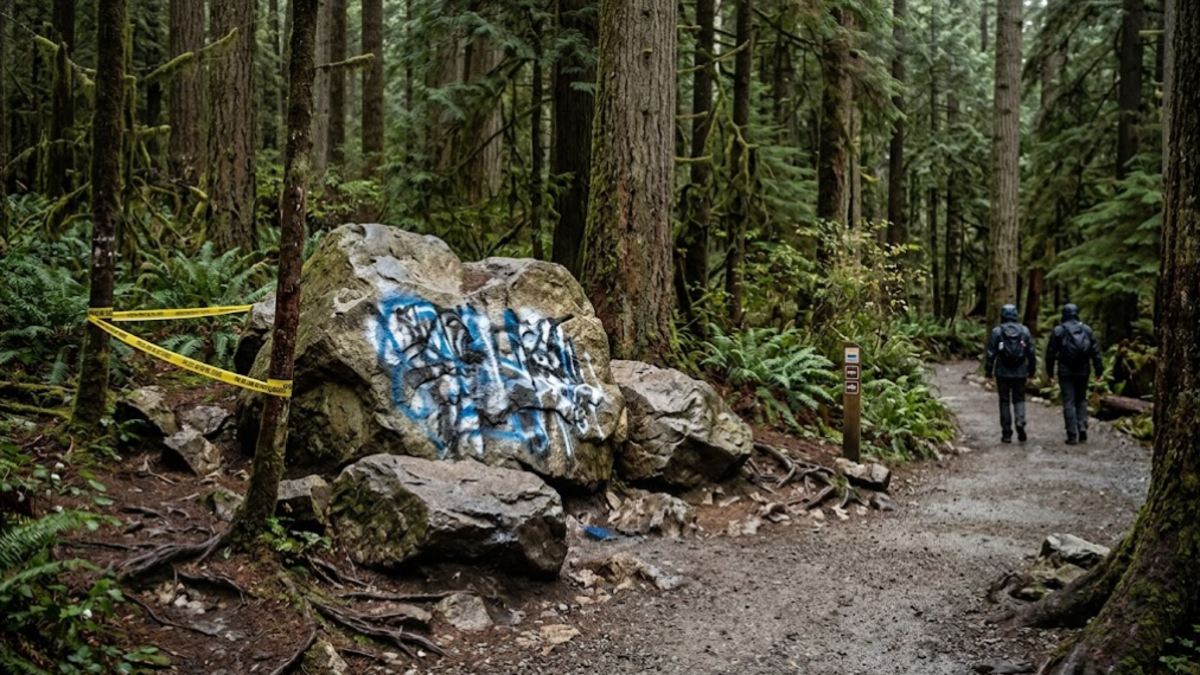
The arrest follows an investigation into graffiti that appeared on boulders near the Lower Falls trail in the park. Police initially began looking into the incident after receiving a report from a member of the public.
The case has drawn attention because the graffiti appeared to have been intended as a memorial for a man who drowned in the area.
Despite that apparent purpose, police have stressed that vandalism in a protected area remains a criminal offence.
The Maple Ridge RCMP said investigators are still gathering evidence, seeking additional information and preparing reports for possible criminal proceedings. The force also urged the public not to reach conclusions about the case before investigators have examined all the facts.
The latest police update represents a significant development in an investigation that began after photographs and videos of the graffiti circulated online.
Police have been working with BC Parks throughout the investigation. The provincial agency is conducting a separate investigation under the BC Parks Act.
What happened at Golden Ears Provincial Park?
The incident took place near Gold Creek in Golden Ears Provincial Park, an extensive protected area north of Maple Ridge.
Maple Ridge RCMP said frontline officers received a report from the public after an unknown male was reported to have spray-painted graffiti near the Lower Falls trail.
The graffiti appeared shortly after a drowning death in the same general area.
Earlier reports indicated that a message had been painted on the rocks and that video circulating on social media showed the date associated with the message. The timing led authorities and members of the public to view the graffiti as an apparent memorial tribute.
Police acknowledged that interpretation when they first announced the investigation.
However, officers made clear that the apparent intention behind the graffiti did not change its legal status. Painting or otherwise damaging natural features inside a protected area can harm the environment and affect other visitors’ experience of the park.
The police response also reflected the sensitive circumstances surrounding the drowning.
Officers expressed sympathy for the family and friends of the man who died and encouraged people who want to pay their respects to use appropriate and legal methods.
The distinction is important. Authorities have not suggested that the memorial intention itself was criminal. Rather, the concern centres on the act of applying graffiti to rocks in a protected natural area.
That distinction remains central as the investigation moves forward.
Why the graffiti became a public issue
Golden Ears Provincial Park is one of British Columbia’s largest and most popular parks. It attracts visitors for hiking, camping, swimming, canoeing and other outdoor activities.
Because the affected rocks are part of a natural environment, the graffiti raised concerns beyond ordinary property damage.
BC Parks said vandalism in protected areas can negatively affect the natural environment and the visitor experience. The agency also recognized that the drowning had affected the victim’s family, friends and the wider community.
The incident therefore generated a difficult public discussion: how should people commemorate someone who has died in a natural area without damaging the environment?
Some visitors expressed sympathy for those affected by the drowning while objecting to the method used to create the memorial.
That tension has been reflected in the public reaction to the case. The apparent memorial purpose did not eliminate concerns about vandalism, cleanup and the protection of the park.
Authorities have also emphasized that the Gold Creek area presents serious safety hazards.
The area near the Lower Falls has been associated with dangerous water conditions. Warning signs, fences and closures have been used in the area to discourage visitors from entering hazardous sections and to reduce the risk of further accidents.
That safety issue adds another dimension to the investigation.
The graffiti was not simply found in an ordinary roadside location. It appeared in an area where authorities already warn visitors about potentially life-threatening conditions.
BC Parks faces a difficult cleanup decision
The graffiti has also created a practical problem for BC Parks.
Removing paint from natural rock is not necessarily straightforward, particularly in a difficult-to-access area where water conditions can change rapidly.
BC Parks has been assessing whether the graffiti can be safely removed. Officials have indicated that any attempt to clean the affected rocks must take account of the risks faced by employees or contractors entering the area.
The agency has also considered whether seasonal high-water flows could eventually remove the graffiti naturally.
That means authorities must weigh two competing concerns: removing the unwanted markings and avoiding unnecessary risks to people responsible for the cleanup.
The condition of the site and the safety hazards around Gold Creek make the decision more complicated than simply sending a crew to remove the paint.
The issue also illustrates why officials treat vandalism in protected areas differently from graffiti on an ordinary urban surface.
A cleanup operation in a remote or hazardous natural setting can require additional planning and safety measures.
For now, the investigation and the assessment of possible removal measures are proceeding separately.
Police arrest man accused of vandalizing memorial rocks in a B.C. park
The arrest marks the latest stage in the police investigation, but it does not mean the case has been resolved.
Maple Ridge RCMP said the alleged suspect turned himself in to police and was released on a promise to appear in court.
Police did not identify the man in their public update.
They also did not announce a final court outcome or provide details about potential charges beyond describing the incident as a reported mischief case.
Investigators continue to collect evidence and obtain additional information before preparing reports for possible criminal proceedings.
The police wording is significant because an arrest or release on a promise to appear does not establish guilt.
The investigation remains active, and the suspect is entitled to the presumption of innocence unless a court determines otherwise.
Police have specifically asked the public to avoid drawing conclusions while investigators examine the evidence.
That caution comes as interest in the incident has grown online.
Photographs and videos connected with the graffiti circulated on social media, bringing the incident to a wider audience beyond people who had visited the park or learned about it through local reporting.
Online attention can help investigators identify witnesses, but it can also create challenges when allegations spread before authorities have completed their work.
The RCMP has therefore emphasized the need to allow the investigation and court process to proceed on the evidence.
A case involving grief, public space and the law
The Golden Ears incident has highlighted a broader issue surrounding memorials in public and protected spaces.
People often look for immediate ways to remember someone after a sudden death. In this case, the apparent memorial message appeared after a drowning that had affected family members, friends and others in the community.
Authorities have not dismissed that emotional context.
Instead, police and BC Parks have separated the intention to remember someone from the method used to do so.
That approach allows officials to acknowledge the loss while maintaining rules designed to protect public spaces.
Natural areas such as Golden Ears Provincial Park are managed for conservation and recreation. Visitors are expected to leave natural features undisturbed and follow park rules.
When graffiti is added to rocks or other natural features, officials say it can diminish the experience of other visitors and create cleanup costs.
The incident has therefore become more than an isolated act of graffiti. It has prompted questions about how communities respond to tragedy and how individuals can express grief without damaging shared spaces.
For authorities, the immediate priority remains the investigation and the safety of anyone working near the affected area.
Safety concerns at Gold Creek remain important
The location of the graffiti is also relevant because Gold Creek contains areas with significant water hazards.
BC Parks has warned visitors about the dangers around the Lower Falls area. Strong currents and changing water conditions can pose serious risks, particularly to people who move beyond designated or safe areas.
Officials have installed fences and warning signs in locations where access presents safety concerns.
The warnings are particularly important following a drowning, when visitors may be drawn to the location because of the incident or because they want to pay their respects.
Police have encouraged members of the public to follow warning signs and take appropriate precautions when visiting outdoor recreation areas.
The advice applies regardless of the graffiti investigation.
For park users, the case serves as a reminder that natural beauty can coexist with significant hazards. A popular destination can still contain fast-moving water, steep terrain and areas where emergency assistance may be difficult.
Authorities therefore want visitors to respect both environmental rules and safety restrictions.
What happens next in the investigation?
The Maple Ridge RCMP investigation remains ongoing.
Police are continuing to gather evidence and obtain information before preparing reports for potential criminal proceedings.
At the same time, BC Parks is conducting its own investigation under the provincial Parks Act.
The suspect’s release on a promise to appear means the legal process can continue without the man being held in custody.
The police have not provided a detailed timetable for the next stage of the case.
They have also not disclosed the identity of the suspect or released a final assessment of the damage.
Those details could emerge as investigators complete their work and the matter moves through the court system.
Police have asked anyone with information about the incident, including people who witnessed what happened and have not already spoken with investigators, to contact the Maple Ridge RCMP.
The force has previously provided a non-emergency telephone number for information connected with the investigation.
The public interest in the case is understandable, but investigators have urged people to allow the evidence-gathering process to take its course.
That message is especially relevant because the incident has generated substantial discussion online.
The latest development leaves key questions unanswered
The arrest provides a major development in the investigation, but several questions remain unanswered.
Authorities have not publicly identified the suspect. They have not announced a court finding, and the investigation has not concluded.
The circumstances surrounding the creation of the graffiti will form part of the evidence considered by investigators and, if charges proceed, potentially by the courts.
The response from BC Parks will also depend on what officials determine can safely be done at the site.
For now, the rocks remain at the centre of a case involving an apparent memorial, environmental protection and an alleged criminal offence.
The incident has prompted sympathy for the person who died and concern about the impact of vandalism on a protected natural area.
It has also reinforced the importance of following park rules, particularly around dangerous waterways.
As the police investigation continues, the central question is no longer simply who created the graffiti, but how authorities will balance accountability, public safety, environmental protection and the community’s desire to remember someone who died in the park.
Frequently Asked Questions
What happened at Golden Ears Provincial Park?
Graffiti was spray-painted on boulders near the Lower Falls area after a man drowned nearby. Police investigated the incident as reported mischief.
Has anyone been arrested?
Yes. Police said the alleged suspect turned himself in and was released on a promise to appear in court.
Is the investigation finished?
No. Maple Ridge RCMP said investigators are still gathering evidence and preparing reports for possible criminal proceedings.
Will the graffiti be removed?
BC Parks has been assessing safe removal options. Officials have also considered whether seasonal high-water flows could eventually remove the graffiti.
Contact: info@canadaalyom.com