

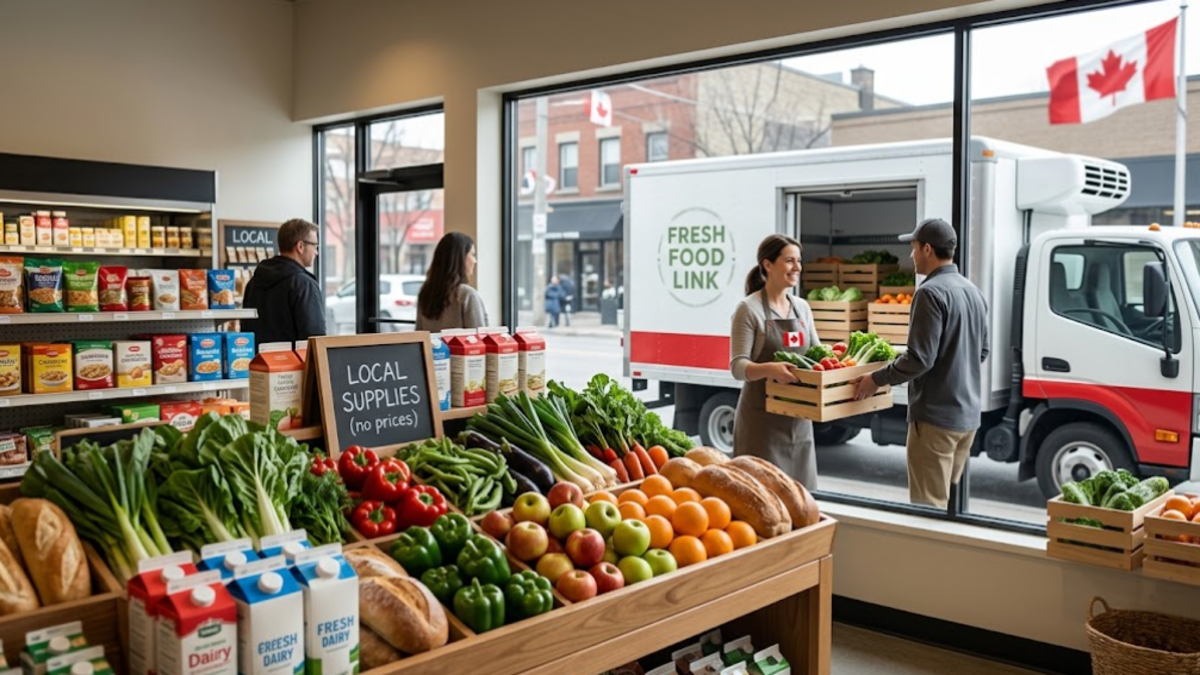
Canada’s $1 Billion Food-Link Fund: Could It Actually Make Groceries Cheaper?
Canada is investing $1 billion over 10 years in a new Food-Link Fund designed to improve food distribution, strengthen competition among grocery retailers and reduce unnecessary costs across the food supply chain. Announced as part of the federal government’s National Food Security Strategy, the initiative aims to help independent grocers access food more competitively and connect Canadian farmers with more buyers.

The goal is ambitious: make it easier for food to reach stores and consumers without relying so heavily on distribution networks controlled by major grocery chains. But while the investment could address some structural problems in Canada’s food market, it does not guarantee lower grocery bills for households.
The real test will be whether better infrastructure and increased competition translate into savings that shoppers can see at the checkout.
What Is Canada’s $1 Billion Food-Link Fund?
The federal government announced the Food-Link Fund on October 5, 2026, as part of its broader National Food Security Strategy, unveiled in June.

The fund will provide $1 billion over 10 years, covering the 2026–27 through 2036–37 fiscal years. Its central objective is to improve how food moves from farms and processors to wholesalers, retailers and consumers.
According to Agriculture and Agri-Food Canada, weaknesses in the country’s food distribution system include limited wholesale alternatives, gaps in refrigerated storage and transportation, and a lack of regional distributors. These problems can increase operating costs, contribute to food spoilage and limit the ability of independent retailers to compete.
The initiative is intended to address those issues through two complementary programs:
- Food Terminal Fund: Supports the development and expansion of wholesale food terminals, where farmers, food businesses and retailers can buy and sell products.
- Food Hub Program: Supports regional food hubs that connect producers with storage, processing, distribution and potential buyers.
Rather than giving households direct grocery rebates, the government is investing in the infrastructure and commercial networks that determine how food reaches the market.
That distinction matters. The fund is designed to influence the cost of supplying groceries, not to set retail prices or guarantee a particular reduction in food bills.
How the Food-Link Fund Could Lower Grocery Prices
The fund’s potential impact comes down to three changes: giving smaller retailers better buying options, reducing distribution costs and making it easier for local producers to reach customers.
1. More competition for major grocery chains
One of the fund’s main goals is to reduce independent grocers’ reliance on wholesale and distribution systems operated by their larger competitors.
This is a significant issue in a market where a small number of retailers account for most grocery sales. Agriculture and Agri-Food Canada’s strategy cites 2023 market data showing that Loblaw, Sobeys, Metro, Walmart and Costco together accounted for about 75% of Canadian grocery sales.
An independent supermarket may have customers willing to shop there, but it still needs reliable access to competitively priced products. If its purchasing and distribution options are limited, competing with a national chain becomes more difficult.
Wholesale food terminals could give independent retailers another way to source products. By purchasing through alternative channels, smaller stores may be able to negotiate better terms, access a wider range of suppliers and reduce their dependence on established retail networks.
If those savings lead to lower shelf prices, consumers could benefit even if they continue shopping at the same stores.
However, the effect will depend on how many retailers use the new infrastructure, whether the alternatives offer genuinely better prices and how much of any savings businesses pass on to customers.
2. Lower transportation, storage and food-waste costs
Moving food across Canada can be expensive. Fuel, labour, vehicle maintenance, refrigeration and storage all contribute to the final cost of groceries.
Regional food hubs are intended to help producers and businesses share access to facilities and logistics services. These hubs could bring together activities such as cold storage, processing, packaging and distribution, reducing the need for businesses to arrange every stage independently.
Consider a farmer supplying fresh vegetables to several small grocery stores. Without nearby storage and efficient distribution, the farmer may face higher transport costs, limited delivery options or losses when produce spoils before reaching customers.
A regional hub could consolidate shipments, provide refrigerated storage and connect the farmer with more buyers. The stores might then receive fresher products at a lower delivered cost.
The same principle applies to meat, dairy products and other perishable foods, although the infrastructure and handling requirements differ by product.
The government’s strategy identifies transportation as accounting for an estimated 7% of consumer spending on domestically produced food, excluding restaurants, based on preliminary federal estimates using 2022 supply-and-use tables.
That figure does not mean the fund can eliminate 7% of grocery costs. It illustrates why distribution efficiency matters, while also showing that transportation is only one part of a much larger cost structure.
3. Better access to Canadian-grown food
The fund also aims to connect farmers and food processors with more buyers, particularly in regions where distribution networks are limited.
For producers, additional storage, processing and transportation capacity could make it easier to sell food beyond their immediate area. For retailers, more direct access to regional suppliers could create alternatives to existing wholesale arrangements.
This may be especially valuable for rural, remote and northern communities, where long distances and limited distribution options can make fresh food more expensive to deliver.
Still, buying Canadian food does not automatically mean buying cheaper food. Domestic production depends on weather, labour, energy, equipment and other inputs. Imported products can sometimes be less expensive, depending on the season and market conditions.
The strongest potential benefit is therefore not simply replacing imports with Canadian products. It is building a more flexible system that gives businesses more ways to source food and respond when one supply route becomes expensive or unreliable.
Where Will the $1 Billion Go?
The Food-Link Fund is divided between two programs that target different parts of the supply chain.
| Program | Main purpose | Potential benefit |
|---|---|---|
| Food Terminal Fund | Develop and expand wholesale food terminals | More buying and selling options for farmers, wholesalers and independent retailers |
| Food Hub Program | Expand regional food storage, processing and distribution | More efficient deliveries, stronger regional supply chains and improved access to local food |
The Food Terminal Fund is administered by Housing, Infrastructure and Communities Canada, while Agriculture and Agri-Food Canada administers the Food Hub Program.
The federal government says eligible projects may include cold-storage facilities, transportation capacity, food processing and packaging equipment, digital systems and facility upgrades.
The emphasis is on infrastructure and distribution capacity rather than direct payments to grocery shoppers.
That makes the fund a long-term supply-side investment. Its success will depend on whether the funded projects fill real gaps in the food system and remain useful after construction is complete.
Could Shoppers See Cheaper Groceries Soon?
Probably not as an immediate, across-the-board result of the fund alone.
The government announced the initiative in October, but infrastructure projects take time to approve, build and put into operation. New storage facilities, terminals and regional distribution networks will not transform grocery supply chains overnight.
The application process opened on October 14, 2026, with an initial intake scheduled to close on December 11, 2026, at 11:59 p.m. Pacific Time. Applicants must first submit an expression of interest, and projects that align with the program’s objectives may then be invited to submit full proposals.
That is an early step toward selecting projects, not evidence that the infrastructure is already operating or that grocery prices have fallen because of it.
There is also a difference between slowing price increases and reducing prices outright.
If a new distribution network helps a retailer avoid higher costs, that could prevent some future price increases without making existing shelf prices cheaper. A store might also use the savings to improve its margins, invest in its business or offer discounts on selected products rather than reduce prices across its entire range.
For households, the meaningful outcome will be whether everyday essentials become more affordable relative to what they would otherwise have cost.
The fund is also only one part of the government’s wider National Food Security Strategy, which includes other measures intended to increase domestic production, strengthen competition and address problems across the food supply chain.
What Could Stop the Fund From Delivering Savings?
The investment has a plausible economic rationale, but several factors could limit its impact.
Savings may not reach consumers
Lower wholesale or transportation costs do not automatically translate into lower retail prices. Retailers still make pricing decisions, and the amount passed on to shoppers may vary by product, location and competitive pressure.
Infrastructure is expensive to build and operate
New terminals and food hubs require land, equipment, staffing, energy and ongoing maintenance. Projects must generate enough operational savings to justify those costs over time.
Public funding can help cover the initial investment, but it does not remove every expense associated with running the facilities.
Food prices depend on factors beyond distribution
The federal government’s own strategy identifies international trade, climate conditions, fuel, fertilizer and production costs as important influences on food affordability.
A more efficient Canadian distribution network cannot prevent every price increase caused by drought, a global supply disruption or a rise in imported input costs.
New facilities must attract enough users
A food terminal is most useful when enough farmers, wholesalers and retailers use it regularly. A regional hub also needs reliable supply, sufficient demand and practical transport links.
If facilities are poorly located or fail to attract enough business, the expected savings may not materialize.
For these reasons, the amount spent is not a sufficient measure of success. What matters is whether the projects produce measurable improvements in distribution costs, competition and the prices consumers pay.
What Should Canadians Watch For?
The fund’s impact should be assessed through results, not just announcements. Several indicators will help show whether the investment is delivering on its promise:
- Lower wholesale costs: Are independent retailers obtaining food at more competitive prices?
- Greater retail competition: Are more independent stores able to compete effectively with established chains?
- Reduced food waste: Are better storage and distribution facilities helping prevent spoilage?
- Improved regional access: Are rural, remote and northern communities gaining more reliable access to fresh food?
- Lower consumer prices: Are grocery prices falling, or rising more slowly, in ways that can reasonably be linked to improved distribution and competition?
It will also be important to distinguish between money committed to projects, infrastructure actually completed and savings that reach consumers. Those are three different stages, and success at one does not automatically establish success at the next.
Our Assessment: A Promising Investment, but Not a Grocery Price Guarantee
Canada’s Food-Link Fund targets a genuine weakness in the food system: businesses cannot compete effectively if they have limited ways to source, store and distribute food.
Creating alternative wholesale networks and improving regional infrastructure could reduce costs while giving independent grocers more freedom to choose their suppliers. That is a credible way to improve competition over time.
But the $1 billion headline should not be mistaken for a promise of immediate savings at the checkout. The fund will operate over a decade, and the size of any consumer benefit will depend on project selection, implementation, retailer participation and whether cost reductions are passed along to shoppers.
The government should therefore be judged on measurable outcomes: more competitive supply arrangements, lower distribution costs, better access to food and, ultimately, more affordable grocery baskets.
The bottom line: The Food-Link Fund could help make groceries cheaper by addressing some of the costs and competitive barriers behind retail prices. Whether it succeeds will depend on what gets built, how effectively businesses use it and whether Canadians see the benefits in their everyday shopping.
Frequently Asked Questions
Will Canada’s $1 billion Food-Link Fund give money directly to consumers?
No. The fund supports food distribution infrastructure, including wholesale food terminals and regional food hubs. It is not a direct grocery rebate or a payment program for households.
When will the Food-Link Fund start?
The fund was announced on October 5, 2026. Its initial application intake opened on October 14 and is scheduled to close on December 11, 2026, at 11:59 p.m. Pacific Time. Projects must go through the application and assessment process before funding can translate into operational infrastructure.
Which businesses could benefit from the fund?
Eligible projects under the two programs may involve food producers, processors, distributors and other organizations developing or expanding qualifying infrastructure. Eligibility requirements differ by program, so prospective applicants should consult the official program guidance.
Will grocery prices fall across Canada?
That is not guaranteed. Better distribution and more competition could reduce some costs, but prices will continue to be affected by production expenses, fuel, weather, international markets and retailers’ pricing decisions. Any reduction is likely to vary by product and region.
How can Canadians follow the fund’s progress?
The best starting point is the official Food-Link Fund program page, which provides program details and application information. Future assessments should look for evidence of completed projects, improved distribution efficiency and measurable consumer benefits.
Official Sources
1. Agriculture and Agri-Food Canada — Food-Link Fund https://agriculture.canada.ca/en/programs/food-link-fund
2. Agriculture and Agri-Food Canada — The Government of Canada Invests in Stronger, More Resilient and Affordable Food Distribution Systems https://www.canada.ca/en/agriculture-agri-food/news/2026/10/the-government-of-canada-invests-in-stronger-more-resilient-and-affordable-food-distribution-systems0.html
3. Agriculture and Agri-Food Canada — National Food Security Strategy https://agriculture.canada.ca/en/department/initiatives/national-food-security-strategy
4. Prime Minister of Canada — Prime Minister Carney Launches National Food Security Strategy to Build a More Affordable and Resilient Food System in Canada https://www.pm.gc.ca/en/news/news-releases/2026/06/11/prime-minister-carney-launches-national-food-security-strategy
Contact: info@canadaalyom.com