
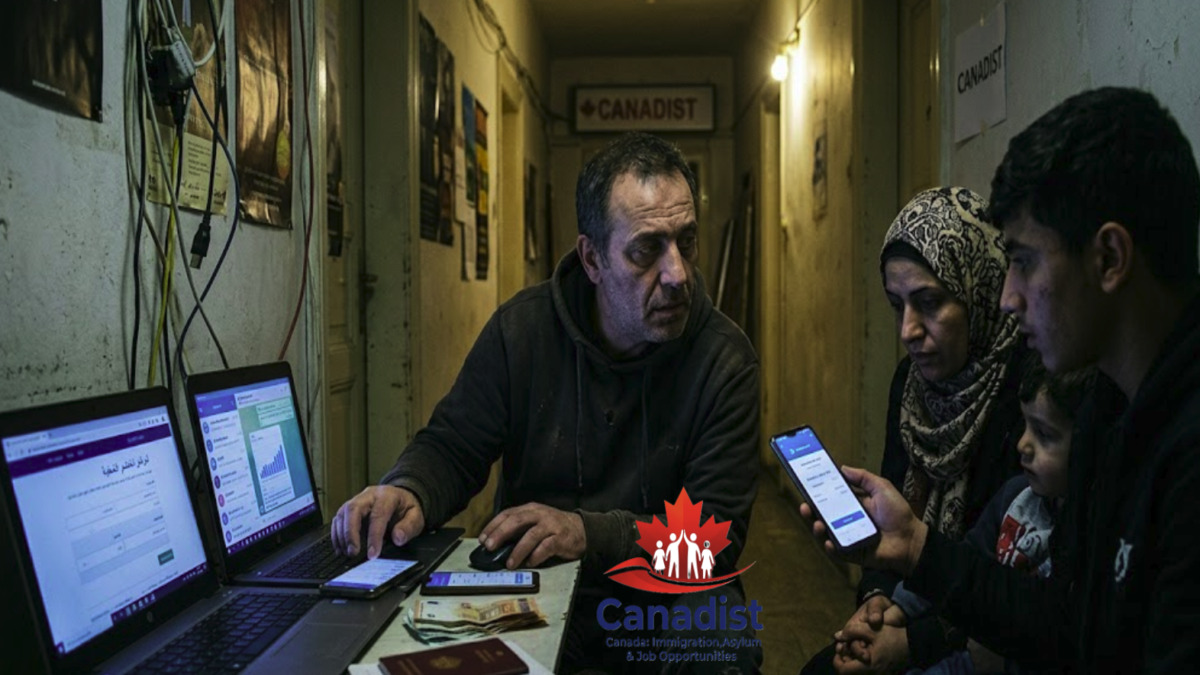
Ottawa – Canadist: The digital asylum mafia has turned human desperation into a high-tech underground economy, operating seamlessly across closed Telegram channels and encrypted WhatsApp groups.

Every day, thousands of vulnerable migrants fleeing war, political persecution, or economic collapse log onto official government portals in Western nations, hoping to secure a free, legal appointment to lodge their refugee claims. Instead, they are met with crashing servers, endless loops, and a chilling reality: there are no appointments left. Within minutes, however, those exact same appointments reappear on social media, wearing a hefty price tag. How did a fundamental human right guaranteed by international law morph into a highly lucrative, lawless online marketplace?
What is the digital asylum mafia?
The digital asylum mafia refers to an organized, highly sophisticated network of cyber-criminals, corrupt intermediaries, unlicensed “consultants,” and tech-savvy opportunists who exploit the administrative bottlenecks of immigration systems. These syndicates treat international protection protocols not as humanitarian lifelines, but as commodities to be hoarded, manipulated, and auctioned to the highest bidder.
By weaponizing technology against outdated governmental infrastructure, these networks have effectively privatized the first step of the immigration process. They control the flow of entry, dictating who gets to speak with an immigration officer and who remains undocumented and vulnerable to deportation. This is no longer a matter of a few street-level fixers making a quick buck; it is a globalized, multi-million-dollar digital black market.

How does the underground asylum market work?
The operation functions like a dark-web version of a premium concierge service, explicitly targeting migrants who do not speak the local language or understand complex legal bureaucracies. The machinery relies on speed, deception, and a total bypass of official security measures.
[Official Government Portal]
       │
       ▼ (Automated Bots intercept all free appointments within milliseconds)
[Digital Mafia Database]
       │
       ▼ (Distributed to Closed Channels)
[Telegram / WhatsApp / Facebook Marketplaces]
       │
       ▼ (Sold to vulnerable migrants)
[Client pays €50 - €250 via anonymous transfers]
The process begins the exact millisecond a government immigration portal releases new appointment slots. Human hands do not stand a chance. Sophisticated automated scripts and specialized software instantly sweep the platform, booking every available slot using fake identities or placeholder data. Once the network monopolizes the supply, the marketing machine kicks into gear across public and private social media feeds, matching the hoarded slots with desperate buyers who willingly hand over their life savings just for a chance to stand in line.
The bots that beat humans in milliseconds
At the technical core of this exploitation is the deployment of aggressive automated software. While an individual refugee sits at a computer, manually typing their name, passport number, and deciphering complex CAPTCHA security codes, automated scripts bypass these hurdles effortlessly. These tools execute thousands of automated requests per second, executing a total institutional lockout of genuine applicants.
A prominent investigation by Reuters exposed how sophisticated criminal networks systematically deployed automated IT infrastructure to seize almost every single appointment slot allocated for foreign nationals and asylum seekers. When the official systems attempt to block these automated attacks, the syndicates simply update their code, utilizing residential proxy networks to mask their locations. The result is a total paralysis of the public system, forcing legitimate applicants to choose between breaking the law by purchasing a black-market slot or remaining in a state of perilous legal limbo.
Inside the black market of appointment booking
| Metric / Feature | Official Government Channel | Digital Black Market |
| Financial Cost | €0.00 (Completely Free by Law) | €50 to €250+ per appointment |
| Processing Speed | Months of endless refreshing | Instant availability upon payment |
| Access Method | Human manual input | Automated software & scripts |
| Security Risk | Safe, confidential data handling | Identity theft & extortion exposure |
Telegram and Facebook: The new silk road for refugees
Social media platforms have shifted from community building to hosting unregulated, anonymous marketplaces where human rights are traded daily. Closed Telegram channels, booming WhatsApp groups, and heavily targeted Facebook pages operating in Arabic, French, Spanish, and Urdu serve as the primary storefronts for these syndicates.
A quick scroll through these underground digital spaces reveals a surreal marketplace. Automated feeds blast updates like: “Three slots available for tomorrow morning, fast processing guaranteed.” These listings sit right next to advertisements for illegal transport, falsified work permits, and contact numbers for shady legal advisors. The anonymity offered by platforms like Telegram makes it incredibly difficult for law enforcement to track the financial trails, allowing cyber-criminals to operate openly without fear of immediate prosecution.
“Applying for asylum is a right, not a business,” stated a stark, formal warning issued by the UNHCR. The UN Refugee Agency has repeatedly sounded the alarm regarding these digital traps, emphasizing that fraudulent operators routinely weaponize platforms like WhatsApp to strip refugees of their money through empty, illegal promises.
The rise of fake lawyers and predatory consultants
Once a migrant is pulled into this digital ecosystem, the exploitation rarely stops at a simple appointment booking. The networks quickly realize that a terrified applicant is a goldmine for further financial drainage. This realization has sparked a massive rise in fraudulent legal professionals—individuals who present themselves as certified immigration attorneys without possessing a single legitimate credential.
[Vulnerable Refugee]
       │
       ├──> Pays €300 - €500 ──> Receives generic, plagiarized narrative
       └──> Pays €2,000+      ──> Promised "guaranteed" asylum approval
These predatory actors charge exorbitant fees ranging anywhere from €300 to upwards of €2,000. In exchange, they promise a bulletproof application package and guaranteed legal residency. They exploit the fact that newly arrived migrants are terrified of deportation and utterly unfamiliar with local legal structures. By the time the applicant realizes their “lawyer” is entirely fictitious, the money is gone, the legal deadlines have passed, and the migrant is left facing the immediate threat of deportation alone.
Fabricating trauma: The industry of fake asylum stories
Perhaps the most damaging element of this underground economy is the systematic manufacturing of fraudulent asylum narratives. Because a refugee claim requires documented proof of targeted persecution, these digital networks have established literal content mills that specialize in fabricating stories of political, religious, or personal trauma.
For a flat fee, syndicates provide applicants with pre-packaged, highly detailed stories of persecution, complete with forged political party letters, altered police reports, and fake medical certificates. Discussions across major digital communities, including Reddit and various investigative forums, have highlighted how these cookie-cutter stories are recycled hundreds of times. When immigration authorities notice identical linguistic patterns and identical narratives across hundreds of unrelated cases, it damages the credibility of the entire system, casting unearned suspicion over genuine refugees who are actually running for their lives.
Phantom translators who alter reality
The final gatekeeper in this chain of exploitation is often the interpreter. In ideal legal scenarios, an official translator is a neutral party ensuring clear communication. However, the digital mafia has introduced a network of unauthorized, unaccredited interpreters who offer their services to migrants outside immigration offices.
These phantom translators frequently demand under-the-table cash payments right before an official interview begins. During the actual proceeding, they often overstep their boundaries significantly—altering the applicant’s spoken answers, injecting fabricated details to match the purchased written narrative, or omitting crucial facts they deem inconvenient. This manipulation can completely destroy an asylum file, as any discrepancy between a spoken testimony and the written application results in an immediate rejection, leaving the migrant to bear the catastrophic consequences.
The economy of fear: Why this dark industry thrives
To truly understand why this shadow economy thrives, one must examine the profound power imbalance between the administrative state and a displaced human being. The digital mafia does not succeed because its technology is infallible; it succeeds because it weaponizes a potent, universal human emotion: pure terror.
The Threat of Deportation: Living without official papers means facing arrest and forced return every single day.
Total Administrative Silence: Government portals offer no feedback, no waiting lists, and no human support lines.
The Linguistic Barrier: Complex legal jargon creates an immediate dependency on external translators and fixers.
Systemic Exhaustion: Weeks of staring at a screen that says “no appointments available” breaks an applicant’s psychological resolve.
When a official system offers zero transparency and zero accessibility, criminal networks step in to fill the void. They present themselves as the only viable escape route from administrative invisibility, transforming structural systemic failures into a highly profitable revenue stream.
Who protects vulnerable migrants from digital scams?
The fight against this digital exploitation is incredibly complex, as law enforcement agencies find themselves constantly lagging behind the technological curve. However, major crackdowns have shown that states are beginning to take the threat seriously. National police forces have executed coordinated raids targeting these syndicates, resulting in the arrest of dozens of individuals tied to the illicit resale of appointments.
Local journalistic investigations, such as detailed reports by The Local Spain, have documented the systematic takedown of networks that used automated scripts to corner local immigration markets. Yet, experts agree that police action alone cannot solve a systemic administrative crisis. As long as official platforms remain broken and inaccessible, criminal syndicates will find a way to bypass security codes, adjust their automated software, and continue capitalizing on human suffering.
FAQ
Is it legal to purchase an asylum appointment from an online agent?
No, it is completely illegal. Official government appointments for international protection are entirely free of charge. Purchasing these slots from third parties fuels criminal networks and can lead to the immediate rejection of your application, heavy financial fines, or potential criminal prosecution.
How can I verify if an immigration lawyer is legitimate?
A legitimate immigration attorney must be registered with a national or local bar association. Always request their official registration number and verify it directly through the public database of the official legal council in your host country before handing over any money or sensitive personal documents.
What happens if I submit a recycled or fabricated asylum story?
Immigration departments use highly sophisticated databases and language-analysis tools to detect fraud. If your application contains a plagiarized or fabricated story provided by an online syndicate, your claim will be denied for lack of credibility, and you could face a permanent ban on entering the country.
Can automated tools completely block a human from getting a free appointment?
Unfortunately, yes. Automated scripts and software can access and book online slots in a fraction of a second, making it nearly impossible for a human using a standard web browser to compete. This technological gap is the primary reason why authorities are being urged to implement advanced bot-detection systems.
The transformation of asylum applications into a digitized black market is a profound humanitarian failure. When technology is weaponized against the vulnerable, and when official pathways become so congested that they collapse entirely, criminal syndicates will always step in to commodify human rights. Solving this crisis requires more than just arresting low-level digital fixers; it demands an immediate, secure overhaul of global immigration infrastructure to ensure that safety is never auctioned off to the highest bidder on social media.
Contact: info@canadaalyom.com