
Radon in Canadian Homes: Why Health Canada Recommends Testing During the Winter
As temperatures drop and Canadian homes are sealed against the cold, Health Canada recommends using the heating season to test indoor radon levels. The reason is practical: radon concentrations are often higher in winter, when windows and doors remain closed and differences in air pressure can draw more soil gas into buildings.

Radon is an invisible, odourless radioactive gas that can accumulate indoors without residents noticing. Long-term exposure increases the risk of lung cancer, making a simple home test an important step for homeowners, tenants and families across Canada.
Why winter is an important time to test for radon
Radon forms naturally when uranium in soil and rock breaks down. It can enter a home through cracks in foundations, construction joints, gaps around pipes, floor drains and other openings where a building meets the ground.
Once inside, the gas can accumulate. Outdoor air usually disperses radon, but enclosed spaces can allow concentrations to rise.

Health Canada explains that indoor radon levels are typically higher during colder months for two main reasons:
Homes are less ventilated: Windows and doors tend to stay closed during the heating season, reducing the exchange of indoor and outdoor air.
The stack effect can draw in more soil gas: Warm air rises and escapes through the upper parts of a building. This can lower indoor air pressure near the foundation, encouraging radon-containing soil gas to enter through openings.
Winter testing can therefore provide a conservative indication of the radon levels occupants may experience over the year. Health Canada’s current measurement guidance recommends that at least 91 days of a test take place during the heating season.
Why a short test may not give a reliable answer
Radon concentrations fluctuate with weather, ventilation, building characteristics and household habits. A reading taken over a few days or weeks may not accurately represent long-term exposure.
Health Canada recommends a long-term measurement lasting three to 12 months to estimate a home’s average annual radon level. Its minimum testing guidance is at least 91 days, with at least 91 days of the measurement period falling during the heating season.
This distinction matters when interpreting results. A low reading from a short test does not necessarily mean a home is safe, and temporary spikes do not automatically mean that the annual average exceeds the Canadian guideline.
The most useful result is the long-term average, not an isolated daily or hourly reading.
canada.ca+2
How to test your home for radon
Health Canada identifies two main options: buy a do-it-yourself long-term test kit or hire a radon measurement professional. Either way, the test should last at least three months.
The location of the detector matters as much as the length of the test. Health Canada’s guidance is to place it in a normally occupied area on the lowest lived-in level of the home. That means the basement if someone regularly spends more than four hours a day there; otherwise, the main floor may be the right place.
Suitable locations include:
A bedroom
A family or living room
A home office or den
A playroom
Avoid kitchens, bathrooms and laundry rooms. The detector should also be kept away from windows, doors, heating or ventilation vents, direct sunlight and strong air currents. Follow the specific placement instructions supplied with the device.
canada.ca+2
Choosing a reliable test device
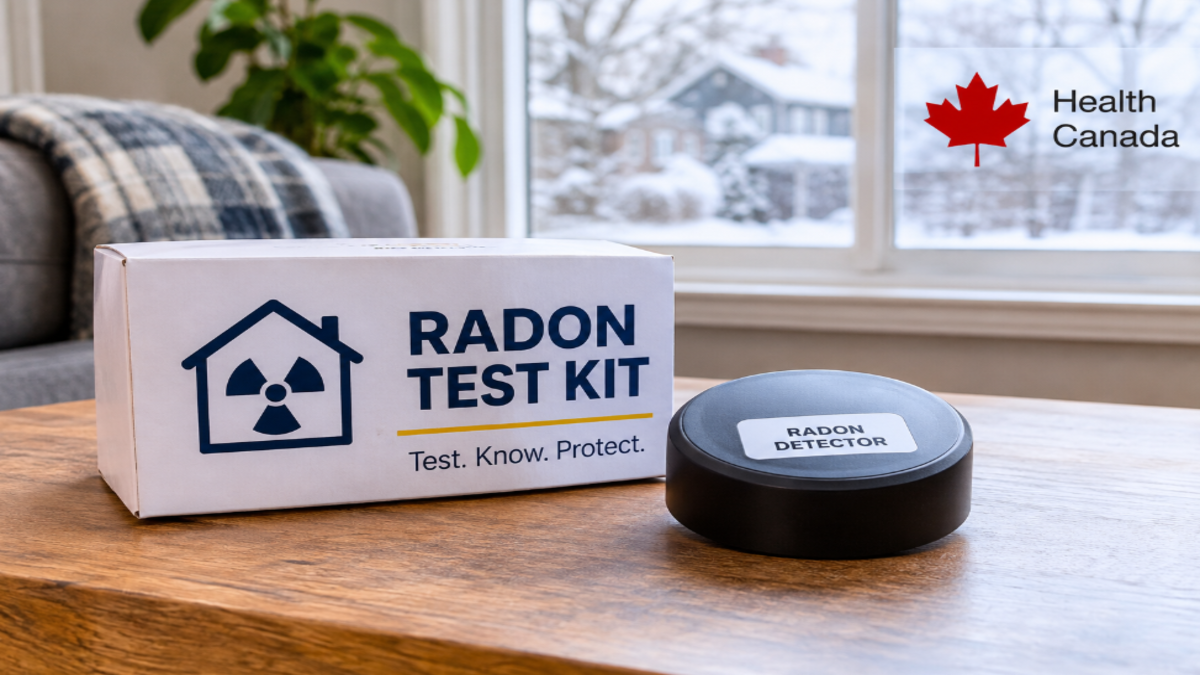
Not every radon detector sold online is suitable for a long-term measurement. Health Canada recommends using devices that have passed performance testing by the Canadian National Radon Proficiency Program (C-NRPP).
This warning is particularly relevant following a public advisory issued by Health Canada on November 16, 2026. The department cautioned that some electronic radon detectors sold online had produced inaccurate readings, potentially giving households a false sense of security or causing unnecessary concern. It referred consumers to the C-NRPP list of monitors that have passed performance testing.
Canada.ca+1
A simple way to reduce the risk of buying an unsuitable product is to check the approved-device list before purchasing an electronic monitor. Homeowners can also use a long-term passive test kit and return it to the laboratory according to the manufacturer’s instructions.
What radon level is considered high in Canada?
Canada’s national guideline recommends corrective action when a home’s average radon concentration exceeds 200 becquerels per cubic metre (200 Bq/m³).
The threshold applies to the long-term average, not a single hourly or daily reading. Radon levels naturally rise and fall, so short-term results should not be used alone to decide whether a home needs mitigation.
| Long-term average result | What it means |
|---|---|
| Below 200 Bq/m³ | Below the Canadian guideline; no immediate corrective action is required under the guideline |
| Above 200 Bq/m³ | Corrective action is recommended to reduce exposure |
Health Canada advises homeowners to reduce levels above 200 Bq/m³ within one year, and to act sooner when concentrations are higher. The aim is to bring radon down as low as reasonably achievable, not simply to stop just below the guideline.
canada.ca+1
What happens if a test result is above 200 Bq/m³?
The next step is to contact a certified radon mitigation professional. The most common reduction method is active soil depressurization. A fan and pipe system draws soil gas from beneath the foundation and vents it outside, reducing the amount of radon entering the home.
The appropriate solution depends on the building and the source of radon entry. Homeowners should seek advice from a qualified professional rather than relying on general ventilation changes or improvised repairs as a substitute for a proper mitigation system.
After mitigation work, the home should be tested again to confirm that the system has reduced radon levels. Health Canada also recommends retesting after renovations or energy-efficiency upgrades that affect the building’s structure or ventilation. Homes with an active soil depressurization system should be tested every five years to check that it continues to work as intended.
canada.ca+1
Does every Canadian home need a radon test?
Health Canada recommends testing every home, regardless of its location, building type or whether a mitigation system is already installed. Radon concentrations can differ considerably between neighbouring properties, including homes with similar designs.
A home’s location may influence the likelihood of elevated radon, but it cannot reliably predict the result for an individual property. A regional map or a neighbour’s test result is therefore not a substitute for measuring the air inside the home.
The issue also concerns tenants, not only property owners. People who rent houses or ground-level apartments can ask their landlord or property manager whether a long-term radon test has been conducted and request access to the results. Responsibility for arranging mitigation may depend on the tenancy and local rules, but the health question is the same for anyone living in the property.
Why radon exposure deserves attention
Radon is a leading cause of lung cancer. Health Canada identifies it as the number one cause of lung cancer among non-smokers in Canada and the second leading cause overall, after smoking.
The risk depends on both the concentration in the air and the length of exposure. Radon decay products can be inhaled and release radiation in lung tissue. The risk is particularly concerning for people who smoke or are exposed to second-hand smoke, as the combination increases the likelihood of developing lung cancer.
There are no reliable ways to detect radon through smell, sight or taste. A home can have elevated levels without any obvious warning signs. Testing is the only way to establish the concentration.
canada.ca+2
Our assessment: winter is a practical opportunity to check indoor air
Winter testing is not simply a seasonal precaution. It is a way to measure radon under conditions that can reveal higher indoor concentrations and provide a more representative basis for decisions about long-term exposure.
The most useful public-health message is straightforward: do not assume a home is safe because it is new, well maintained or located in an area with no known radon problem. Choose a reliable test, place it correctly and allow enough time for a meaningful result.
For households that have never tested, the heating season offers a sensible opportunity to start. A test lasting at least three months can identify a problem that would otherwise remain invisible, while a high result gives residents a clear reason to seek professional help.
Official Sources
Health Canada — Guide for radon measurements in homes — https://www.canada.ca/en/health-canada/services/publications/health-risks-safety/guide-radon-measurements-residential-dwellings.html
Health Canada — Testing your home for radon — https://www.canada.ca/en/health-canada/services/health-risks-safety/radiation/radon/testing-your-home.html
Health Canada — Health Canada warns of inaccurate radon detectors sold online (November 16, 2026) — https://recalls-rappels.canada.ca/en/alert-recall/health-canada-warns-inaccurate-radon-detectors-sold-online
Health Canada — About radon — https://www.canada.ca/en/health-canada/services/health-risks-safety/radiation/radon/about.html