

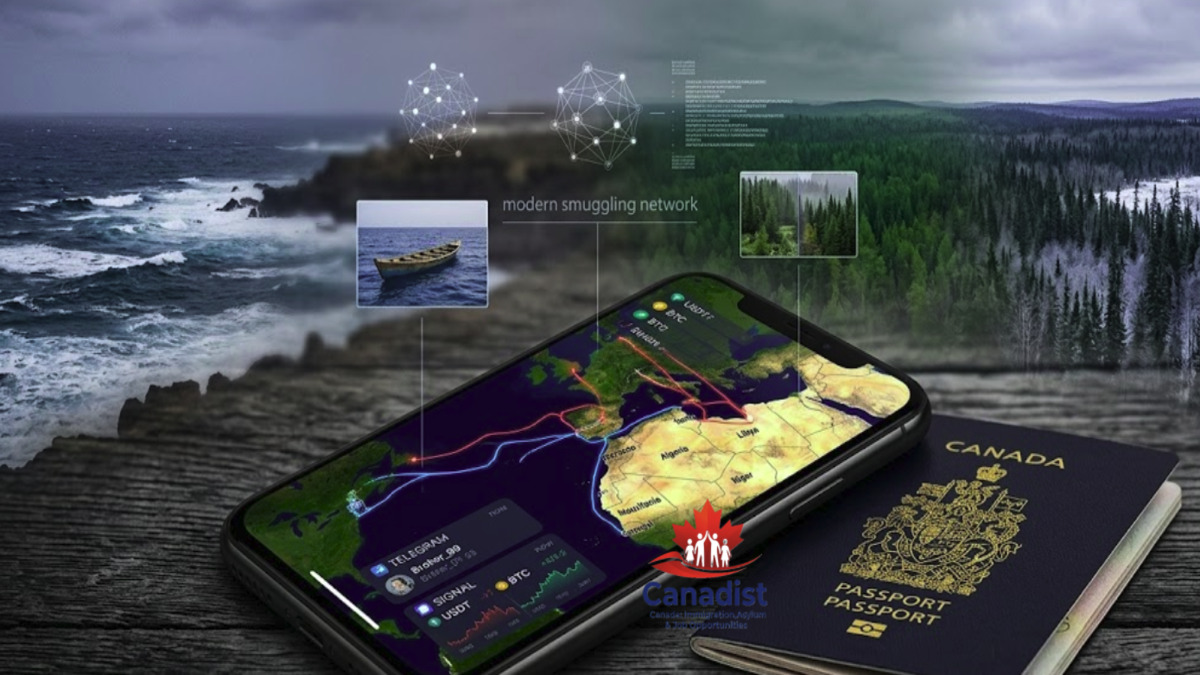
OTTAWA – Canadist: In a private, encrypted Telegram channel with thousands of active members, a single geographic coordinate pinged in the early hours of the morning, followed by a frantic voice note that suddenly went silent.

This is the cold reality of the modern smuggling network, an industry that has quietly evolved from localized, amateur groups into a highly sophisticated, multi-billion-dollar global enterprise. Today, we must ask ourselves: is the West actually fighting human smugglers, or are we merely chasing the digital ghosts of an agile, automated industry that adapts faster than our laws can change?
The traditional image of migrants hiding in the shadows of maritime ports has been replaced by a clean, corporate-like system. Through investigative research, Canadist has uncovered how these networks function like tech startups, utilizing advanced social media marketing, secure crypto-hawala financial systems, and high-quality document forgery to bypass European and Canadian border controls.
What is the Modern Smuggling Machine?
To understand this phenomenon, we must first define what the modern smuggling machine actually is. It is no longer a loose association of local guides who know the regional geography; rather, it is a highly integrated, decentralized global supply chain.

The industry functions on a modular business model where different cells handle marketing, finance, logistics, and document forgery independently. This structural setup means that if law enforcement dismantles a single cell in one country, the rest of the global pipeline continues to operate without any major disruption.
According to exclusive data analyzed by the team at Canadist, this decentralization has allowed smugglers to operate across continents with unprecedented ease. A single journey from West Africa to Canada might involve four different criminal groups who have never met in person, communicating solely through encrypted apps and coordinating payouts through digital escrow accounts.
Why Have the Main Migration Routes Changed?
The geopolitical map of irregular migration has undergone a massive transformation due to heavy border enforcement and maritime blockades. Historically, the Central Mediterranean route—from Libya and Tunisia to Italy—was the primary path to Europe, but European Union funding and intense naval patrols have turned this zone into a militarized barrier.
                  THE WESTWARD SHIFT OF ATLANTIC ROUTES

    [Old Route: Libya/Tunisia] ====> High Interceptions (Militarized)

    [New Route: Mauritania/Senegal] ====> Canary Islands (Longer, Deadlier)
As a result, smuggling syndicates have simply shifted their launch points westward. The Atlantic route, starting from the coastal waters of Senegal and Mauritania toward Spain’s Canary Islands, has seen an unprecedented spike in traffic. While this route is far longer and significantly more dangerous, it offers smugglers a higher probability of bypassing maritime radar systems.
Meanwhile, in Eastern Europe, the overland Balkan route has fractured into smaller, hidden pathways. When countries like Hungary and Croatia erected highly advanced border fences, the networks quickly pivoted their operations through the mountainous terrains of Bosnia and Herzegovina, proving that physical barriers do not stop migration; they merely redirect the flow.
How Does the Digital Smuggling Pipeline Work?
The true power of modern smuggling syndicates lies in their ability to market their services openly on popular social media platforms. TikTok has become the primary virtual storefront for these illegal operations, where smugglers post highly polished videos showing fast speedboats, modern GPS equipment, and successful arrivals.
+-------------------------------------------------------------------------+
|  🎶 TikTok Search: "Guaranteed Travel to Europe"                        |
|                                                                         |
|  [ ▶️ VIDEO: High-speed rigid inflatable boat crossing calm waters ]    |
|  Caption: "VIP Trip to Spain. Safe, fast, 100% guaranteed. DM for info" |
+-------------------------------------------------------------------------+
Once a prospective client interacts with a video, they are immediately redirected to encrypted Telegram groups. These channels serve as digital marketplaces where clients can browse a tiered menu of services:
Standard Maritime Crossing: Large, crowded wooden boats with high safety risks.
VIP Speedboat Route: Twin-engine inflatable vessels with smaller, select groups.
The Transatlantic Pipeline: Complete packages involving flights to South America and subsequent land transit.
By moving their recruitment operations online, smugglers have completely eliminated their physical footprints in transit towns, making it incredibly difficult for local police forces to conduct raids or gather physical evidence.
The Economics of Transit: Crypto and Hawala Networks
Tightened borders have naturally driven up the price of passage, transforming irregular migration into an expensive endeavor that requires significant family capital.
To move these vast sums of money across international borders without triggering anti-money laundering alarms, smugglers have built a highly secure financial ecosystem. They have largely abandoned traditional bank wires in favor of a hybrid system utilizing physical Hawala brokers and digital cryptocurrencies like Tether (USDT).
Under this escrow system, a migrant deposits the agreed-upon fee with a trusted Hawala broker in a transit hub like Istanbul or Tripoli. The broker only releases the funds to the smuggler once the migrant sends a specific, pre-arranged code confirming they have arrived safely at their destination, ensuring financial security for both parties.
Canada: The Premium Dream and the Visa Loophole
While the European borders are characterized by dangerous sea crossings, the route to Canada has become the premium option for affluent migrants seeking long-term stability.
Smuggling networks targeting Canada rarely use sea routes; instead, they exploit administrative and legal loopholes within the Canadian immigration system. The most common method involves securing fraudulent acceptance letters from Canadian educational institutions, allowing clients to enter the country legally on student visas before disappearing into the informal labor market.
                    THE CANADIAN EXPLOIT PIPELINE

  [Fake College Acceptance] ➔ Student Visa Approval ➔ Legal Flight ➔ Informal Labor
Another common method involves flying clients to South or Central American countries that do not require visas, and then guiding them northward through the United States border. Following the closure of official entry points like Roxham Road, smugglers have shifted their focus to guiding individuals through dense, unmonitored forested regions along the vast US-Canada border.
Who Actually Profits from the Smuggling Market?
To truly address this issue, we must look at the financial balance sheet of the entire industry. The smuggling market is highly profitable, and the revenue is distributed among a wide array of specialized actors:
The Boatbuilders: Carpenters in coastal towns who build reinforced wooden hulls specifically for long-distance ocean travel.
The Document Forgers: Specialized workshops in metropolitan hubs that produce realistic passports and visa stamps.
The Digital Marketers: Individuals who manage social media accounts, edit promotional videos, and run Telegram escrow channels.
The Local Enforcers: Corrupt officials and local security personnel paid to look the other way at checkpoints.
Because the profits are so high and the labor is so distributed, the system is incredibly resilient. When governments increase border patrols, they do not stop the trade; they simply increase the final price of the ticket, making the smugglers even richer.
A Comparison of Modern Migration Systems
Understanding the differences between the major global migration pipelines helps illustrate how smugglers tailor their business models to specific regional realities:
What Does This Mean for Global Policy?
The digitalization of human smuggling has rendered traditional border enforcement strategies obsolete. Governments continue to spend billions of dollars on physical walls, maritime patrol vessels, and radar stations, yet the flow of people continues because the logistical and financial infrastructure of the trade remains completely intact.
To make a real impact, international authorities must target the digital and financial roots of the industry. This means working closely with social media giants to dismantle smuggling advertisements in real-time, and targeting the illicit crypto-wallets used to fund these global networks.
Until our global policies shift from physical deterrence to digital disruption, the smuggling machine will continue to adapt, profit, and thrive, leaving desperate families to bear the immense financial and human costs of this underground economy.
Frequently Asked Questions
How do smugglers use cryptocurrency?
Smuggling networks use stablecoins like Tether (USDT) to move large volumes of cash between regional bosses across different countries. This allows them to purchase boats, pay local enforcers, and fund document forgery operations without using traditional banks.
Why has Mauritania become a major launch point for Europe?
Mauritania has become a key departure point because traditional routes through Libya and Tunisia are heavily patrolled by coast guards. The Mauritanian coast offers direct access to the open Atlantic, allowing boats to attempt the journey to Spain’s Canary Islands.
How do fraudulent student visas work in Canada?
Smuggling networks work with corrupt foreign educational consultants to obtain official-looking acceptance letters from Canadian colleges. Once the student visa is approved, the individual enters Canada legally but enters the workforce instead of attending school.
Why don’t physical border walls stop human smuggling?
Physical walls do not address the root causes of migration or the high profits of smuggling. When a physical barrier is built, smugglers simply find alternative, more expensive routes, such as using forged documents or traversing difficult natural terrains.
The modern human smuggling trade has successfully transformed into a highly efficient, corporate-style digital service. To read more about how international laws are struggling to keep pace, you can check the official UNODC Global Study on Smuggling of Migrants which highlights the shifting dynamics of these global networks.…More
Contact: info@canadaalyom.com