

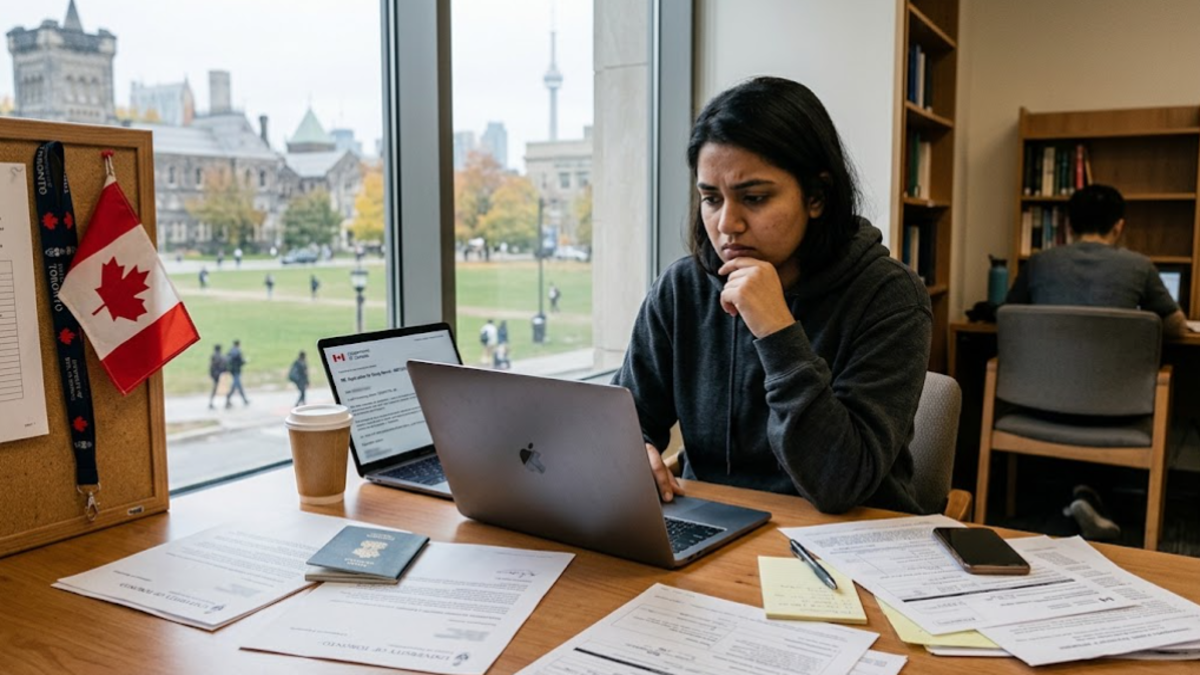
OTTAWA – Canadist: Canada Study Permit Refusal has become a growing concern for international students as Canadian immigration authorities apply tighter scrutiny to new applications. Recent data and industry analysis show that refusals remain high, while financial documentation, travel history, the credibility of the study plan and an applicant’s intention to leave Canada after studying can all influence the final decision.

The latest figures also point to a significant reduction in the number of students arriving in Canada compared with previous years, reflecting the government’s broader effort to reduce temporary resident numbers and bring the international student system under tighter control. But what exactly is causing so many otherwise qualified students to receive a refusal?
Canada Study Permit Refusal rates remain high as Canada tightens its student system
Canada’s international education system has changed considerably since the federal government introduced measures designed to slow the growth of temporary residents. The changes include limits on new study permits, stronger document verification and higher financial expectations for applicants.
Official figures show that the refusal rate for new study permit applications rose to 59 percent during the latest full reporting period, compared with 52 percent in the preceding year. The rate reached 62 percent at the beginning of the latest reporting period, while refusal rates for study permit extensions remained much lower, at around 10 percent.

The distinction between new applications and extensions matters. Students already studying in Canada generally face a different assessment from people seeking their first study permit from outside the country.
At the same time, the number of international students entering Canada has fallen sharply. Government statistics show 292,885 new study permit holders in one earlier year, followed by 115,005 in the next. In the first six months of the latest reporting period, the figure stood at 22,405.
That decline does not mean every application has become impossible to approve. In fact, recent analysis from ApplyBoard indicates that approval rates improved among applicants who continued to apply, even as the overall volume of applications declined. The company reported that new post-secondary study permit applications fell by roughly 40 percent year over year during the first four months of the latest period, while the approval rate increased from 26 percent to 36 percent.
The message for prospective students is therefore more complicated than simply saying Canada is refusing international students. Canada is still approving applications, but applicants now face a much more demanding assessment.
Canada Study Permit Refusal: the biggest issue may be whether you will leave
One of the clearest findings from recent refusal data concerns an applicant’s intention to leave Canada after completing studies.
According to ApplyBoard’s analysis of Canadian student visa refusals, the most frequently cited reason was that an immigration officer was not satisfied that the applicant would leave Canada at the end of the authorized study period. This reason appeared in 79 percent of refusal cases in the analysis for the earlier period and 81 percent in the more recent sample.
This does not necessarily mean that an applicant openly stated an intention to remain permanently in Canada. Instead, officers can assess the overall circumstances surrounding an application.
Travel history can form part of that assessment. Officers may consider whether an applicant previously obtained visas for other countries and complied with the conditions attached to those visas. Previous immigration history can therefore become an important part of the credibility assessment.
The applicant’s personal circumstances also matter. Family connections, employment, education, financial position and the reasons for choosing a particular Canadian program can collectively influence whether the officer accepts the temporary purpose of the application.
For students, this makes the study plan particularly important. A generic explanation about wanting to obtain a Canadian education may not adequately explain why the chosen program makes sense in the context of the applicant’s previous studies and professional plans.
A convincing application should establish a logical connection between past education, the proposed Canadian program and the applicant’s future plans.
That does not mean applicants must prove that they will never seek another immigration status in Canada. It means they must satisfy the temporary-resident requirements applicable to the study permit they are requesting.
Financial documents are under much closer examination
Financial capacity has emerged as another major source of refusals.
Recent reporting by The Economic Times, citing analysis from BorderPass and ApplyBoard, says Canadian immigration officers are paying closer attention not only to the amount of money shown by an applicant but also to its source, stability and credibility. Officers may request additional financial or employment documents where they need more evidence to understand the applicant’s financial position.
This distinction is crucial.
Having enough money in a bank account does not automatically mean that an applicant has presented convincing financial evidence. An officer may want to understand where the funds came from and whether they are genuinely available to support tuition and living expenses.
For example, a sudden large deposit can raise questions if the application does not clearly explain its origin. Similarly, funds belonging to a sponsor require a credible explanation of the sponsor’s relationship with the student and the sponsor’s ability to provide the promised support.
Recent analysis of refusal decisions found that inadequate proof of funds appeared in 47 percent of refusals examined. The research looked at 2,812 Canadian study permit decisions and 1,370 refusal letters, highlighting the difference between having money and proving financial capacity convincingly.
The issue therefore goes beyond the final bank balance.
Students should ensure that financial evidence tells a consistent story. Bank statements, income evidence, employment records, tax documents, education payments and sponsorship information should not contradict one another.
The stronger the financial story, the easier it becomes for an officer to understand how the student will pay for the proposed education without relying on unauthorized or uncertain sources of income.
A weak study plan can undermine an otherwise strong application
Another recurring problem is the lack of a convincing academic explanation.
Canadian immigration officers must determine whether the applicant’s primary purpose in Canada is genuinely to study. A study permit application can therefore face difficulties when the selected program appears disconnected from the applicant’s previous education or professional experience.
A sudden change in academic direction is not automatically a reason for refusal. However, applicants should explain significant changes clearly.
Consider a student with a bachelor’s degree and several years of professional experience who suddenly chooses a lower-level program unrelated to that background. The application may require a particularly clear explanation of why the program represents a reasonable academic or professional step.
The same principle applies to applicants who already possess qualifications similar to the Canadian credential they intend to pursue.
The question is not simply whether a Canadian institution accepted the student. The immigration officer must independently assess whether the proposed studies make sense for the applicant.
The application should therefore answer practical questions: Why this course? Why this institution? Why Canada? Why now? How will the program improve the applicant’s professional prospects?
A strong admission letter from a college or university does not, by itself, guarantee a study permit.
Canada is also increasing program-integrity checks
The tougher refusal environment forms part of a wider effort to protect the integrity of Canada’s International Student Program.
The federal government says it has introduced measures including an annual cap on international student study permits, mandatory verification of acceptance letters and stronger financial requirements. The government has also said it wants to reduce temporary resident numbers and make the international student system more sustainable.
The impact is visible in the number of students entering Canada.
Government figures show that new student arrivals during the first half of the latest reporting period were 82 percent lower than during the comparable period several years earlier. The government has set a target for student arrivals and says it remains on track to stay within that target.
For applicants, this means the current environment differs significantly from the period when Canadian colleges and universities experienced rapid international enrolment growth.
Immigration officers are assessing applications in a policy environment that places greater emphasis on program integrity, financial preparedness and the overall credibility of applicants.
Misrepresentation remains another concern, although official figures indicate that refusals specifically attributed to misrepresentation represented a relatively small proportion of total refusals compared with other grounds.
Applicants should never alter, conceal or manufacture information to make their profile appear stronger. Inconsistent or false information can create much more serious immigration consequences than an ordinary refusal.
Why applicants with money and admission letters can still be refused
A common misconception is that three things guarantee approval: admission to a Canadian institution, sufficient money and a complete application form.
In reality, immigration officers assess the application as a whole.
An applicant can have a valid letter of acceptance and still receive a refusal if the officer is not satisfied about financial capacity, the purpose of the visit, the applicant’s temporary intent or another eligibility requirement.
Canada’s official guidance confirms that officers can refuse a study permit when applicants cannot demonstrate sufficient financial support, cannot satisfy the officer that studying is their primary purpose, or cannot convince the officer that they will leave Canada at the end of their authorized study period. Medical requirements and the validity of the acceptance letter can also affect the outcome.
For the latest official requirements and application instructions, applicants should consult Immigration, Refugees and Citizenship Canada (IRCC).
The practical lesson is straightforward: applicants should build an evidence-based application rather than simply assemble a checklist of documents.
Travel history and personal circumstances can influence the decision
Travel history has received particular attention in recent refusal analysis.
An applicant who has previously travelled internationally and complied with immigration rules may be able to provide useful evidence of responsible temporary travel. Conversely, complicated immigration histories can require additional explanation.
This does not mean that a student must have travelled extensively before applying. A lack of travel history is not automatically a refusal ground.
Instead, the officer considers the circumstances presented in the application.
The same applies to family circumstances. An applicant’s family ties in the home country can be relevant to the assessment of temporary intent, but the officer can consider the entire personal situation rather than relying on a single document.
The key issue is consistency.
If an applicant says they intend to return home after completing their studies, the academic and professional plan should support that explanation. If the application describes a career objective in the home country, the applicant should be able to explain how the Canadian qualification contributes to that objective.
The refusal letter is becoming more useful for applicants
There is also an important development for students who receive a refusal.
Canadian authorities now provide officer decision notes with refusal letters for study permits and study permit extensions. These notes explain the reasoning behind the officer’s decision and give applicants more information than the refusal letter alone may have provided in the past.
That change can make the next step more informed.
Instead of immediately submitting the same application again, a refused applicant can examine the officer’s concerns and determine whether the weaknesses are genuine and whether new evidence can address them.
For example, if the officer questioned the source of funds, the applicant may need clearer evidence concerning the sponsor’s income and the origin of the money.
If the officer questioned the applicant’s purpose of study, the applicant may need a substantially stronger explanation of the academic progression and career objective.
If the concern involved temporary intent, the applicant should review the evidence supporting the explanation of their circumstances and future plans.
A second application should therefore not simply repeat the first one with minor formatting changes.
What students should check before submitting a new application
The latest refusal trends suggest that applicants should take a more strategic approach before submitting a study permit application.
First, the academic pathway should make sense. The proposed Canadian program should have a clear connection with the applicant’s education, experience or realistic career plans.
Second, financial documents should demonstrate both capacity and credibility. Applicants should be prepared to explain significant transactions and establish the source of funds.
Third, the study plan should be specific rather than generic. Statements that could apply to thousands of students are unlikely to explain an individual applicant’s circumstances effectively.
Fourth, immigration and travel history should be disclosed accurately. Previous refusals, visa applications and travel should not disappear from the story simply because they may complicate the application.
Finally, applicants should review the current documentation requirements before submitting their files. Canadian rules have changed repeatedly, and using an old checklist can create avoidable problems.
The broader trend is clear: Canada has not closed the door to international students, but it has raised the standard for demonstrating that an application is genuine, financially credible and consistent with the temporary nature of a study permit.
What the latest numbers mean for future applicants
The latest data presents two seemingly contradictory developments.
On one side, Canada’s student permit system is producing high refusal rates and significantly fewer new arrivals. On the other, analysis of recent applications suggests that approval rates improved among the students who continued to apply.
That combination suggests that the system is becoming more selective rather than simply refusing everyone.
The government’s own data supports the broader picture. Canada says it has deliberately reduced the number of new international students arriving and introduced measures intended to strengthen program integrity.
For genuine students, that makes preparation more important than ever.
An applicant cannot control the overall number of permits Canada issues. They can, however, control the quality and consistency of the evidence submitted with their application.
The strongest applications are likely to be those that tell one coherent story from beginning to end: a credible academic objective, a realistic financial plan, a logical career pathway and evidence that addresses the requirements for temporary residence.
In the current environment, simply being accepted by a Canadian school is no longer enough.
FAQ
Why is my Canada study permit application refused?
Common reasons include insufficient financial evidence, concerns about the applicant’s intention to leave Canada, doubts about the purpose of study, an invalid acceptance letter or failure to meet medical requirements.
Is having enough money enough to get a study permit?
No. Applicants must demonstrate that their funds are sufficient and credible. Officers may examine the source and stability of the money and request additional evidence when necessary.
Can I apply again after a Canada study permit refusal?
A refused applicant can consider submitting another application, but the new file should address the concerns identified by the immigration officer rather than simply repeat the previous application.
Can I see why my study permit was refused?
Yes. Canada now provides officer decision notes with refusal letters for study permits and study permit extensions. These notes explain the officer’s reasoning and can help applicants understand the refusal.
Contact: info@canadaalyom.com