

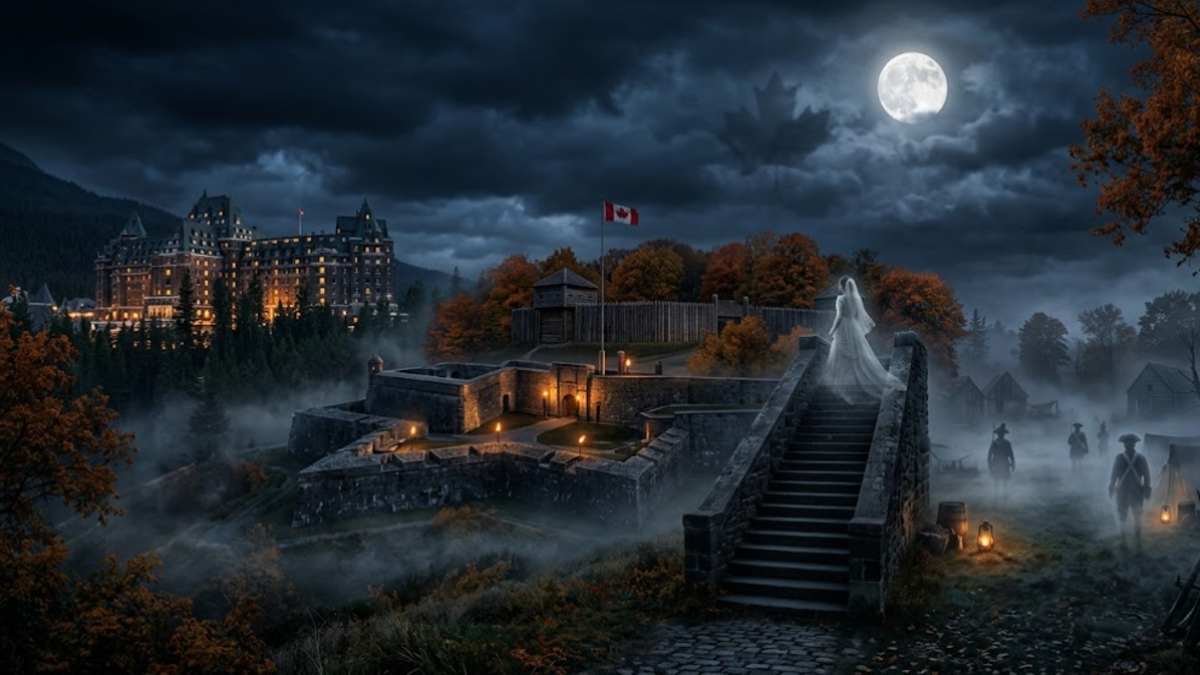
Canada’s Spookiest Historic Places: Real Ghost Stories, Dark History and Halloween Legends
Canada’s spookiest historic places offer something more compelling than a good Halloween scare: centuries-old buildings, forgotten tragedies, military secrets and ghost stories that have become part of the country’s cultural heritage. From the candlelit tunnels of Halifax Citadel to the mysterious corridors of Banff’s famous castle-like hotel, these destinations combine documented history with supernatural legends that continue to fascinate visitors.

Some stories are rooted in the lives of real people, while others have grown through decades of retelling. In certain cases, the places themselves have helped explain how a legend began. For travellers planning an autumn getaway, these historic sites offer a chance to explore Canada’s past while discovering the stories that have earned them a reputation for being haunted.
The distinction matters: reports of ghostly encounters are not scientific proof of paranormal activity. However, the historical records, architecture and folklore behind these places provide plenty of reasons to explore them, especially around Halloween.
1. Fairmont Banff Springs, Alberta: The Ghost Bride and the Helpful Bellman




Few places capture the atmosphere of a classic haunted hotel as effectively as Fairmont Banff Springs. Surrounded by the Rocky Mountains, this landmark opened in 1888 and has become known for its grand architecture, long hospitality history and enduring ghost stories.
The hotel itself acknowledges three of its best-known legends: the Ghost Bride, the Missing Room and Sam the Bellman. Its own account of these tales also distinguishes between documented history and folklore.
The Ghost Bride
According to legend, a young bride died after falling on the hotel’s grand staircase before reaching her wedding ceremony. Versions of the story describe her in a white wedding dress, appearing on the staircase or in the ballroom.
The hotel, however, makes an important admission: it has found no written record confirming that a bride died or was injured there in the circumstances described by the legend. The story should therefore be treated as folklore rather than a verified historical tragedy.
That uncertainty has not diminished its appeal. The image of a bride forever separated from her wedding remains one of the hotel’s most recognisable supernatural tales.
The mystery of the Missing Room
Another story describes a room that supposedly disappeared behind a sealed doorway, sometimes with suggestions that a terrible event was concealed inside.
The hotel’s explanation is considerably more ordinary. During a mid-century redesign, two smaller guest rooms were combined into a larger suite. One doorway was removed, but a ceiling light remained in the hallway near the former entrance. Curious visitors subsequently began knocking on the wall, sometimes receiving knocks in return from guests on the other side.
A renovation detail, in other words, helped fuel a supernatural mystery.
Sam the Bellman
Not every ghost story involves a tragic death. Sam the Bellman is said to appear when guests need help finding their way around the hotel or opening a difficult door.
Fairmont says the legend is based on a real, popular bellman who worked there as late as the 1950s. The supernatural encounters attributed to him remain unverified, but the connection to an actual former employee gives the story a different character from the Ghost Bride legend.
Why visit: The hotel’s history and architecture are attractions in their own right. Visitors should check accommodation, dining and tour options directly with the property, as access to guest areas depends on hotel arrangements.
Official source: Fairmont Banff Springs — Ghost Stories.
2. Lower Fort Garry, Manitoba: Ghostly Footsteps and a Loyal Dog

Located north of Winnipeg, Lower Fort Garry National Historic Site offers some of Canada’s most distinctive historic ghost stories. Established by the Hudson’s Bay Company in the 19th century, the site has served several purposes over its nearly 200-year history, including as a trading fort, a penitentiary and a psychiatric hospital.
Parks Canada has documented several local supernatural tales connected to people and animals associated with the property. These stories are particularly interesting because they draw on the site’s changing uses and the people who once lived and worked there.
The Three-Step Ghost
One of the site’s most unusual stories involves a sequence of three footsteps. According to Parks Canada, team members have reported hearing what sounds like someone walking along a gravel path, climbing the steps and entering the blacksmith’s bedroom.
The sequence is reportedly so familiar that staff members have sometimes prepared to welcome visitors. Yet when they investigate, no one is there.
The account remains a reported unexplained experience rather than proof of a haunting. Its setting, however, gives it a distinctly unsettling quality: a historic path, an old building and a sound that seems to announce a visitor who never arrives.
Tit Loup, the dog that never stopped waiting
A more poignant legend centres on Tit Loup, meaning “Little Wolf”, the dog of York boat tripsman Jean-Louis Blanchard.
According to the story shared by Parks Canada, Blanchard regularly departed from Lower Fort Garry in the spring for trading journeys. His dog remained behind, watching him leave from the riverbank and waiting for his return.
One year, Blanchard was involved in an accident and never came back. The legend says that Tit Loup can still be seen running along the riverbank at night, apparently waiting for his owner.
Unlike stories built around frightening apparitions, this one focuses on loyalty and loss. Its emotional power comes from the familiar idea of an animal waiting faithfully for someone who will never return.
The Warehouse Keyholder
The site’s former penitentiary provides another unsettling story. Thomas Slack served as a keyholder there between 1871 and 1877. Parks Canada recounts a tragic story associated with him and the warehouse building.
The account includes suicide, so it is worth approaching with sensitivity rather than treating it as a simple Halloween spectacle. The story is part of the site’s interpretive folklore; it should not be confused with independently established evidence of paranormal activity.
Why visit: Lower Fort Garry is a strong choice for travellers interested in the intersection of ghost stories, fur-trade history and the changing uses of historic buildings. Check Parks Canada’s official website for visitor information and seasonal programming.
Official source: Parks Canada — Spooky Stories from Lower Fort Garry.
3. Halifax Citadel, Nova Scotia: Haunted Tunnels and the Shadows of Soldiers

Overlooking Halifax Harbour, Halifax Citadel National Historic Site is one of Canada’s most atmospheric military landmarks. Its imposing fortifications and dark passageways make it a natural setting for stories of restless soldiers and unexplained encounters.
The site’s history stretches back to the colonial era. Several successive fortifications occupied Citadel Hill, and the present star-shaped fort reflects the British military presence of the 19th century. Parks Canada interprets the Citadel as a place to understand Halifax’s military and social history, not simply as a backdrop for ghost stories.
A ghost tour through the fort
Unlike many destinations that rely exclusively on local legends, Halifax Citadel offers an organised experience built around its haunted reputation.
Parks Canada’s “Dare to Be Scared” ghost tour takes visitors through the historic fort at night. Guided by an interpreter in period uniform, participants explore dimly lit passageways and learn about the site’s ghost stories and accounts of unexplained events. The experience also includes areas associated with former military confinement.
The tour’s atmosphere is part of the attraction. A lantern illuminating a stone corridor, footsteps echoing through an enclosed passage and the knowledge that soldiers once lived under strict military discipline can make the past feel unusually immediate.
That experience does not establish that the Citadel is haunted. It does, however, offer a historically grounded way to encounter the stories attached to the site.
What lies beneath the legends?
The Citadel’s appeal is inseparable from its real history. Military service, confinement, routine hardship and the strategic defence of Halifax shaped life within its walls. Understanding those conditions helps explain why stories of ghosts and unexplained sounds have become associated with old military installations.
For visitors, the most rewarding approach is to learn about the actual people and events first, then consider how supernatural traditions have developed around them.
Why visit: The Citadel is particularly suitable for Halloween-season travellers who want a guided experience rather than simply a list of haunted locations. Parks Canada lists public ghost tours on selected dates from July to October, with private tours also available subject to conditions. Check the official booking information before travelling.
Official sources:
4. Fort George, Ontario: Echoes of the War of 1812

At Fort George National Historic Site, the supernatural atmosphere is closely connected to a documented period of military conflict. The British built the fort between 1796 and 1803 to defend the Niagara River and the surrounding settlement. During the War of 1812, the fort became part of the struggle between British and American forces in the region.
Today, reconstructed military buildings, defensive earthworks and wooden palisades help visitors understand what life was like at this strategic outpost.
Ghost stories behind the palisades
Fort George is also the setting for organised ghost tours run by the Friends of Fort George, a nonprofit organisation involved in interpreting and preserving Niagara’s historic sites.
The tours combine the fort’s military past with local stories about spirits and unexplained occurrences. Candlelit walks and accounts of supposed ghostly encounters create an eerie experience, particularly after dark.
The distinction between history and legend is essential here. The War of 1812 and the fort’s military role are documented historical facts. Stories of spirits associated with the grounds belong to local folklore and guided storytelling, not to the verified historical record.
The setting nevertheless makes the stories compelling. Walking among historic defensive structures after sunset encourages visitors to imagine the soldiers, officers and other people who once occupied the site.
A Halloween visit with historical context
Fort George is a useful choice for travellers who prefer a ghost tour that also explains the history of a place. Rather than separating entertainment from education, the experience uses the site’s real past as the foundation for its legends.
Why visit: Niagara-on-the-Lake is well suited to a wider heritage trip, and Fort George adds a military-history dimension to the region’s better-known cultural attractions. Ghost tours are seasonal, so confirm dates and availability with the organisers.
Official sources:
5. The Plains of Abraham, Quebec City: The Ghosts of a Battlefield

The Plains of Abraham is one of Canada’s most historically significant landscapes. The battlefield is associated with the Battle of the Plains of Abraham in 1759, a decisive confrontation between British and French forces during the Seven Years’ War in North America.
The battle helped shape the future of New France and the wider political history of the region. Today, the site is a major historic urban park where visitors can explore the landscape, learn about the conflict and reflect on its consequences.
It has also inspired ghost stories.
Apparitions on the battlefield
Canadian historical writing has recorded reports of apparitions of soldiers appearing to advance across the Plains of Abraham carrying muskets. These stories fit a familiar pattern in battlefield folklore: places associated with violent conflict become settings for tales of figures supposedly repeating events from the past.
The reports are legends, not verified evidence that spirits inhabit the battlefield. They also should not overshadow the real history of the site, including the people who fought and died there and the lasting effects of the conflict on the region.
Why the landscape matters
Open ground, changing light and the scale of the battlefield can make historical events feel distant yet tangible at the same time. The ghost stories add another layer to the site’s public memory, but its historical significance stands independently of them.
Why visit: The Plains of Abraham are especially worthwhile for travellers who want to combine Canadian history, outdoor exploration and Quebec City’s cultural heritage. Check the official site’s visitor information for current activities and access details.
For this destination, the reported ghost story is supported by Canadian historical writing rather than a verified paranormal investigation. Visitors should therefore treat it as folklore associated with a real battlefield.
How to Explore Canada’s Haunted Historic Sites Responsibly
Visiting a supposedly haunted place can be an enjoyable way to discover Canadian history, but a little preparation makes the experience more rewarding.
- Book official tours in advance. Ghost tours often operate seasonally, and dates may be limited. Check the site’s own website for current schedules, prices and booking conditions.
- Separate documented history from folklore. A building’s age, a person’s biography or a military event may be supported by records even when the associated ghost story is not.
- Respect private and restricted areas. Hotels, forts and historic buildings may have areas that are closed to visitors. Never enter restricted spaces in search of paranormal activity.
- Dress for the weather. Evening tours can involve outdoor walking, stone passageways and uneven ground. Suitable footwear and warm layers are particularly useful in autumn.
- Be considerate when stories involve real suffering. Accounts involving death, imprisonment, war or suicide deserve historical context and sensitivity rather than sensationalism.
The best haunted-history trips combine the atmosphere of a ghost story with the opportunity to understand the real people who shaped a place.
Our Editorial Assessment: The Best Kind of Canadian Ghost Story
Canada’s historic ghost stories are most interesting when they reveal something about the places that produced them. At Banff Springs, a hotel renovation helped create a legend about a missing room. At Lower Fort Garry, stories of footsteps and a loyal dog connect supernatural folklore to the lives associated with a former trading fort. At Halifax Citadel and Fort George, military history provides the setting for tales of unexplained encounters.
These examples also show why accuracy matters. A legend can be culturally significant without being factually verified. Fairmont Banff Springs openly acknowledges that it has no written record confirming the Ghost Bride’s supposed death, while Parks Canada’s interpretation of Lower Fort Garry presents its supernatural accounts as stories associated with the site.
In our assessment, the most rewarding Halloween destinations are not necessarily those with the most frightening reputations. They are the ones where the historical evidence is strong, the storytelling is transparent and visitors can experience the past without confusing folklore with established fact.
For anyone planning an autumn trip, these locations offer a compelling combination of architecture, history and Canadian legend. Whether visitors believe in ghosts or not, the stories provide a memorable reason to explore the country’s historic places.
Frequently Asked Questions About Canada’s Haunted Historic Places
What is the most famous haunted place in Canada?
Fairmont Banff Springs is among Canada’s best-known haunted hotels, with legends including the Ghost Bride, the Missing Room and Sam the Bellman. The hotel itself acknowledges that some elements of these stories are folklore rather than verified history.
Can you take a ghost tour at Halifax Citadel?
Yes. Parks Canada offers the Dare to Be Scared ghost tour on selected dates, with public tours generally scheduled during the summer and autumn season. Private tours may also be available. Check the official website for current dates and booking details.
Are Canada’s haunted historic places really haunted?
There is no established scientific evidence that these locations are haunted. Some reported encounters remain unexplained, while other stories have identifiable origins in local folklore, historical events or changes to buildings. Their supernatural reputations should not be confused with proof of paranormal activity.
Which Canadian historic sites are worth visiting around Halloween?
Fairmont Banff Springs in Alberta, Lower Fort Garry in Manitoba, Halifax Citadel in Nova Scotia and Fort George in Ontario are all strong choices. The Plains of Abraham in Quebec City is another option for visitors interested in battlefield legends and Canada’s military history.
Official Sources
1. Fairmont Banff Springs — Ghost Stories — https://www.fairmont.com/en/hotels/banff/fairmont-banff-springs/ghost-stories.html
2. Fairmont Banff Springs — A Legacy in the Rockies — https://www.fairmont.com/en/hotels/banff/fairmont-banff-springs/story.html
3. Parks Canada — Spooky Stories from Lower Fort Garry — https://www.parcs.canada.ca/lhn-nhs/mb/fortgarry/culture/blog/effrayante-spooky
4. Parks Canada — Halifax Citadel National Historic Site — https://parks.canada.ca/lhn-nhs/ns/halifax
5. Parks Canada — Ghost Tour: Dare to Be Scared — https://parks.canada.ca/lhn-nhs/ns/halifax/activ/decouverte-tours/visite-hante-ghost-tour?wbdisable=true
6. Parks Canada — Fort George National Historic Site Visitor Guide — https://parks.canada.ca/lhn-nhs/on/fortgeorge/visit/guide
Contact: info@canadaalyom.com