

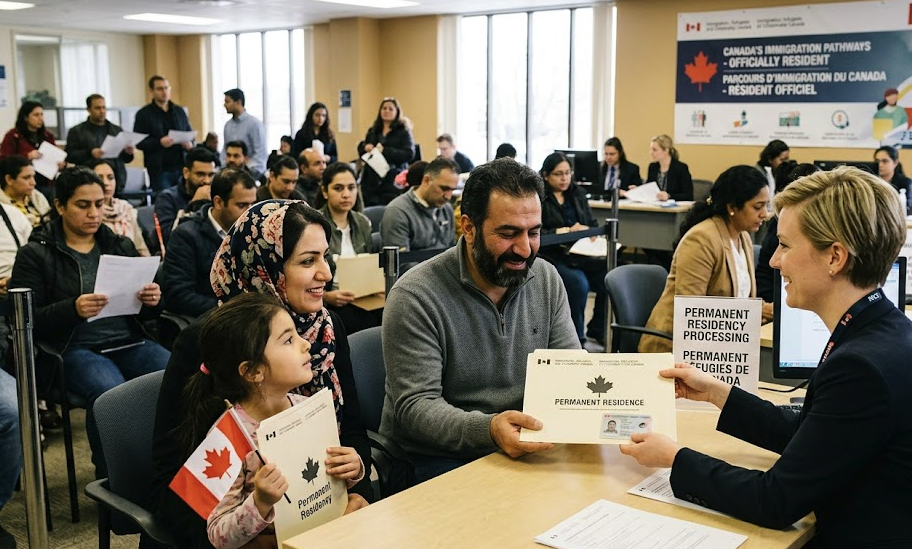
Toronto – Canadist: The search for the regularization of immigrants in Canada—or more accurately, the quest to secure official permanent residency—has driven millions of global applicants to look for a “fast track to Canada.” However, the Canadian immigration system does not offer a single, universally guaranteed or rapid shortcut. Instead, it operates on a highly competitive, points-based structure that evaluates qualifications, language proficiency, and personal circumstances. While many internet platforms promise quick fixes, a realistic question persists: which route is truly the fastest to obtain legal residency in Canada—work, study, asylum, or family sponsorship? According to analysis by Canadist, the answer depends entirely on how an applicant’s profile aligns with current immigration quotas and economic needs.

What Are the Official Pathways to Obtain Legal Residency in Canada?
Canada’s legal framework offers several distinct streams designed to welcome new residents. Each stream caters to different demographics, varying significantly in terms of cost, processing times, and overall requirements.
🧑💼 1. Economic Immigration via Express Entry
This is the most prominent and widely utilized pathway for skilled individuals worldwide. The federal Express Entry system manages applications for three major economic programs: the Federal Skilled Worker Program, the Canadian Experience Class, and the Federal Skilled Trades Program.
The system operates on the Comprehensive Ranking System (CRS), which evaluates applicants through a meticulous score configuration based on:

Age: Points peak for candidates in their twenties and early thirties.
Language Proficiency: High-level results in official English (IELTS/CELPIP) or French (TEF/TCF) exams.
Work Experience: Verifiable skilled employment background.
Education: Validated post-secondary credentials.
Is it the fastest? Yes, if your CRS score ranks above the draw cutoff lines, applications can be processed in less than six months. However, if your score is low, you face intense global competition and may remain in the pool without receiving an Invitation to Apply (ITA).
🎓 2. The International Student Pathway
Studying in Canada does not grant immediate permanent residency, but it serves as a highly popular stepping stone.
The process involves specific progressive phases:
Securing an acceptance letter from a Designated Learning Institution (DLI).
Obtaining an official Canadian Study Permit.
Completing the educational program and applying for a Post-Graduation Work Permit (PGWP).
Gaining Canadian work experience to transition to permanent residency via Express Entry or Provincial programs.
The Pros: Admission to colleges or universities is often more accessible than receiving a direct job offer from abroad.
The Cons: Tuition fees for international students are remarkably high, and this pathway requires a long-term commitment before achieving permanent residency.
🤝 3. Family Sponsorship
Family reunification remains one of the pillars of the Canadian immigration system. Under this stream, Canadian citizens or permanent residents can sponsor specific relatives to obtain permanent residency.
This program primarily includes:
Spouses, common-law partners, or conjugal partners.
Dependent children.
Parents and grandparents (subject to specific annual lotteries and income requirements).
The Pros: This pathway offers a relatively high approval rate and predictable timelines, provided the sponsor meets the necessary financial criteria.
The Cons: It relies entirely on having a qualified, close legal relative already residing in Canada as a citizen or permanent resident.
🛂 4. Asylum and Refugee Protection
Asylum is not a standard, voluntary migration option; it is a rigid legal framework meant for humanitarian protection. Canada offers protection to individuals facing a well-founded fear of persecution, social discrimination, or danger to their lives in their home countries.
The Pros: Individuals receive legal protection and work or study authorizations while their claims are being adjudicated by the Immigration and Refugee Board of Canada (IRB).
The Cons: Claims are highly scrutinized, outcomes are never guaranteed, and the legal proceedings can stretch over several years before a final verdict is reached.
🏞 5. Provincial Nominee Programs (PNP)
Apart from the federal streams, each Canadian province and territory (such as Ontario, Alberta, or British Columbia) operates its own Provincial Nominee Program (PNP). These programs allow provinces to nominate specific individuals who meet local labor market demands.
The Pros: A provincial nomination adds 600 points to an applicant’s federal Express Entry CRS score, virtually guaranteeing an invitation to permanent residency.
The Evolving Landscape of Immigration Policies and Future Projections
The structural framework governing the regularization of immigrants in Canada is undergoing significant modifications as the federal government balances humanitarian commitments with domestic labor market absorption capacities. Historically, Canada has relied on predictable economic immigration draws to maintain demographic equilibrium; however, changing global dynamics and domestic housing pressures have forced immigration authorities to reassess their annual intake targets. For prospective applicants, this means that tracking policy shifts in real-time is no longer optional, but a fundamental requirement for a successful application.
According to recent policy updates analyzed by the editorial team at Canadist, Immigration, Refugees and Citizenship Canada (IRCC) is shifting its focus toward “in-country” candidates. This strategy aims to prioritize individuals who are already residing within Canadian borders on temporary permits—such as international graduates and temporary foreign workers—thereby reducing the immediate strain on social infrastructure while filling critical vacancies in healthcare, technology, and skilled trades. Consequently, individuals hoping to achieve permanent status from abroad must optimize their profiles to remain competitive within the federal pool.
Furthermore, regionalization has emerged as a dominant trend in contemporary Canadian immigration strategy. Smaller provinces and Atlantic territories are increasingly leveraging their unique streams to attract newcomers directly to communities facing severe demographic declines. These pathways often feature lower comprehensive ranking scores or alternative language requirements compared to the mainstream federal programs, offering a viable alternative for applicants who find themselves priced out of the competitive Express Entry system. Understanding these regional distinctions can significantly reduce processing timelines and increase approval probabilities.
Looking ahead, the long-term viability of securing status in Canada will depend heavily on an applicant’s adaptability to automated selection systems and occupation-specific draws. The implementation of category-based selection means that having a high overall points score is occasionally secondary to possessing targeted experience in an in-demand profession. Therefore, navigating this landscape requires a strategic evaluation of one’s professional trajectory, language capabilities, and financial readiness, proving that a successful immigration journey is built on meticulous, long-term planning rather than short-term procedural shortcuts.
Reality Check: Which Pathway Is Truly the Fastest?
When stripping away the marketing promises often found online, the speed and viability of Canadian immigration streams depend heavily on personal profiles. Generally, family sponsorship yields the quickest results due to fixed regulatory pathways. Economic streams via Express Entry are highly balanced and swift for elite applicants with top-tier language scores and advanced degrees. The international study route is the longest, requiring years of academic and professional investments, while asylum remains entirely unpredictable as it is governed by individualized judicial assessments.
A Comparative Look at Canada’s Legal Pathways
| Immigration Pathway | Processing Speed | Approval Probability | Associated Cost |
| Express Entry (Work) | Moderate | High (for qualified profiles) | Moderate |
| International Study | Slow | High (at admission stage) | Very High |
| Family Sponsorship | Fast | Very High | Low |
| Asylum Protection | Unpredictable | Variable (case-by-case) | Low |
| Provincial Programs (PNP) | Moderate | Good | Moderate |
What Most Applicants Often Overlook
Canadist regularly reviews policy updates and legal frameworks, noting that prospective immigrants frequently fall victim to common misconceptions:
The Job Offer Myth: Many believe a basic job offer guarantees immediate residency. In reality, employers must usually obtain a positive Labor Market Impact Assessment (LMIA) to prove no Canadian citizen was available for the role.
The Education Guarantee: Graduating from a Canadian college does not automatically hand you a passport; you still must successfully compete in the points system using your newly acquired Canadian experience.
The Asylum Misconception: Treating refugee claims as a simple shortcut can lead to swift rejections, deportations, and long-term bans if the claim lacks substantial, verifiable evidence of danger.
Analytical Summary
Securing legal residency in Canada is not a uniform task, but rather a complex ecosystem where applicants compete globally. The Canadian system prioritizes individuals who can seamlessly integrate into the economic fabric or those who have genuine, legally verifiable ties to the country. Therefore, the most critical question an applicant should ask is not “What is the fastest way?” but rather “Which specific legal pathway fits my unique professional and personal profile?”…More
Contact: info@canadaalyom.com