

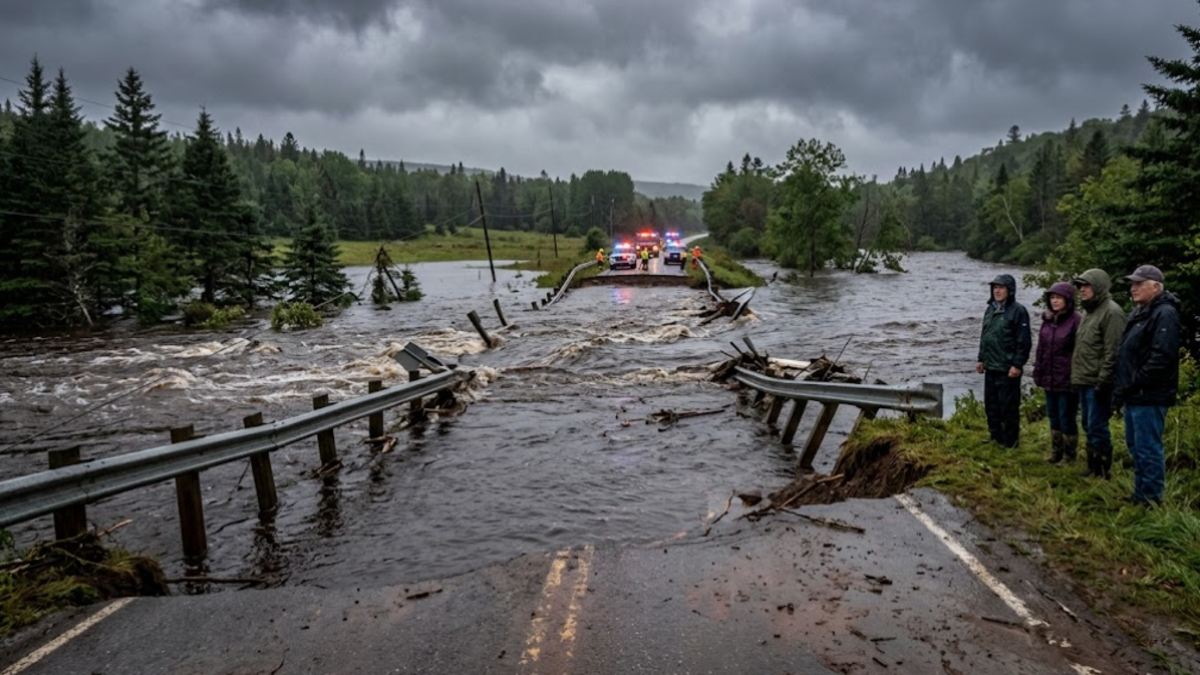
HALIFAX – Canadist: Nova Scotia flooding has left one woman dead and caused extensive damage across Cape Breton, with emergency officials warning residents to remain cautious as additional rainfall threatens already saturated communities. Roads, bridges and other infrastructure have suffered major damage, while authorities continue assessing the scale of the destruction. What does the latest situation mean for residents as another round of rain moves across the region?

Nova Scotia flooding leaves province mourning after woman’s death
Nova Scotia is mourning a Cape Breton woman who died during a weekend of intense rainfall and flooding that overwhelmed parts of the province.
The Royal Canadian Mounted Police confirmed that the body of a 46-year-old woman from Cleveland, Nova Scotia, was recovered Saturday afternoon after she was reported missing earlier that day.
Police said the woman’s vehicle had been found near her residence, on the far side of a flooded bridge. RCMP officers, search-and-rescue volunteers and local fire services then launched a search.

Responders recovered her body at about 2:30 p.m. in the Cleveland area, according to police information reported by The Canadian Press. RCMP said the death was not considered suspicious, but authorities have not publicly detailed the circumstances surrounding her death.
The death has added a deeply personal dimension to an emergency that has already disrupted communities across Cape Breton.
Premier Tim Houston expressed condolences to the woman’s family and loved ones while thanking first responders, emergency personnel, volunteers and municipal teams working in affected communities.
Houston also urged people to follow instructions from local authorities and avoid unnecessary travel while dangerous conditions continued.
The circumstances surrounding the woman’s death remain limited to what police have publicly confirmed. Authorities have not provided a detailed account of how she died, and that distinction matters as emergency crews continue to document the effects of the storm.
The flooding itself has been extensive, with some areas receiving more than 200 millimetres of rain over the course of the event.
Nova Scotia flooding damages roads, bridges and communities
Cape Breton has absorbed some of the heaviest rainfall, with several communities reporting totals exceeding 200 millimetres.
Environment and Climate Change Canada recorded exceptionally high rainfall totals at several official stations. Ingonish Beach recorded 211.5 millimetres, while Eskasoni First Nation recorded 193.2 millimetres and Sydney Airport recorded 182.8 millimetres in the weather agency’s Sunday summary. Port Hawkesbury recorded 126.4 millimetres.
Those volumes have translated into significant damage on the ground.
Roads have been washed out, culverts have failed and bridges and barriers have been damaged. Floodwater has also affected transportation routes in communities across Cape Breton and parts of northeastern mainland Nova Scotia.
In Marble Mountain, in Inverness County, flooding damaged a section of road so severely that a large opening was left where concrete had given way to the water, according to reports from the scene.
Richmond County has also experienced particularly serious flooding. More than 200 millimetres of rainfall was reported in parts of the county, with high water approaching bridges and threatening transportation links.
The scale of the damage prompted Inverness, Richmond and Victoria counties to declare local states of emergency.
Officials have stressed that the danger does not disappear simply because the most intense rainfall has passed. Flooded roads can conceal structural damage, weakened bridges and washed-out sections of pavement.
That is why emergency officials have repeatedly asked residents to avoid unnecessary travel.
Nova Scotia’s emergency authorities have warned people to respect road closures and barricades, check conditions before travelling and never drive through floodwater.
For residents in affected communities, the immediate challenge is therefore twofold: dealing with damage that has already occurred while preparing for additional rainfall that could further weaken roads and infrastructure.
Nova Scotia flooding comes after an unusually intense rainfall event
The weather system responsible for the flooding was slow-moving, allowing heavy rain to persist across eastern sections of the Maritimes.
Environment Canada described the event as a heavy rainfall system associated with a slow-moving low-pressure system tracking south of Nova Scotia.
The agency’s rainfall summary showed that the heaviest totals were concentrated in Cape Breton and surrounding areas, although substantial amounts also fell elsewhere in the province.
The figures help explain why local authorities quickly moved into emergency-response mode.
When more than 200 millimetres of rain falls over already saturated ground, water can overwhelm drainage systems, rivers can rise rapidly and roads can lose structural support.
The consequences were visible across Cape Breton, where communities reported washed-out roads and damaged infrastructure.
Local officials described the event as unusually severe.
Terry Doyle, the chief administrative officer in Port Hawkesbury, told The Weather Network that officials had not experienced anything of this size and effect in the community.
Richmond County Warden Lois Landry also described the storm as different from what the community normally experiences, despite the region’s long history of dealing with powerful weather events.
The flooding has consequently become more than a weather story. It is now an infrastructure and public-safety emergency affecting roads, transportation, electricity and local government operations.
Environment Canada warnings changed, but the weather threat remains
One of the most important developments is the change in weather warnings.
On Sunday, Environment and Climate Change Canada lifted its weather alerts for Nova Scotia as the heaviest part of the initial rainfall event moved away. At that point, forecasters expected another 10 to 20 millimetres in some areas, with the heaviest rain expected to taper while showers could continue.
However, conditions have since evolved.
Environment Canada has issued a yellow rainfall warning for eastern Cape Breton today, calling for another 25 to 40 millimetres of rain, with locally higher amounts possible in thunderstorms.
The warning applies to areas including Cape Breton’s eastern sections and reflects the fact that the ground has a reduced ability to absorb additional rainfall after the previous storm.
Forecasters are warning that water may pool on roads and in low-lying areas. They are also advising travellers to watch for washouts around rivers, creeks and culverts.
The latest forecast for Cape Breton calls for rain to end this afternoon, followed by cloudy conditions and a chance of showers. The forecast also includes a risk of a thundershower during the morning and early afternoon.
That means residents cannot assume that the end of the initial rainfall event marks the end of the emergency.
The combination of saturated ground and damaged infrastructure makes even a smaller amount of additional rain potentially significant.
Nova Scotia flooding leaves emergency declarations in place
The local states of emergency in Inverness, Richmond and Victoria counties underline the seriousness of the situation.
The declarations allow municipal authorities to coordinate emergency operations while crews inspect roads, bridges and other infrastructure.
Officials have also been dealing with the effects of widespread flooding on transportation.
Nova Scotia Emergency Management has warned that road conditions can change quickly and that roads affected by floodwater may be damaged or unsafe.
The advice to residents has been straightforward: stay away from flooded roads, obey closures and barricades, and turn around rather than attempting to cross water-covered routes.
That guidance has particular importance after reports of washed-out roads and damaged bridges.
A road that appears passable from a distance may have lost its supporting structure underneath the water. Drivers also risk becoming stranded if floodwater rises rapidly.
The province’s emergency information system continues to list flooding in parts of Cape Breton as an active event, with authorities urging residents to avoid non-essential travel while response crews assess the damage.
For communities that experienced the heaviest rainfall, the recovery process will take longer than the weather event itself.
Crews must determine which roads can reopen safely, which bridges require repairs and where temporary transportation arrangements may be necessary.
Power outages fall, but recovery work continues
The flooding also caused widespread electricity disruptions during the worst of the storm.
At one point Saturday, tens of thousands of customers were without power, according to Nova Scotia Power’s outage information cited by The Canadian Press.
By Sunday evening, the number had fallen to fewer than 200 affected customers.
The rapid improvement in electricity service offers some relief, but it does not mean the broader emergency has ended.
Power restoration is only one part of the recovery effort. Roads, bridges, culverts and other public infrastructure still require inspection and, in some cases, major repairs.
The province has also indicated that crews and equipment can be moved from other areas once conditions allow, with the aim of repairing roads and infrastructure as quickly as possible.
That work will depend heavily on access.
Flooded or damaged roads can prevent heavy equipment from reaching affected locations, while continued rain could complicate inspections and repairs.
Local authorities therefore face a difficult balance between restoring transportation links and keeping residents and workers away from unsafe areas.
Federal officials monitor the Nova Scotia flooding response
The flooding has also drawn attention from Ottawa.
Prime Minister Mark Carney said his thoughts were with people affected by the rainfall and flooding in eastern Nova Scotia and Cape Breton. He also thanked first responders working to protect residents.
Federal Emergency Management Minister Eleanor Olszewski said she was in contact with Nova Scotia Emergency Management Minister Kim Masland and that the federal government was prepared to provide support if required.
Conservative Leader Pierre Poilievre also called on the federal government to provide Nova Scotia and municipalities with resources needed to protect people and communities.
The federal response is being closely watched because the eventual cost of repairing damaged infrastructure could be substantial.
For now, however, the immediate priority remains public safety.
Officials are focused on keeping people away from dangerous roads, monitoring additional rainfall and assessing damage as floodwaters recede.
Nova Scotia flooding puts the focus on what happens next
The death of the Cleveland woman has become the most tragic element of the flooding, but officials are also confronting a much broader emergency.
Entire sections of Cape Breton have been affected by water damage, and the full cost of repairing roads and infrastructure remains unknown.
Authorities have warned that the complete picture will become clearer only as floodwaters recede and crews can safely reach damaged locations.
That assessment will be particularly important in Richmond, Inverness and Victoria counties, where local emergencies were declared after the storm caused widespread damage.
The latest weather forecast adds another layer of uncertainty.
Although the initial warnings were lifted Sunday, today’s rainfall warning for eastern Cape Breton shows that the weather threat has not completely disappeared.
The additional 25 to 40 millimetres forecast in some areas could put further pressure on already saturated ground and damaged infrastructure.
Residents therefore remain under pressure to make careful decisions about travel.
The advice from authorities is not to take chances with flooded roads, even where water levels appear manageable.
The emergency response is now moving from the initial phase of protecting people from rising water toward a longer process of damage assessment, infrastructure repair and community recovery.
That process will also have to account for the possibility of more rainfall.
For families affected directly by flooding, the recovery may involve damaged homes, disrupted travel and uncertainty over when roads and bridges will become safe again.
For the wider province, the storm is another reminder of how quickly severe rainfall can transform transportation and public-safety conditions.
The death of one resident has made the human cost of the event impossible to overlook.
Premier Houston’s message to Nova Scotians has remained focused on safety and solidarity: people should look after one another, listen to local officials and stay away from dangerous roads while conditions remain unsettled.
As crews continue their assessments and another round of rain moves through eastern Cape Breton, the priority remains clear: prevent further loss of life, keep damaged routes closed until they are safe, and begin the difficult work of rebuilding communities affected by one of the province’s most significant recent flooding events.
FAQ
What happened in the Nova Scotia flooding?
Heavy rainfall caused widespread flooding across Cape Breton and parts of northeastern Nova Scotia, damaging roads, bridges, culverts and other infrastructure.
Did anyone die in the flooding?
Yes. RCMP confirmed that a 46-year-old woman from Cleveland was found dead after being reported missing during the flooding. Police said the death was not considered suspicious.
Are there still weather warnings in Nova Scotia?
Environment Canada lifted its broader Nova Scotia alerts on Sunday, but a yellow rainfall warning is now in effect for eastern Cape Breton, where another 25 to 40 millimetres of rain is possible.
Which areas were most affected?
Cape Breton was among the hardest-hit areas, particularly Richmond, Inverness and Victoria counties. Those three counties declared local states of emergency following severe flooding and infrastructure damage.
Contact: info@canadaalyom.com