

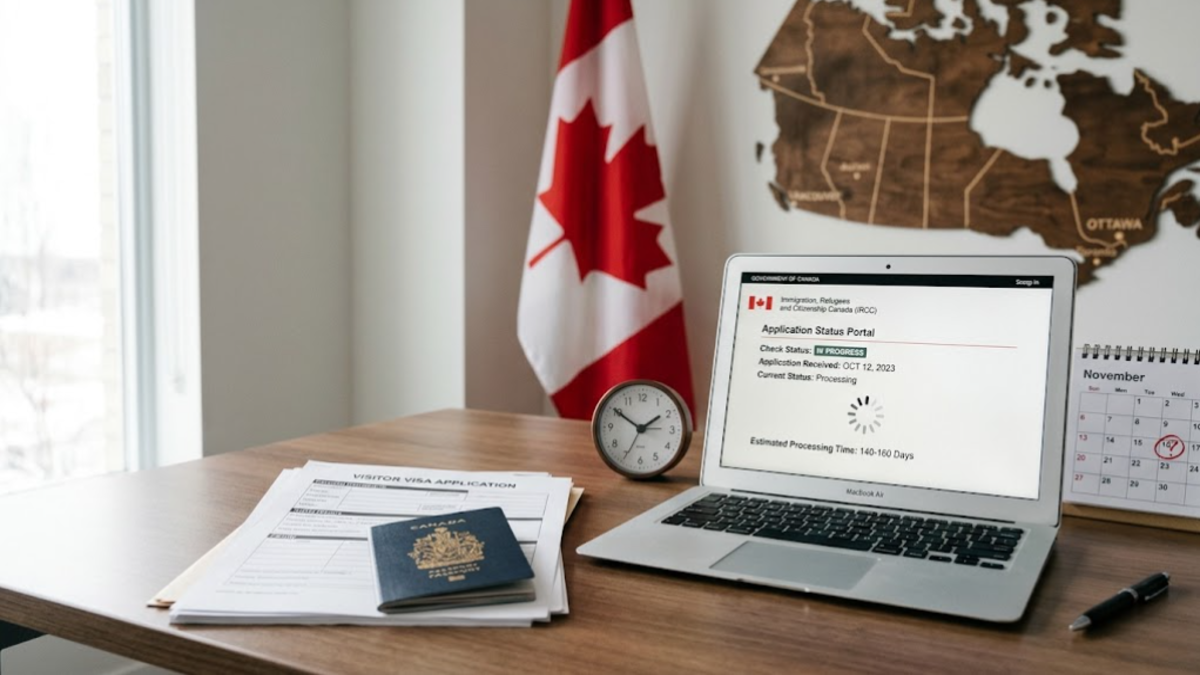
OTTAWA – Canadist: Canada Visitor Visa Processing Time remains a key concern for travellers planning family visits, holidays and short business trips, with the latest Immigration, Refugees and Citizenship Canada (IRCC) figures showing that waiting periods can differ sharply depending on where an application is submitted. So, how long are applicants really waiting now, and what can travellers do while their applications are in the queue?

The latest weekly figures available this week show a mixed picture for visitor visa applicants. Some major application streams have seen processing times rise, while others have improved considerably compared with earlier in the year.
For applicants, the most important point is that there is no single Canada visitor visa processing time that applies worldwide. IRCC calculates estimates according to the applicant’s location, the type of application and the department’s current workload.
That means two people applying for the same Canadian visitor visa can face very different waiting periods.

Recent immigration reporting based on IRCC’s latest weekly figures shows that applications submitted from India were estimated at 31 days, while applicants from Pakistan faced an estimated 75-day wait. Nigeria stood at 76 days, while applications from the United States and the Philippines were both estimated at 21 days.
The figures underline why travellers should check the processing estimate for their own country rather than relying on a general number found online.
Canada Visitor Visa Processing Time varies by country
IRCC’s latest figures reveal a considerable gap between different countries.
Applicants submitting visitor visa applications from India faced an estimated 31-day processing period in the latest update. That figure increased by four days from the previous weekly update, although it remained substantially below the level recorded at the beginning of the year.
For Pakistan, the estimated wait reached 75 days. The weekly increase was particularly noticeable, with the processing time rising by 27 days from the preceding update.
Nigeria recorded an estimated 76 days, the longest wait among the major countries highlighted in the latest figures. The Nigerian estimate increased by eight days during the same weekly period.
The United States presented a very different picture. Applications submitted there were estimated at 21 days, with no weekly change. The Philippines also stood at 21 days, although its estimate increased by five days.
These figures demonstrate why applicants should avoid treating reports about another country’s visa queue as a prediction for their own case.
IRCC itself warns that processing times are estimates rather than guarantees. The department says the timeline can change according to application completeness, workload, verification requirements and the speed with which applicants respond to requests.
For travellers with fixed plans, that distinction matters. A published processing estimate does not mean an applicant will receive a final decision exactly on the stated day.
The latest data also show that Canada’s visitor visa system is handling a substantial volume of applications. IRCC reported that more than 1.3 million visitor visa applications had been finalized since the beginning of the year, while about 337,100 applications had not yet been finalized in data covering the end of June.
That inventory helps explain why processing times can move from one weekly update to the next.
Canada Visitor Visa Processing Time has improved in some markets
The current numbers also need to be viewed against the broader trend.
Earlier updates showed much longer waits for some applicants. For example, visitor visa processing for applicants in India stood at 71 days in late February before falling to 57 days in March and then continuing to move lower during subsequent updates.
By late July, the reported estimate for India had fallen to 22 days, although it later increased to 31 days in the latest weekly figures. That movement illustrates how quickly processing estimates can change.
The decline from earlier peaks is important for travellers who remember reports of much longer waits.
However, the recent increase for several countries shows that applicants should not assume the downward trend will continue indefinitely.
Pakistan provides one of the clearest examples. Its visitor visa estimate rose from 48 days in an earlier update to 75 days in the latest figures. Nigeria also experienced an increase, reaching 76 days.
At the same time, the latest numbers do not point to a universal deterioration. Applications from the United States remained at 21 days, while the Philippines also stood at 21 days.
The result is a highly uneven processing landscape.
For travellers, the practical lesson is straightforward: check the IRCC estimate shortly before applying and again when planning important travel. The figure can change even when an applicant has already submitted a complete application.
Why the published number is only an estimate
IRCC uses processing-time estimates to give applicants an indication of how long an application may take. The department says the calculation considers factors including the number of applications already in its inventory, the number of people available to process them and expected application volumes.
The department also distinguishes between different methods of calculating processing times.
For temporary residence applications, the figures can include estimates based on current inventories and processing capacity. IRCC also uses historical data in certain circumstances, looking at how long it took to finalize a large proportion of applications in the past.
That distinction is important because an estimate does not function like a guaranteed service deadline.
An applicant who sees a 31-day estimate, for example, should not automatically treat the figure as a promise that a decision will arrive exactly one month after submission.
What applicants are waiting for after submitting
Once an application reaches IRCC, the process can involve several stages.
First, officials check whether the application contains the required information and documents. A missing document or incomplete application can create problems and may result in a refusal or delay.
Applicants may also need to provide biometrics. IRCC advises applicants who need fingerprints and a photograph to book their biometrics appointment as soon as possible because delays at that stage can affect the overall process.
The department may request additional information if officers need clarification.
Depending on the individual case, IRCC can ask an applicant to attend an interview, provide additional documents, complete a medical examination or obtain a police certificate.
These extra steps mean that two applications submitted on the same day may not finish at the same time.
The applicant’s circumstances can also affect how easily IRCC verifies the information provided.
This is one reason travellers should prepare their application carefully rather than treating the processing estimate as the only factor that determines the outcome.
A complete application can reduce the risk of avoidable delays, although it cannot guarantee faster processing or approval.
Applicants should also monitor their IRCC account for messages and requests. Ignoring a request for documents or failing to complete a required step can extend the process.
What the latest figures mean for travellers
For people planning a holiday, family visit or business trip, the latest numbers suggest that timing remains critical.
Someone applying from India may currently be looking at roughly one month according to the latest estimate, while applicants from Pakistan and Nigeria may need to allow considerably more time.
That difference becomes especially important during periods when travel dates cannot easily change.
A traveller attending a wedding, family event, conference or other fixed-date occasion should not assume that a visitor visa application will be completed before the planned departure simply because the published processing estimate appears shorter than the available preparation window.
The safest approach is to submit a complete application as early as practical and avoid making the visa decision the final step in a tightly scheduled travel plan.
Applicants should also remember that processing time is separate from the question of eligibility.
A short processing estimate does not mean approval is automatic.
IRCC evaluates whether the applicant meets the requirements for a visitor visa, including whether the person is genuinely seeking temporary entry and whether the information and documents support the application.
The Canadian government describes a visitor visa, also known as a temporary resident visa, as the official document placed in a passport to show that the holder meets the requirements needed to travel to Canada.
Travellers should therefore distinguish between three separate issues: how long the application may take, whether the applicant qualifies and whether the visa will be issued in time for the intended journey.
How applicants can monitor their Canada Visitor Visa Processing Time
Applicants can monitor their application after receiving the appropriate acknowledgement and by using their IRCC account and available application-status tools.
IRCC’s latest guidance says visitor visa applicants can check their status through the secure account and, where available, the application status tracker.
The department also recommends checking the current processing-time tool because estimates change.
The status page can provide information about the progress of an individual file, while the processing-time tool gives a broader estimate for the relevant application category and location.
These are not the same thing.
An applicant should not interpret a published processing estimate as proof that an individual file has reached a particular stage.
Likewise, a period without a visible status change does not necessarily mean that an application has been abandoned or ignored.
IRCC says applications can take longer than the published estimate when they are incomplete, unusually complex or require additional security checks.
The department may contact the applicant if it needs more information.
For this reason, travellers should ensure that their contact information remains current and check their account regularly.
Why visitor visa applicants should plan beyond the published estimate
The latest processing figures offer useful guidance, but they should not become the sole basis for travel planning.
The biggest risk comes from confusing an estimate with a deadline.
IRCC explicitly states that processing times are not a maximum and do not guarantee that an application will be completed within the published period.
That warning is particularly relevant for applicants from countries currently experiencing longer waits.
Pakistan and Nigeria, for example, have estimates of roughly two and a half months in the latest data. An applicant with a non-refundable flight, hotel reservation or event scheduled shortly after that period could face significant financial and logistical pressure if the decision takes longer.
Even applicants from countries with shorter estimates should leave room for unexpected developments.
Biometrics, additional document requests, interviews and other checks can affect individual cases.
The current data also show why old articles can quickly become misleading. Processing times have changed substantially during the year, including significant reductions for some applicant groups followed by increases in later weekly updates.
Applicants should therefore rely on the latest available IRCC information rather than a processing figure published several months earlier.
What travellers should take from the latest update
The current picture is neither a simple improvement nor a universal slowdown.
Instead, Canada visitor visa processing remains highly dependent on the applicant’s country and the circumstances of the application.
India’s latest estimate of 31 days represents a significant improvement compared with earlier levels, but the weekly increase shows that the queue can move in either direction.
Pakistan and Nigeria now face substantially longer estimates, while the United States and the Philippines remain at 21 days in the latest figures.
The broader application data also show that IRCC continues to process a very large number of visitor visa files, with more than one million applications finalized and hundreds of thousands still awaiting finalization in the latest available inventory figures.
For applicants, preparation remains the strongest practical response.
Submit the required information, provide biometrics promptly when requested, monitor the account and respond quickly if IRCC asks for additional material.
Most importantly, plan travel around the uncertainty rather than assuming the published estimate guarantees a decision date.
The latest figures provide a useful snapshot of the queue, but every visitor visa application remains individual.
FAQ
How long does a Canada visitor visa take?
The latest estimates vary by country. Recent figures show about 31 days for India, 75 days for Pakistan and 76 days for Nigeria, while applications from the United States and the Philippines were estimated at 21 days.
Is the Canada visitor visa processing time guaranteed?
No. IRCC describes its processing times as estimates, not guarantees. Individual applications can take longer because of completeness issues, verification, security checks or additional requests.
Can applicants speed up a visitor visa application?
There is no general guarantee that an applicant can accelerate a standard visitor visa application. Providing complete information, completing biometrics promptly and responding quickly to IRCC requests can help avoid applicant-caused delays.
Where can I check my current processing time?
Applicants should use the official IRCC processing-time tool and their IRCC account to monitor the latest estimate and individual application status…More
Contact: info@canadaalyom.com