

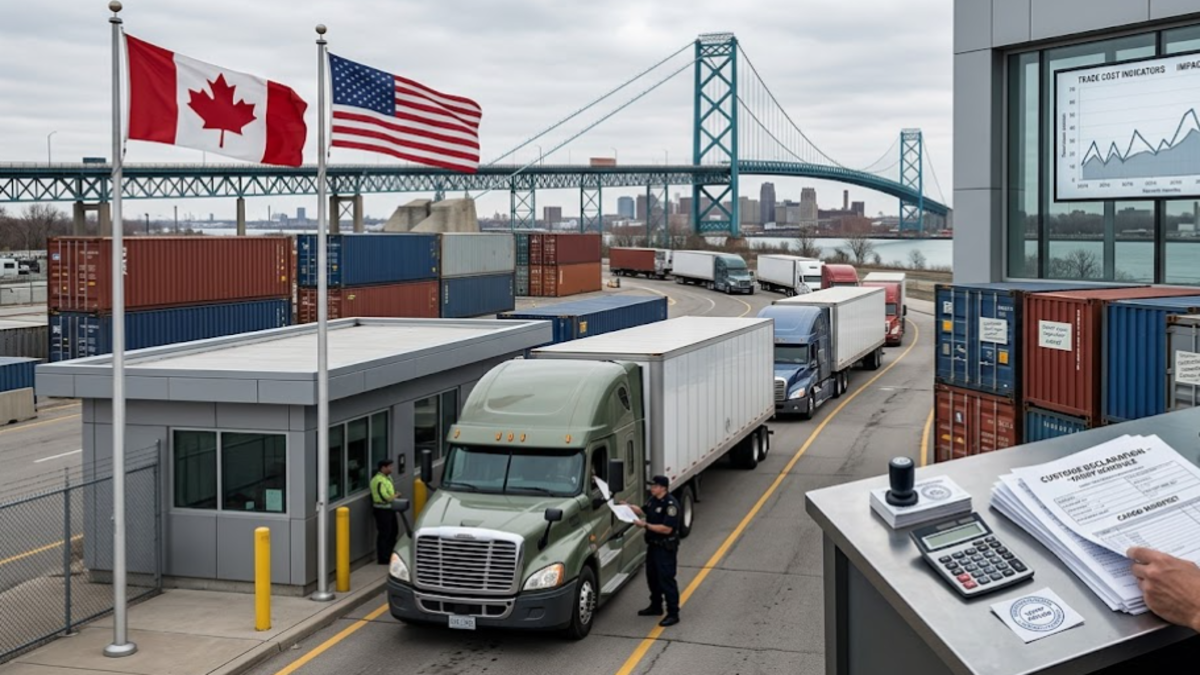
Ottawa – Canadist: Canada–U.S. trade relations are facing renewed pressure as tariffs, countermeasures and uncertainty continue to affect Canadian businesses, consumers and the broader economy, but how deep are the effects becoming?

The relationship between the two economies remains highly integrated, with goods and services worth about US$2.5 billion crossing the border every day, according to the Canadian government. At the same time, the trade dispute has created new costs and uncertainty for companies that depend on cross-border supply chains and access to the U.S. market.
The Canada-United States-Mexico Agreement, or CUSMA, continues to provide broad protection for Canadian exports. According to Canada’s Spring Economic Update, about 85% of Canada’s exports to the United States remain tariff-free under the agreement, while the effective average U.S. tariff rate on Canadian goods is 5.2%. However, sector-specific tariffs remain a major source of pressure.
Canada–U.S. Trade Relations and the Pressure on Canadian Businesses
For Canadian businesses, the impact of the trade dispute is not limited to the direct cost of tariffs. Companies also face uncertainty over future market access, supply chains and investment decisions.

Statistics Canada reported that 34% of businesses expected U.S. tariffs on Canadian imports to have a negative impact on their operations over the following 12 months. The proportion was higher in manufacturing, at 54%, wholesale trade, at 47.1%, and agriculture, forestry, fishing and hunting, at 46.3%.


The same survey showed that more than one-quarter of businesses had passed tariff-related cost increases on to customers during the preceding 12 months. That creates a direct link between trade policy and the prices paid by consumers, particularly when businesses have limited room to absorb higher costs themselves.
The pressure is also visible in earlier business data. In the first quarter, 32.2% of Canadian businesses reported that U.S. tariffs had negatively affected their operations during the previous 12 months. Manufacturing, agriculture, forestry, fishing and hunting, and wholesale trade were among the sectors reporting the highest levels of negative impact.
These figures show that the consequences are uneven. Some companies may experience little direct impact, while businesses that export heavily to the United States or rely on imported inputs can face greater exposure.
Canada–U.S. Trade Relations and the Impact on Consumers
Tariffs ultimately affect consumers through several channels. When an imported product becomes more expensive because of a tariff, businesses must decide whether to absorb the additional cost, reduce margins or pass part of it on to customers.
The Canadian government has warned that tariffs can increase costs for consumers and put jobs at risk. It has also encouraged Canadians to consider Canadian-made products where possible, particularly as companies affected by weaker U.S. exports seek stronger domestic demand.
The effect on consumers also depends on the structure of the product and its supply chain. A Canadian-made product may still contain materials or components sourced from the United States, meaning that trade measures can affect prices even when the finished product is manufactured in Canada.
This is particularly relevant to highly integrated industries, where components can cross the border multiple times before reaching the final customer.
For households, the result can be a more complicated purchasing environment in which prices depend not only on the final product but also on the origin of its components and the tariff treatment applied at the border.
Tariffs and the Canadian Economy
The wider economic effect depends on how businesses, consumers and governments respond to the trade disruption.
Canada’s government has maintained that its objective is to protect Canadian workers and businesses while seeking a negotiated settlement with the United States. Since September 1, 2025, Canada has removed most of its counter-tariffs on U.S. imports, while keeping measures targeting U.S. steel, aluminum and automobiles in place.
The automotive sector remains a key example of the complexity of the dispute. Canada applies a 25% tariff to non-CUSMA-compliant vehicles imported from the United States, as well as to the non-Canadian and non-Mexican content of CUSMA-compliant vehicles imported from the U.S.
The Canadian government has also introduced tariff relief and support measures aimed at helping businesses adjust. Federal programs include tariff remission, support for affected workers and businesses, and financing measures for companies facing trade-related pressures.
The challenge for the Canadian economy is that the United States remains a critical export destination even as Canada seeks to diversify its trade relationships. The government has said that the U.S. market remains a top destination for Canadian exports, making stable and predictable trade conditions important for investment and long-term business planning.
What Comes Next for Canada–U.S. Trade Relations?
The future of Canada–U.S. trade relations will depend heavily on negotiations, tariff policy and the continued operation of CUSMA.
For Canadian companies, the immediate priority is managing uncertainty. Businesses may need to review supply chains, assess their exposure to U.S. tariffs and consider alternative markets where commercially viable. However, the ability to diversify varies considerably between industries and individual companies.
For consumers, the effects will depend on how much of the additional cost businesses pass through to retail prices and whether Canadian or alternative suppliers can replace affected imports.
For the economy as a whole, the central issue is whether trade tensions remain temporary or become a longer-term feature of North American commerce. The longer uncertainty persists, the more difficult it can become for companies to make investment and expansion decisions with confidence.
The Canadian government continues to provide information and support for businesses, workers and exporters affected by the changing trade environment through its official Canada–U.S. relations portal.
How important is the U.S. market to Canada?
The United States remains a major destination for Canadian exports, and the two countries have deeply integrated supply chains and extensive cross-border trade.
Are all Canadian exports to the U.S. subject to tariffs?
No. Under CUSMA, about 85% of Canada’s exports to the United States remain tariff-free, although sector-specific tariffs continue to affect areas including steel, aluminum, automotive and forestry products.
How are tariffs affecting Canadian businesses?
The impact varies by industry. Statistics Canada reported that 34% of businesses expected U.S. tariffs to have a negative effect on their operations over the following 12 months, with manufacturing and several other trade-exposed sectors reporting higher levels of concern.
Can tariffs increase prices for Canadian consumers?
Yes. Businesses facing higher import or production costs may absorb those costs, reduce margins or pass some of them on to customers. Statistics Canada reported that more than one-quarter of businesses had passed tariff-related cost increases on to customers during the preceding 12 months.
Conclusion
Canada–U.S. trade relations remain central to Canada’s economic outlook, but tariffs and continuing uncertainty are creating pressure across businesses, supply chains and consumer markets. While CUSMA continues to protect a large share of Canadian exports, sector-specific tariffs and countermeasures are forcing companies and policymakers to adapt. The scale of the long-term impact will depend largely on whether the two countries can restore greater predictability to their trading relationship.
Contact: info@canadaalyom.com