

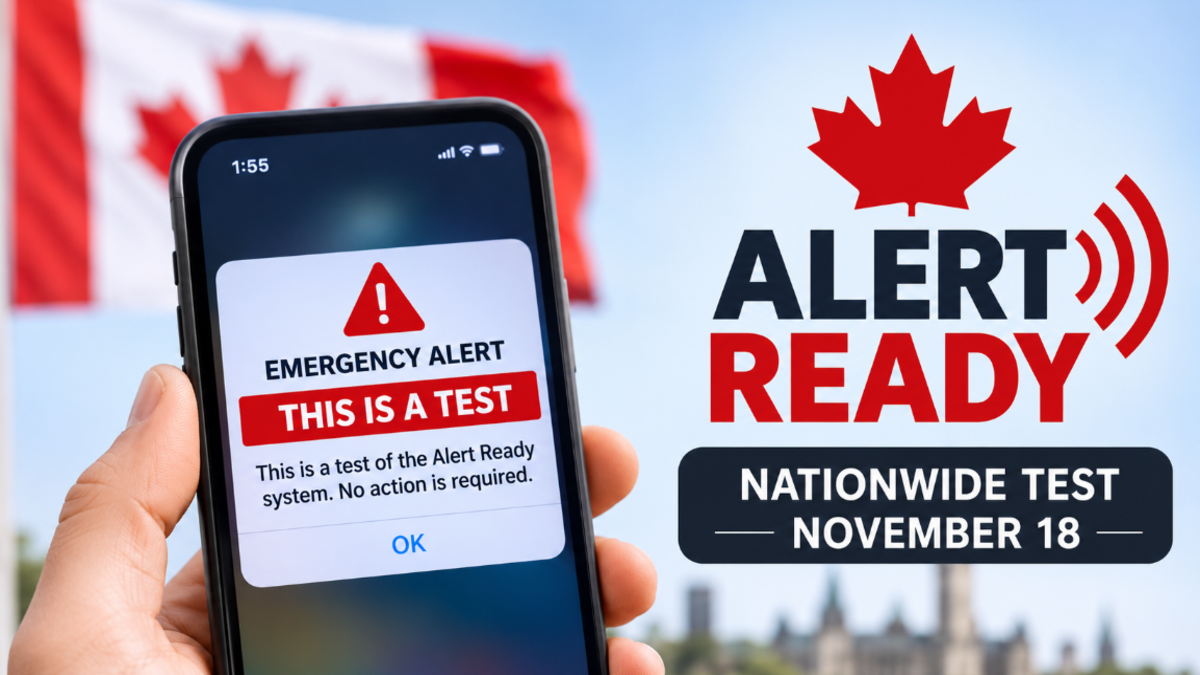
Canada to Conduct Nationwide Alert Ready Emergency Test on November 18
Canadians across the country will hear emergency alert tones on their mobile phones, televisions and radios on Wednesday, November 18, as authorities conduct a nationwide test of the Alert Ready emergency alert system.

The test will take place in all provinces and territories. It is designed to check that the national public alerting infrastructure is working properly and to familiarise residents with the sound and appearance of emergency warnings.
Although the notification may resemble a real emergency alert, the message will clearly identify itself as a test. Residents do not need to take any action.
When will the Alert Ready test take place?
The national test is scheduled for November 18, with different local broadcast times depending on the province or territory.

The announced schedule is as follows:
| Province or territory | Local test time |
|---|---|
| British Columbia | 1:55 p.m. |
| Alberta | 1:55 p.m. |
| Saskatchewan | 1:55 p.m. |
| Manitoba | 1:55 p.m. |
| Ontario | 12:55 p.m. |
| Quebec | 1:55 p.m. |
| New Brunswick | 10:55 a.m. |
| Nova Scotia | 1:55 p.m. |
| Prince Edward Island | 12:55 p.m. |
| Newfoundland and Labrador | 9:55 a.m. |
| Northwest Territories | 1:55 p.m. |
| Yukon | 1:55 p.m. |
| Nunavut | 1:55 p.m. |
These are the announced regional times for the November test. Residents should consult their provincial or territorial emergency management authority for any local updates.
Which devices will receive the emergency alert?
The Alert Ready system distributes test messages through three main channels:
Mobile phones: Compatible wireless devices connected to an LTE or newer network, including 5G.
Television: The test interrupts regular television programming.
Radio: Participating radio stations broadcast the alert tone and test message.
The system is designed to reach people in the affected geographical area rather than relying on individual phone numbers.
However, not every mobile phone will necessarily receive the notification. Reception depends on several factors, including:
Whether the device is compatible with wireless public alerts.
Whether it is connected to an LTE or 5G network.
Whether it is within the coverage area of a participating cell tower.
Whether its software and settings support the alert system.
The Canadian Radio-television and Telecommunications Commission (CRTC) confirms that location services do not need to be enabled to receive emergency alerts. The messages are distributed through a dedicated wireless broadcast channel rather than conventional SMS text messages.
CRTC+1
Residents can check device compatibility through the official Alert Ready wireless compatibility page.
Why is Canada testing the Alert Ready system?
The test is not simply an exercise to make mobile phones produce an emergency sound. It is an opportunity to assess the infrastructure used to distribute urgent warnings across the country.
The National Public Alerting System (NPAS) brings together federal, provincial and territorial authorities, emergency management organizations, broadcasters, wireless providers and technical partners.
The process works in several stages:
An authorized government or emergency management organization prepares an alert.
The message is submitted to the National Alert Aggregation and Dissemination (NAAD) System.
The system distributes the alert to participating broadcasters and wireless service providers.
The public receives the notification through compatible devices, television or radio.
Pelmorex operates the NAAD technical infrastructure, which helps collect and distribute alerts from authorized issuers.
passengerprotect-protectiondespassagers.gc.ca+1
Regular testing helps identify technical problems, check communication between participating organizations and ensure that the public recognises the warning signal.
The system is used during genuine emergencies, including:
Tornadoes and severe weather events.
Floods and other natural disasters.
Wildfires and evacuation situations.
AMBER Alerts involving children believed to be in serious danger.
Other threats that require urgent public notification.
Can Canadians opt out of the Alert Ready test?
No. Canadians cannot opt out of receiving emergency alerts, including public test notifications.
The CRTC requires wireless service providers to distribute alerts to compatible devices connected to LTE or newer networks within the designated geographical area.
The system is intended to warn people about potentially life-threatening situations. Allowing users to disable these warnings entirely would undermine its public safety purpose.
Some phones may offer options to adjust how notifications are presented, such as vibration or sound settings. However, these options should not be confused with the ability to opt out of the national alerting system.
CRTC+1
What should you do when the test alert appears?
When the notification arrives, read the message and check that it clearly identifies itself as a test.
There is no need to evacuate, contact emergency services or take any other protective action in response to the scheduled exercise.
A few practical recommendations can help households prepare for real emergencies:
Make sure your mobile phone has up-to-date software.
Check whether your device is compatible with Alert Ready.
Become familiar with the emergency alert tone.
Discuss an emergency communication plan with family members.
Keep a basic emergency kit and know where to find official local instructions.
One important distinction: A genuine emergency alert will provide information about the actual threat and instructions on what people in the affected area should do. Never assume that a notification is a test simply because it arrives unexpectedly.
A safety consideration for people using hidden devices
There is another issue worth considering before the test.
The Anishinabek Police Service has warned that emergency alert notifications could expose hidden mobile phones or tablets used by people experiencing intimate partner violence as part of a personal safety plan.
Anyone relying on a concealed device for protection should consider the potential risk of an unexpected alert and follow appropriate safety-planning advice. The police service specifically advises switching off hidden devices before the test to reduce the risk of discovery.
Anishinabek Police Service
How often does Canada test its emergency alert system?
The CRTC explains that broadcasters and wireless service providers conduct two public alert tests each year.
The first generally takes place in May during Emergency Preparedness Week, while the second usually occurs in November.
The exact schedule can vary between provinces and territories, as local emergency management authorities coordinate their participation.
The November exercise is therefore part of an established testing programme rather than a response to a newly declared national emergency.
CRTC+1
Our assessment: Why these tests matter
Emergency alerts are useful only if messages can reach the public quickly and people understand what they mean.
Canada’s Alert Ready system provides an important communication channel during situations where minutes can make a difference. However, its effectiveness depends on more than the technology itself. Authorities must be able to issue accurate information, telecommunications infrastructure must distribute it reliably, and residents must recognise the warning and understand how to respond.
Regular public tests are therefore a necessary part of emergency preparedness. They also give households an opportunity to review their own plans rather than treating emergency notifications as something that concerns only government agencies.
The November 18 exercise should be understood for what it is: a routine test of a public safety system, not an indication that a nationwide emergency is taking place.
Official Sources
1. Public Safety Canada — National Public Alerting System
https://www.passengerprotect-protectiondespassagers.gc.ca/cnt/mrgnc-mngmnt/mrgnc-prprdnss/ntnl-pblc-lrtng-sstm-en.aspx
2. Canadian Radio-television and Telecommunications Commission (CRTC) — Emergency Alerts and the National Public Alerting System
https://crtc.gc.ca/eng/television/services/alert.htm
3. Pelmorex Corp. / Alert Ready — Emergency Alert Test in Canada: Alert Ready to Issue Nationwide Test on November 18, 2026
https://www.globenewswire.com/news-release/2026/11/16/3403288/0/en/emergency-alert-test-in-canada-alert-ready-to-issue-nationwide-test-on-november-18-2026.html
4. Anishinabek Police Service — Upcoming Test of the Alert Ready System: Nov. 18, 2026
https://www.anishinabekpolice.ca/upcoming-test-of-the-alert-ready-system-nov-18-2026
5. Alert Ready — Wireless Device Compatibility
https://www.alertready.ca/wireless/