
Daylight Saving Time Ends on November 1: What Canadians Need to Know
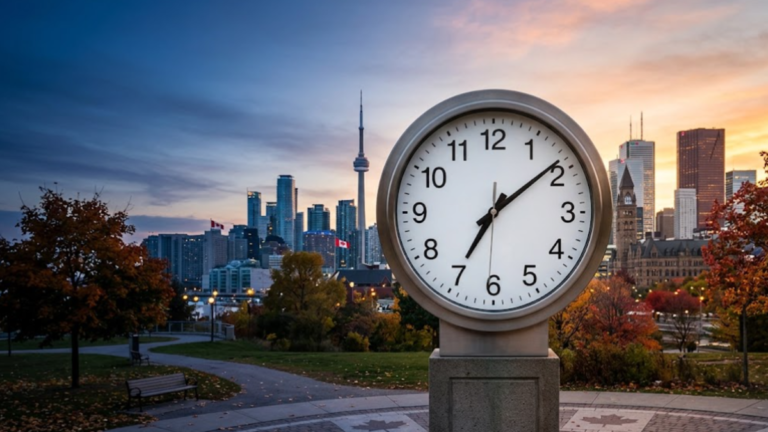
Daylight saving time ends on Sunday, November 1, 2026, in most parts of Canada. At 2:00 a.m., clocks move back one hour to 1:00 a.m., giving residents an extra hour on the clock and marking the return to standard time.

The change affects millions of Canadians, but not everyone follows the same schedule. Some provinces and territories do not observe daylight saving time, while certain communities follow local arrangements. Knowing the rules in your area can help avoid confusion with work schedules, travel, appointments and digital devices.
When do clocks go back in Canada?
In most Canadian regions that observe daylight saving time, the change takes place at 2:00 a.m. local time on November 1. Clocks are turned back to 1:00 a.m.
This means the night is effectively one hour longer. After the change, mornings become brighter earlier, while sunset occurs earlier in the afternoon and evening.

The return to standard time is part of Canada’s seasonal clock system. Daylight saving time generally begins in spring, when clocks move forward one hour, and ends in autumn, when they move back.
Does all of Canada change its clocks?
No. Canada’s timekeeping rules are not identical across the country. Most provinces and territories observe daylight saving time, but some areas remain on standard time throughout the year.
Examples include:
Most of Saskatchewan: The province generally stays on Central Standard Time throughout the year, although some border communities follow different arrangements.
Yukon: The territory adopted year-round Mountain Standard Time in 2020 and no longer changes clocks seasonally.
Some communities in British Columbia: Certain northeastern communities do not follow the same seasonal clock changes as most of the province.
Other local exceptions may apply, so residents should check the time zone used by their municipality rather than assume that every nearby community changes its clocks.
Major changes in 2026: several regions will not turn clocks back
The usual November clock change no longer applies across as much of Canada as it once did. Several jurisdictions have adopted permanent time arrangements, meaning residents will keep the same clocks on November 1.
British Columbia: Most of the province has adopted year-round Pacific Time. November 1 will be the first date on which clocks remain unchanged under the new system. Some southeastern communities will continue to follow their existing seasonal arrangements.
Alberta: The province has adopted permanent Alberta Time, ending the fall clock change.
Manitoba: The province has adopted year-round Manitoba Standard Time, which matches the time previously used during daylight saving time.
Northwest Territories: The territory has introduced permanent Northwest Territories Time, set at UTC−6.
Yukon: The territory has used UTC−7 year-round since 2020.
Most of Saskatchewan: The province continues to use Central Standard Time year-round, with local provisions for border communities.
These changes mean that November 1 is not a nationwide clock-change date. Residents in the jurisdictions above should not automatically set their clocks back.
Province of British Columbia+5
Where the seasonal change still applies
Residents in the following areas should still expect the traditional fall change:
Newfoundland and Labrador: The provincial government confirmed that clocks go back at 2:00 a.m. on November 1.
Nova Scotia, New Brunswick and Prince Edward Island: These provinces continue to use the seasonal Atlantic time change.
Most of Quebec and Ontario: The usual November change remains in place, although local exceptions apply.
Nunavut: The territory spans three time zones. Most communities follow seasonal changes, but Southampton Island remains on Eastern Standard Time throughout the year.
In northwestern Ontario, a new regulation takes effect on November 1, keeping the area west of the 90th meridian on year-round time aligned with Manitoba. Ontario communities east of that line continue to change their clocks.
News Releases+6
What time change means for daily life
For people in regions that still move their clocks back, the most noticeable effect is the shift in daylight. Sunrise comes earlier by the clock, but sunset also happens earlier. This can make mornings feel brighter while reducing the amount of daylight available after work or school.
The change can also affect:
Work schedules: Overnight shifts may involve the repeated hour between 1:00 a.m. and 2:00 a.m. Employers should make sure shift and payroll arrangements account for the change.
Travel: Flights, trains, buses and intercity connections should be checked using the local time at the departure and arrival points.
Appointments: People arranging meetings across provinces should confirm the time zone, particularly where neighbouring communities no longer change clocks together.
Technology: Smartphones and computers usually update automatically when their time-zone settings are correct. Some household clocks, car displays and appliances may need manual adjustment.
Because several jurisdictions have changed their systems, relying on an old province-wide time-change calendar could lead to missed appointments or incorrect travel plans.
What should you do on November 1?
If you live in an area that still observes the seasonal change:
Turn back manually operated clocks by one hour, if they do not update automatically.
Check alarms, heating controls, vehicle clocks and other devices.
Confirm travel bookings and work schedules, especially for overnight shifts.
Replace the batteries in smoke alarms and carbon monoxide detectors if they are due for replacement.
Newfoundland and Labrador’s government has specifically encouraged residents to use the clock change as a reminder to check smoke-alarm and carbon-monoxide-detector batteries.
News Releases
Is Canada ending daylight saving time?
There is no single nationwide decision to abolish seasonal clock changes. Timekeeping is largely a provincial and territorial responsibility, which is why different parts of Canada can adopt different systems.
The changes introduced in 2026 show that the issue is evolving. Some governments have chosen a permanent time arrangement, while others continue to follow the traditional spring and autumn changes. In some regions, the decision is also influenced by the need to stay aligned with neighbouring jurisdictions.
For residents, the practical lesson is simple: check the rules that apply to the specific city or community, rather than assuming the whole province or territory follows one schedule.
Our assessment
Canada’s move towards different permanent-time arrangements makes the annual clock change less uniform than it used to be. Ending the twice-yearly adjustment may make life more predictable in some regions, but different rules across provincial borders can create new complications for travel, business and public services.
The most useful approach is clear communication from local governments and reliable time-zone settings on digital devices. Until more jurisdictions coordinate their policies, Canadians should check their local rules before assuming that November 1 means turning the clock back.
Official Sources
National Research Council Canada — Time Zones and Daylight Saving Time — https://www.cnrc.canada.ca/en/certifications-evaluations-standards/canadas-official-time/time-zones-daylight-saving-time
Government of British Columbia — Permanent Daylight Saving Time — https://www2.gov.bc.ca/gov/content/governments/celebrating-british-columbia/daylight-saving-time
Government of Alberta — Alberta’s New Time System — https://www.alberta.ca/albertas-new-time-system-abt
Government of Manitoba — No More Falling Back — https://gov.mb.ca/timechange/index.html
Government of the Northwest Territories — Northwest Territories Ends Seasonal Time Change — https://www.gov.nt.ca/en/newsroom/northwest-territories-ends-seasonal-time-change
Government of Yukon — Learn About Yukon Standard Time — https://yukon.ca/en/your-government/about-yukon/learn-about-yukon-standard-time
Government of Saskatchewan — Saskatchewan Time System — https://www.saskatchewan.ca/Government/Municipal-Administration/Tools-Guides-and-Resources/Saskatchewan-Time-System
Government of Newfoundland and Labrador — Public Advisory: Daylight Saving Time Ends November 1 — https://www.gov.nl.ca/releases/2026/mca/1030n06/
Government of New Brunswick — Time Definition Act — https://laws.gnb.ca/en/document/cs/2011-C.229
Government of Québec — Changement d’heure (temps légal) — https://www.quebec.ca/gouvernement/portrait-quebec/changement-heure
Government of Ontario — Ontario Regulation 333/26: Variation of Time in Effect — https://www.ontario.ca/laws/regulation/260333