

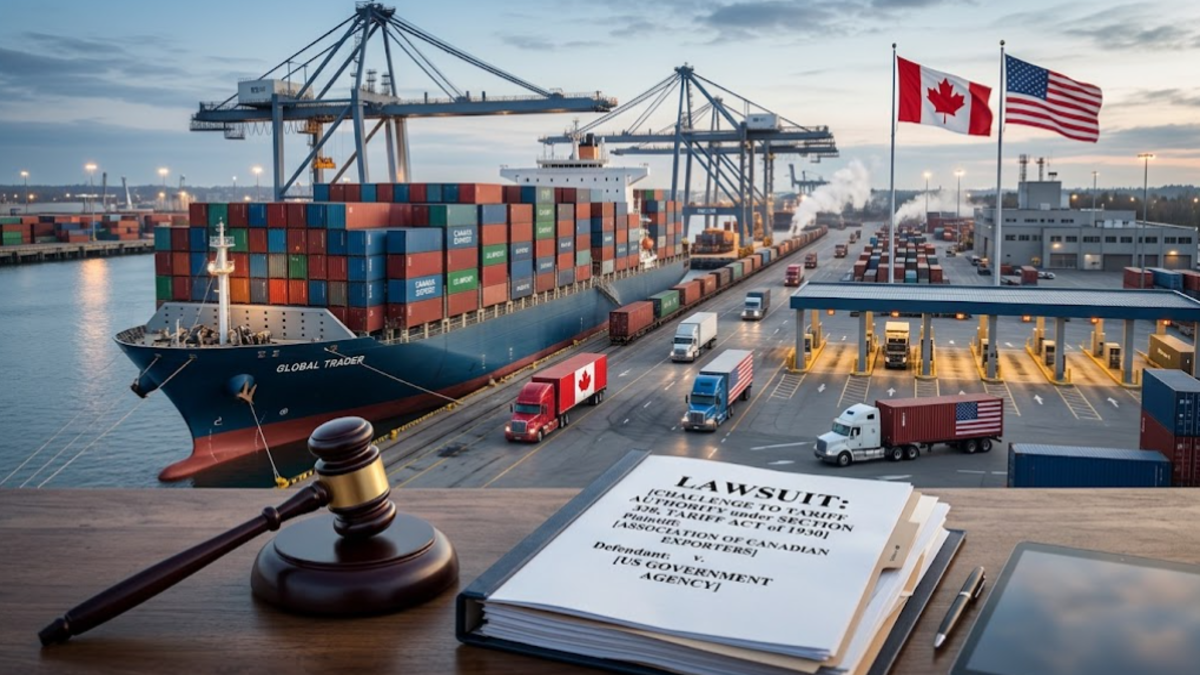
US Tariffs on Canadian Goods: What the New Section 338 Lawsuit Could Mean for Canada
A new lawsuit challenging the United States’ 50% tariffs on a range of Canadian imports could become an important test of presidential authority over trade policy. Filed on October 20, 2026, by food importer Gellert Global Group, the case challenges the Trump administration’s use of Section 338 of the Tariff Act of 1930, a rarely used provision invoked to impose duties on Canadian goods. The outcome could affect importers, Canadian exporters, cross-border supply chains and the wider trade relationship between the two countries.


AP News
+1
The legal challenge does not suspend the tariffs automatically. Unless a court orders otherwise or the government changes its policy, businesses should continue to treat applicable duties and import restrictions as active.
What is the new Section 338 lawsuit?
Gellert Global Group, a US food importer that handles Canadian products including cheese, has filed a case against the Trump administration in the US Court of International Trade. The lawsuit argues that the president exceeded his legal authority by relying on Section 338 to impose the tariffs.

According to reports on the filing, the company’s legal challenge raises two central questions: whether Section 338 can support the measures imposed against Canada, and whether later trade laws have limited or superseded the president’s authority under that older statute. The arguments remain claims by the plaintiff, not a judicial finding that the tariffs are unlawful.
AP News
+1
The case is significant because Section 338 dates from 1930 and has rarely been used in modern trade disputes. The administration maintains that the provision authorizes additional duties when a foreign country discriminates against US commerce.
The lawsuit must now proceed through the legal process. No final ruling on the merits is established by the filing itself.
Why did the United States impose the tariffs?
The US administration announced the Section 338 measures on July 20, citing what it described as discriminatory Canadian treatment of American products in three sectors: motor vehicles, alcoholic beverages and dairy.
The administration’s position is that Section 338 allows the president to impose additional duties to offset disadvantages faced by US commerce. The statute permits duties of up to 50% under specified conditions and also provides for possible import exclusions in certain circumstances.
United States Trade Representative
+1
The measures subsequently expanded in scope. Canadian government guidance says that, from August 22, a 50% tariff applied to a wider range of Canadian imports valued at approximately C$27.6 billion, including products in sectors such as plastics, furniture, electronics, machinery, wood, paper, textiles and sporting goods. Later US actions also modified the product lists and introduced import bans affecting certain Canadian goods.
tradecommissioner.gc.ca
+1
A key issue for businesses is that qualifying for preferential treatment under the Canada–United States–Mexico Agreement (CUSMA, known as USMCA in the United States) does not, by itself, exempt a product from these Section 338 tariffs. Exporters must check the specific product classification and applicable measures rather than assume that CUSMA origin rules eliminate the additional duty.
tradecommissioner.gc.ca
+1
What is Section 338, and why is it legally controversial?
Section 338 is part of the Tariff Act of 1930. It gives the president authority to impose additional duties when the statutory conditions concerning discriminatory or unequal treatment of US commerce are met.
The dispute is not simply about whether tariffs are economically desirable. It concerns how much authority Congress delegated to the president, what findings are required before that authority can be used, and whether later trade legislation affects the interpretation or application of the older provision.
The importer’s lawsuit reportedly argues that subsequent laws established more restrictive procedures or limits on presidential tariff powers. The government, by contrast, has publicly defended its Section 338 actions as a response to what it considers discriminatory Canadian trade practices.
AP News
+1
These competing positions will need to be assessed through the legal process. The existence of other disputes over presidential tariff powers does not automatically determine this case: the statute invoked, the official findings and the specific measures under challenge all matter.
How could the lawsuit affect Canada?
The immediate plaintiff is a US importer, not the Canadian government. Nevertheless, the case could have important consequences for Canadian businesses if it leads to a court order limiting the tariffs or if it influences the administration’s future trade policy.
| Possible outcome | What it could mean for Canada |
|---|---|
| The challenge succeeds and the court blocks the measures | Some affected importers could receive relief, potentially improving market access for covered Canadian products, subject to the scope of the ruling and any appeal. |
| The court rejects the challenge | The tariffs could remain in place while other legal or political avenues continue. |
| The court issues a narrower ruling | Relief could apply only to certain products, parties or legal questions rather than ending all Section 338 measures. |
| The dispute prompts a policy change or negotiations | The US and Canada could alter the measures or reach an arrangement, but the lawsuit itself does not guarantee this outcome. |
These are possible scenarios, not predictions. The effect on any particular exporter will depend on the court’s decision, the products covered and whether other duties or restrictions apply.
Canadian exporters: What to do now
Businesses selling to US customers should avoid basing financial plans on the assumption that the lawsuit will succeed. Practical steps include:
Verify tariff exposure: Check the current US tariff schedule and official product-specific Section 338 actions using the precise customs classification.
Review contracts: Establish who bears the cost of duties under existing supply agreements and whether prices can be adjusted.
Document origin and classification: Keep records needed to substantiate the product’s origin, tariff classification and customs declarations.
Assess supply-chain alternatives: Consider whether other markets or customers could reduce exposure if tariffs persist.
Monitor official updates: Follow US government announcements and Canadian trade guidance for changes in product coverage, exclusions and countermeasures.
Canadian firms may also consult federal support resources for businesses affected by US tariffs. The Government of Canada has announced targeted countermeasures and support programs, although eligibility and relief depend on the relevant program’s rules.
Gobierno de Canadá
+1
Our assessment
The lawsuit creates a legal avenue for challenging the tariffs, but Canadian businesses should distinguish a challenge from an actual change in trade policy. A successful ruling could provide relief within the scope of the court’s order; a failed or limited challenge could leave many exporters facing continued costs and uncertainty.
For Canada, the broader concern is the unpredictability of access to its largest export market. Even before a final judgment, uncertainty over tariffs can complicate pricing, investment decisions, hiring and long-term supply agreements.
The most useful response is to combine close monitoring of the case with practical contingency planning. Until a court or the administration changes the applicable measures, exporters should not assume that the lawsuit will remove their tariff obligations.
Frequently asked questions
Have the Section 338 tariffs been suspended because of the lawsuit?
No suspension is established by the filing itself. Businesses should check official tariff notices and any subsequent court orders before changing their customs procedures.
Why is the lawsuit important to Canadian companies?
A ruling could affect the legality or scope of tariffs on certain Canadian imports, influencing costs and access to US customers. The precise impact would depend on the court’s decision.
Does CUSMA protect Canadian goods from these tariffs?
Not necessarily. Canadian government guidance states that goods qualifying for preferential CUSMA treatment are not automatically exempt from the Section 338 tariffs. Importers should verify the applicable product-specific rules.
What is Section 338 of the Tariff Act of 1930?
It is a US law that authorizes additional duties, up to 50% under specified conditions, when the president makes the required findings concerning discrimination or disadvantages affecting US commerce.
What should Canadian exporters do while the case proceeds?
They should confirm tariff classifications and current measures, review contract terms, retain origin documentation, assess alternative markets and follow official updates from US and Canadian authorities.
Official Sources
United States Code, Office of the Law Revision Counsel — 19 U.S.C. § 1338: Discrimination by Foreign Countries — https://uscode.house.gov/view.xhtml?edition=prelim&num=0&req=granuleid%3AUSC-prelim-title19-section1338
Office of the United States Trade Representative — Ambassador Greer Issues Statement on President Trump Imposing Section 338 Tariffs on Canada — https://www.ustr.gov/about/policy-offices/press-office/press-releases/2026/july/ambassador-greer-issues-statement-president-trump-imposing-section-338-tariffs-canada
The White House — Fact Sheet: President Donald J. Trump Imposes Additional Tariffs on Canada — https://www.whitehouse.gov/fact-sheets/2026/07/fact-sheet-president-donald-j-trump-imposes-additional-tariffs-on-canada/
Government of Canada, Trade Commissioner Service — Answers to Common Questions About U.S. Tariffs — https://www.tradecommissioner.gc.ca/en/market-industry-info/search-country-region/country/canada-united-states-export/us-tariffs/answers-common-questions-tariffs.html
Contact: info@canadaalyom.com