
EDMONTON – Canadist: Alberta dual-practice health care is moving into a new phase, with nearly 400 specialist physicians expressing interest in participating in a system that allows doctors to work in both publicly funded medicine and private-pay services. The development has intensified an already heated debate over wait times, physician shortages and the future of universal health care in the province. But what could the growing interest mean for patients across Alberta?

Alberta dual-practice health care moves ahead
Nearly 400 specialist physicians have expressed interest in Alberta’s new dual-practice health-care model, according to figures released by the provincial government and reported locally by the Medicine Hat News.
The figure emerged after the province invited physicians to indicate whether they were interested in participating during a summer submission period. Those expressions of interest are now being reviewed before doctors can formally enter the program.
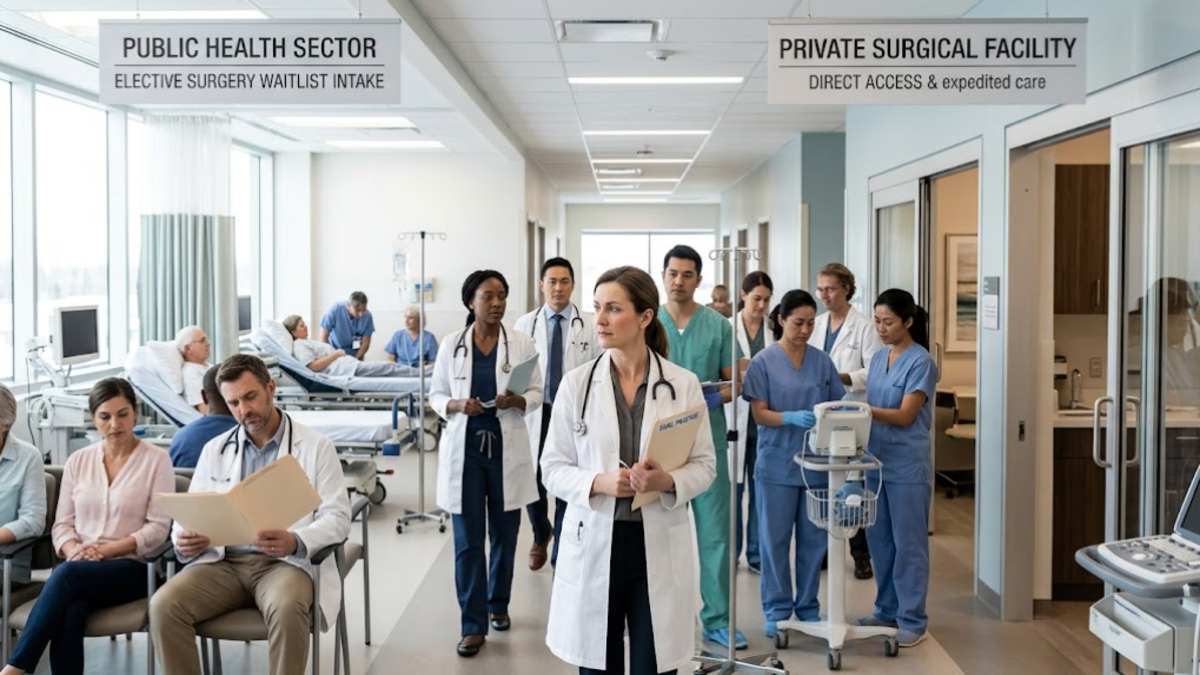
The new arrangement was enabled through Bill 11, the Health Statutes Amendment Act. It creates a framework under which approved physicians can provide privately paid services while continuing to work within Alberta’s publicly funded health system.

The provincial government says the objective is to expand surgical capacity and help reduce wait times. The initial focus will include elective procedures such as hip and knee replacements.
The government has emphasized that participation will come with conditions. Physicians who enter the dual-practice system must maintain their existing volume of publicly funded procedures, while applications will also face eligibility checks and additional monitoring and reporting requirements.
The government has not treated the nearly 400 expressions of interest as automatic approvals. Officials still have to complete a formal application and review process before privately funded surgeries can begin.
That distinction matters because the current figure represents interest rather than a final list of doctors who have been authorized to perform private procedures.
Why nearly 400 specialists are drawing attention
The number is significant because Alberta has a much larger physician workforce, but a comparatively small pool of doctors who specialize in surgery.
Figures from the College of Physicians and Surgeons of Alberta cited in the reporting show about 14,150 registered physicians in the province, including nearly 550 specialists working in some form of surgery.
Orthopedic surgeons make up 272 of those registered physicians. Their specialty is particularly relevant to the first stage of the dual-practice model because hip and knee replacements are among the procedures expected to be offered.
The nearly 400 expressions of interest therefore represent a substantial share of the province’s surgical specialist workforce, although it would be inaccurate to say that all 400 are surgeons or that all will ultimately participate.
The provincial government has described the expressions of interest as a way to understand how specialists view the new model and to prepare for the formal application process.
For patients, the issue is less about the headline number itself and more about what happens after the approvals.
If doctors who currently perform publicly funded surgeries also provide private services, the central question will be whether the new arrangement creates additional capacity or simply divides existing physician time between two streams of care.
That question sits at the centre of the political and professional dispute surrounding the policy.
Public system and private care under the same framework
Under the new model, an eligible physician can continue working within the publicly funded health system while also providing selected services for private payment.
The province argues that the approach can give physicians more flexibility while creating additional options for patients. The government has also said Alberta’s existing system is not serving patients well enough and that new approaches are needed to address access and waiting lists.
Premier Danielle Smith has defended the policy on the grounds that Albertans who want to pay privately for eligible elective surgery should be able to receive that care in Alberta rather than leave the province.
The government’s position is that public and private services can operate alongside one another without undermining publicly funded care.
The rules requiring participating physicians to maintain their existing volume of publicly funded procedures are therefore a central safeguard in the provincial argument.
Officials have also said applications will be examined for compliance with requirements covering public surgery hours, monitoring and reporting.
However, critics question whether those safeguards will be enough.
Their concern is straightforward: Alberta does not have an unlimited supply of surgeons, nurses, technicians and other health professionals. If the private sector draws heavily on the same workforce, expanding private capacity could place additional pressure on the public system.
The debate is consequently not only about where patients receive treatment. It is also about how the province allocates scarce medical resources.
Critics warn of pressure on public health care
Opposition politicians and health-care organizations have strongly criticized the move.
Sarah Hoffman, the Alberta NDP’s surgical services critic, argued that creating a parallel private system could pull resources away from public health care rather than increase the overall capacity of the system.
Her criticism focuses on the question of whether Alberta can genuinely add surgical capacity if the same doctors are working in both systems.
The Health Sciences Association of Alberta has raised a similar concern about workforce shortages. Its president, Leanne Alfaro, said expanding private delivery does not automatically create more health-care professionals and warned that public and private providers would compete for the same limited workforce.
That argument is especially important in a health system already dealing with pressure on access.
The concern is not necessarily that every physician who joins the model will reduce public services. Rather, critics want evidence that the new system will produce additional overall capacity rather than rearrange existing capacity.
They also question whether private-pay services could become more attractive to physicians because of greater control over working arrangements or financial incentives.
The debate has consequently expanded beyond Alberta’s immediate surgical backlog and into a larger discussion about how Canadian medicare should operate.
Federal health-care rules enter the debate
The dispute has also reached Ottawa.
National medical and health-care organizations have raised questions about whether Alberta’s approach is compatible with the principles of Canada’s publicly funded health-care system.
The federal government’s framework is set out in the Canada Health Act, which establishes conditions for provincial and territorial health insurance plans. The act requires insured health services to be provided according to its principles and addresses extra-billing and user charges.
The federal government explains that medically necessary hospital, physician and certain surgical-dental services fall within the insured-services framework, while the legislation prohibits extra-billing and user charges for insured services.
This does not mean that every private medical service is automatically prohibited in Canada. The legal question depends on the nature of the service, how it is insured and whether patients are being charged for services covered by provincial health insurance.
That distinction is important in the Alberta debate.
Critics argue that allowing private payment for procedures that would otherwise fall within the public system risks creating unequal access based on ability to pay.
The provincial government rejects the suggestion that its policy represents a move toward a U.S.-style health-care system.
Instead, Alberta says the objective is to provide more choice while maintaining public access and public surgical volumes.
Doctors are looking for more flexibility
The interest from specialists also offers another perspective on the dispute.
Canadian Medical Association president Dr. Bolu Ogunyemi said physicians across the country are frustrated by their inability to influence changes in the health-care system.
He said he was therefore not surprised that hundreds of Alberta specialists were interested in trying another approach.
Ogunyemi pointed to private delivery and care outside traditional hospital settings as areas where physicians can sometimes work more efficiently and exercise greater control over their professional environment.
His comments add an important dimension to the story.
The interest in dual practice cannot simply be viewed through the lens of physician income. It also reflects concerns among doctors about how they work, how much control they have over their practices and how health-care services are organized.
For Alberta, the challenge will be to determine whether that desire for flexibility can coexist with the province’s responsibility to maintain publicly accessible care.
If physicians see the private model as a way to gain autonomy without reducing their public commitments, the system could develop differently from what its critics fear.
If substantial numbers reduce their public activity in practice, however, the pressure on publicly funded services could become more difficult to manage.
The government’s application and monitoring system will therefore be closely watched.
What happens before private surgeries begin?
The nearly 400 expressions of interest do not mean that private surgeries under the new model have immediately begun for every participating physician.
The province still has to review applications and determine which physicians meet the requirements.
Maddison McKee, a spokesperson for Surgical Services Minister Adriana LaGrange, said the expressions of interest were intended to help the government understand specialist participation and prepare for the formal application process.
The review is expected to consider eligibility, public surgery-hour requirements, monitoring and reporting obligations.
The government has indicated that the first dual-practice surgeries are expected later in the fall, once the necessary approvals have been completed.
That timeline means the coming months will be important for determining how the policy works beyond its legislative framework.
Questions remain about how many doctors will ultimately receive approval, which facilities will provide the services, what procedures will be offered and how the province will measure the impact on public wait times.
Those details will help determine whether the system delivers the additional capacity promised by the government.
The wait-time question remains central
For many Albertans, the most immediate issue is not the political argument over public versus private medicine. It is how long they must wait for care.
Hip and knee replacements can affect mobility, independence and quality of life. When patients remain on surgical waiting lists for long periods, their health and ability to work or participate in daily activities can suffer.
The province is presenting dual practice as one possible response to those delays.
The logic is that patients who choose private treatment could receive surgery outside the publicly funded stream, potentially freeing capacity for others.
Critics dispute whether that effect will materialize if doctors, nurses and other health-care workers simply move between the two streams.
The answer will ultimately depend on how the system is implemented and measured.
If public surgical volumes remain stable while private procedures add genuinely new operating capacity, the government’s argument could gain strength.
If public capacity declines or waiting lists grow, critics will argue that the new system has failed to solve the problem it was designed to address.
That makes reliable monitoring particularly important.
Alberta dual-practice health care faces a major test
The controversy surrounding Alberta’s policy is unlikely to disappear when the first private procedures begin.
Instead, the launch will mark the start of a much larger test.
Nearly 400 specialists have now signalled interest, but the final number of approved physicians remains unknown. The province must still process applications and enforce the conditions attached to participation.
The government says the model can increase flexibility, expand surgical options and reduce wait times while preserving public services.
Opponents say Alberta risks creating a two-tier system in which people with greater financial means can move ahead of patients relying entirely on public care.
The disagreement reflects two fundamentally different views of the same problem.
One side sees private delivery as an additional tool that can help relieve pressure on an overloaded system. The other sees private payment as a potential drain on a workforce that the public system already struggles to retain and expand.
The first results will therefore matter more than the initial headline number.
Albertans will want to know whether public surgery volumes actually remain protected, whether waiting lists fall, whether staffing levels remain adequate and whether patients can access care without financial barriers.
The province’s dual-practice experiment has now moved from political proposal to implementation. The nearly 400 expressions of interest show that there is significant physician interest in the concept, but they do not yet answer the bigger question: can Alberta expand private access without weakening the public system?
FAQ
What is Alberta’s dual-practice health-care model?
It allows approved physicians to provide privately paid services while continuing to work within Alberta’s publicly funded health-care system.
How many specialists have expressed interest?
Nearly 400 specialist physicians have expressed interest in participating, although expressions of interest do not represent final approvals.
Which procedures are expected to be offered first?
The initial phase is expected to focus on elective procedures, including orthopedic surgeries such as hip and knee replacements.
Have private surgeries already started under the model?
The province still has to complete its formal application and review process before physicians can provide privately funded procedures under the new arrangement.
Contact: info@canadaalyom.com